










Hindustan Zinc sees exports supporting expanded zinc output
Key highlights
- Hindustan Zinc management said India may not consume all additional zinc capacity, making exports part of its stated plan.
- Steel accounts for about 60% of zinc consumption, and management cited 300 million tonnes of Indian steel capacity by 2027.
- Management expects relevant zinc-consuming sectors to double over seven to eight years by 2030.
- Hindustan Zinc reported net cash of about Rs 10,000 crore to Rs 15,000 crore and expects to use internal accruals over three to five years.
powered by IRIS
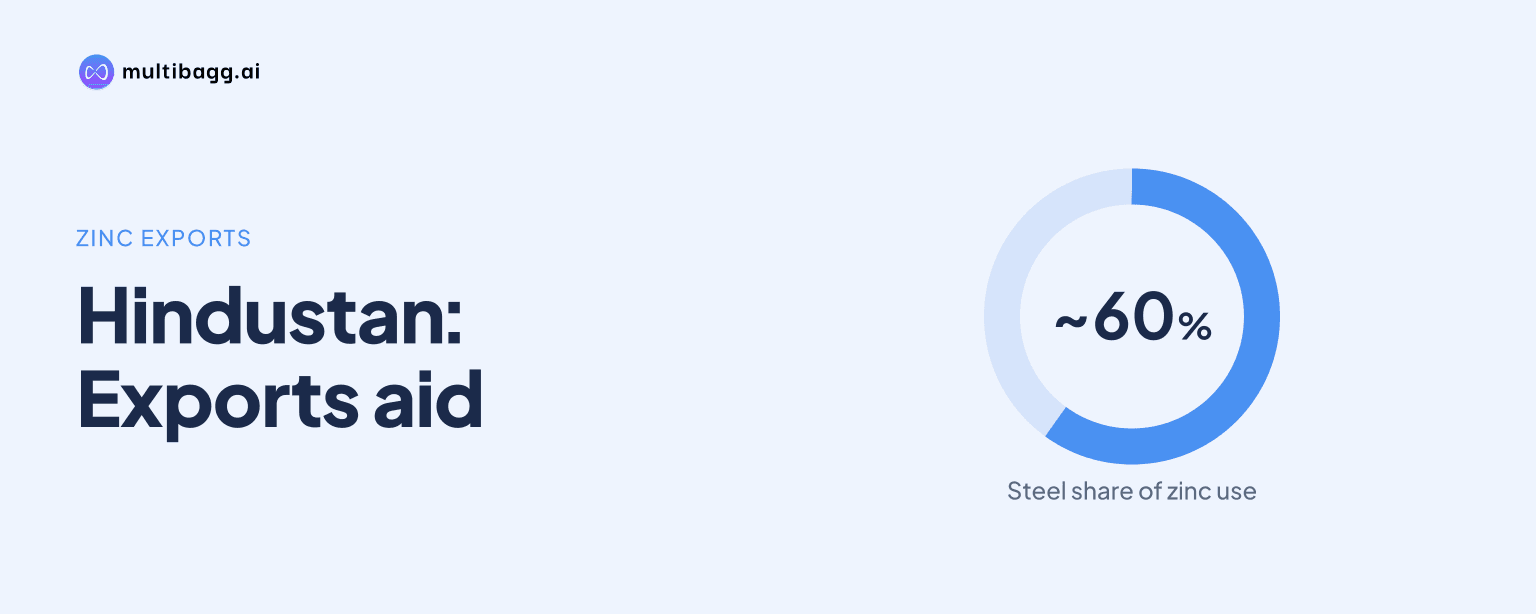
Hindustan Zinc Limited says exports and import substitution will supplement Indian demand for its expanded zinc output because management does not expect India alone to consume all capacity; it cited steel’s roughly 60% share of zinc use and a seven-to-eight-year demand-doubling window by 2030.
Know Hindustan Zinc inside out
Results, valuation, peers and who's buying, in one view.
What domestic zinc demand does Hindustan Zinc expect?
Hindustan Zinc expects zinc demand in India to grow with steel, automobiles, railways and other manufacturing, and management said consumption in these sectors could double over a seven-to-eight-year window by 2030. The company’s central demand indicator is steel, which management said accounts for about 60% of zinc consumption.
Management linked the steel opportunity to the National Steel Policy’s 300 million tonnes of steel capacity. It said the company has visibility of India reaching that capacity level in 2027. That statement is management’s view of the market backdrop, rather than a Hindustan Zinc forecast for annual zinc sales or a disclosed commitment from steel customers.
An analyst described the expansion under discussion as adding about 0.5 million tonnes of zinc capacity and about 0.2 million tonnes of lead capacity. Management’s response did not say that domestic consumption would absorb all of the additional zinc. Instead, it set out two routes: growth in existing Indian end markets and initiatives to increase the amount of zinc used in selected products.
The distinction matters because the 2030 outlook is not a quantified domestic offtake plan. Hindustan Zinc said relevant consuming sectors could double by that date, but did not disclose a tonne-based target for Indian zinc sales, a customer allocation, or the domestic share of the additional output. Steel galvanising remains the largest demand channel described in the call, with autos, railways and manufacturing adding further potential uses.
How will Hindustan Zinc use import substitution?
Hindustan Zinc plans to increase zinc intensity through products designed to replace other metals, with sanitary ware identified as the example. Management said sanitary ware uses brass fixtures and that those brass components are imported, creating an opportunity for zinc-based products that could lower costs for that industry while substituting imports.
Management described the sanitary-ware initiative as a twin track of import substitution and cost reduction. The mechanism is different from simply supplying more zinc to existing steel users: it seeks to create demand in an application where brass fixtures are currently used. Hindustan Zinc did not disclose a product-launch date, expected annual volume, customer agreement or revenue contribution from the proposed replacement products.
The company positioned the initiative alongside, rather than in place of, established zinc markets. In discussing the mine plan, management said Rampura Agucha has a remaining stretch of around 1.5 million tonnes, while RD and Zawar are expected to contribute most of the new capacity. The changing production mix reinforces the commercial need to develop several routes to market for refined metal.
Management also acknowledged that capacity growth will involve some ore-grade dilution. It assumed a future mining grade of about 7% and said roughly 14 to 14.5 tonnes of ore would be consumed to produce one tonne of refined metal. These operating assumptions do not quantify the sanitary-ware opportunity, but they show that product substitution forms part of a wider expansion programme rather than a standalone sales initiative.
Got a follow-up? Ask IRIS
Why does Hindustan Zinc see exports as necessary?
Hindustan Zinc plans to use export markets because management said all of the additional capacity cannot be consumed in India alone. It said the company has active plans and clear strategies for exports, making overseas sales the third element of its absorption plan after domestic demand growth and import substitution.
Management argued that its production costs could support that approach, saying Hindustan Zinc is among the lowest-cost zinc producers globally and referring to the margin difference with global producers. It said the company could, if required, displace competitors to sell its products. The filing does not provide an export sales target, destination countries, contracted volumes, or a timetable for scaling overseas shipments.
The export case also rests on management’s view of global mine supply over the next 10 years. It said smelter capacity may be close to consumption, but mining capacity is likely to decline as many producers face grade depletion and mines near closure. Management added that new mine announcements are difficult to identify; these are market assessments stated on the call, not independently quantified forecasts in the filing.
The contrast is therefore between a domestic demand opportunity extending to 2030 and a global supply thesis extending over 10 years. Neither proposition establishes a guaranteed market for the additional zinc. However, management’s acknowledgement that India may not absorb all output makes exports a stated requirement of the overall commercial strategy, not merely an optional extra.
What operating and funding factors could affect the plan?
Hindustan Zinc continues to guide for cost of production below $1,000 per tonne despite the expected change in mine mix. Management said deeper mines will bring some cost increases, but greater volume at the same locations should spread fixed costs. Fixed costs currently account for 35% of total cost, according to management.
To explain the potential scale benefit, management used a hypothetical scenario in which fixed costs do not increase as capacity almost doubles. In that example, it said savings of 15% to 17% could result. Management stressed the figure was illustrative rather than a forecast, while maintaining that scale benefits and higher costs from deeper mining should offset each other sufficiently to keep cost of production in the current guided range.
Silver recovery is another execution element of the broader project. Management said new smelter and refinery projects include fumers, equipment intended to recycle slag and by-products for silver recovery. Previously installed fumers had not reached 100% capacity because of design features, but management said debottlenecking over the past year and performance in the last two to three months had increased its confidence that the equipment could operate at capacity going forward.
Mine tenure and funding remain relevant dates and constraints. Management named Rampura Agucha, Dariba and the Zawar group as mines due for renewal in 2030, while saying it did not see a conflict between five-year mining plans and the renewal or rebidding process. It also said Hindustan Zinc had net cash of about Rs 10,000 crore to Rs 15,000 crore and expected to fund the project through internal accruals over the next three to five years, subject to temporary annual cash-flow mismatches.
Conclusion
Hindustan Zinc’s stated strategy for expanded zinc output combines a domestic demand case, import substitution in products such as sanitary-ware fixtures, and export markets for volumes India may not consume. The evidence management cited includes steel’s roughly 60% share of zinc consumption, the 300 million-tonne steel-capacity target, and an expected seven-to-eight-year period to 2030 in which relevant consuming sectors could double.
The next issues to watch are whether the 2030 demand window produces disclosed sales or offtake milestones, whether zinc-based sanitary-ware products gain measurable adoption, and whether export plans receive volume or market targets. Operationally, management’s below-$1,000-per-tonne cost guidance, fumer performance after the last two to three months of improvement, and the 2030 renewal process for three mine groups will be important markers for the expansion plan.