










Hindustan Zinc Files Call Transcript on ₹80,000 Crore Expansion
Key highlights
- Hindustan Zinc filed the transcript of its November 16, 2026 investor call on November 23, 2026.
- The board approved a ₹80,000 crore capacity-expansion plan.
- The stated refined metal capacity target is 2.0 million tonnes per annum.
- The supplied filing summary does not disclose a project completion schedule or funding mix.
powered by IRIS
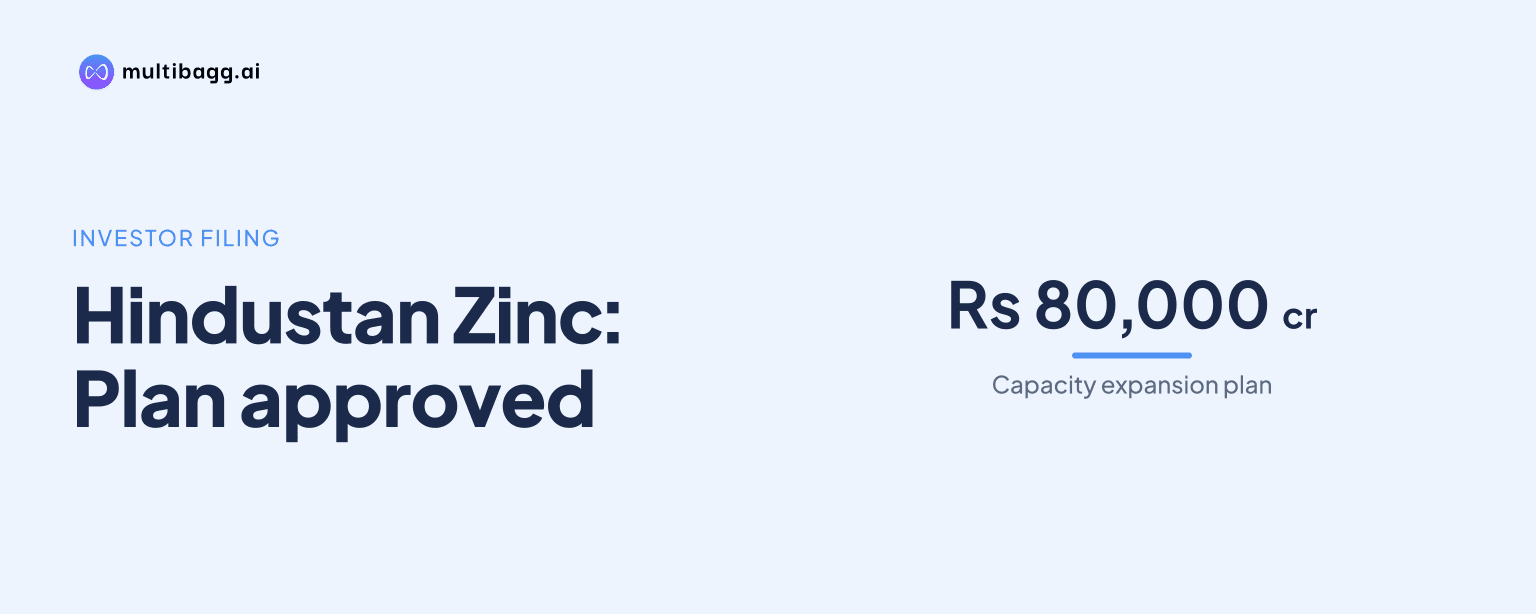
Hindustan Zinc Limited filed the transcript of its November 16, 2026 investor call after its board approved a ₹80,000 crore capacity-expansion plan to lift refined metal capacity to 2.0 million tonnes per annum. The filing formally places the approved investment and capacity target before investors, making it a material operational disclosure for the company.
Know Hindustan Zinc inside out
Results, valuation, peers and who's buying, in one view.
What did Hindustan Zinc file with the exchange?
Hindustan Zinc filed the transcript of an investor call held on November 16, 2026, focused on the approved expansion of its refined metal capacity. The filing date is November 23, 2026, and the stated subject is the investor-call transcript rather than a separate financial-results announcement.
The central disclosure is that the board has approved an expansion plan involving ₹80,000 crore of investment. The stated objective is to increase refined metal capacity to 2.0 million tonnes per annum. The filing does not provide a project-wise allocation of this investment, a completion schedule, or separate capacity figures for individual metals in the information provided.
Investor-call transcripts are used by listed companies to place management discussions on record after interactions with investors and analysts. In this case, the document gives market participants access to the discussion linked to the board-approved capacity plan.
What capacity target has Hindustan Zinc approved?
Hindustan Zinc has approved a target of 2.0 million tonnes per annum of refined metal capacity. This is the operating target disclosed in connection with the ₹80,000 crore expansion approval.
Refined metal capacity is an important operating measure for a metals producer because it indicates the potential scale of processed output after mining and smelting activities. However, the supplied filing summary does not state the company’s current refined metal capacity, the incremental tonnes to be added, or the facilities where the expansion will be undertaken.
The filing also does not specify the financing mix for the plan, expected capital-spending phases, regulatory approvals, or commissioning milestones. Investors therefore have a confirmed board approval and stated end-capacity target, but not a detailed execution timetable from the material provided.
Why is the investor-call transcript relevant to shareholders?
The transcript is relevant because it records the discussion around a board-approved plan with a stated investment of ₹80,000 crore. For shareholders, the filing identifies the scale of the proposed capacity build-out and the targeted refined metal production capability.
A large expansion programme can influence how investors assess future capital allocation, operating scale and execution requirements. The present disclosure confirms the board’s approval, but it does not provide enough information to calculate potential revenue, profitability, return on investment or the annual capital-spending requirement.
Hindustan Zinc’s earlier FY27 earnings calls, referenced in the provided background, discussed India’s domestic growth environment and infrastructure investment. That background provides context for the company’s market discussion, but the November 23 filing itself is specifically about the investor-call transcript and the approved expansion plan.
Got a follow-up? Ask IRIS
How does the approval affect the metals sector context?
The approval indicates that Hindustan Zinc is planning for a larger refined metal production base, with the disclosed endpoint set at 2.0 million tonnes per annum. For the domestic metals sector, capacity plans of this size are relevant because refined metal availability is linked to industrial consumption, including infrastructure and manufacturing activity.
The supplied material does not state how the new capacity will be split between zinc, lead or other refined metals. It also does not indicate whether production will serve domestic customers, export markets, or both. As a result, any assessment of product-market effects or regional supply changes would go beyond the information in the filing.
For investors, the main immediate consideration is the difference between an approved plan and completed capacity. The filing confirms the approval and target, while implementation details remain undisclosed in the supplied text. Progress updates on expenditure, project locations, approvals and construction milestones would be needed to assess execution over time.
What should investors monitor after the filing?
Investors should monitor subsequent disclosures for the sequencing of the ₹80,000 crore investment and the timeline for reaching the 2.0 million-tonne annual refined metal capacity target. Such disclosures would clarify the pace at which the approved plan moves from board approval into project execution.
Further updates could also provide information on funding, production mix, expected commissioning dates and operational requirements. None of these details are included in the filing summary provided, so they should not be assumed from the announced investment figure alone.
Conclusion
Hindustan Zinc’s November 23 filing records the November 16 investor-call discussion of a board-approved ₹80,000 crore expansion plan. The confirmed operational objective is to raise refined metal capacity to 2.0 million tonnes per annum, making the filing significant for investors tracking the company’s capital-allocation plans and future production scale.
The next items to watch are disclosures on how the investment will be phased, the projects included in the plan and the schedule for achieving the 2.0 million-tonne target. The supplied filing establishes the approval and end target, while the execution framework remains to be detailed.