










Where Does the India–US Trade Deal Stand After the Midterms?
Key highlights
- A 10% Section 301 duty has applied to most Indian goods since 24 July 2026.
- The US Supreme Court ruled 6-3 on 20 February 2026 that IEEPA does not authorise tariffs.
- A 16 October 2026 order waived the duties of up to 100% under the Russian-oil tariff law.
- The 6 February 2026 framework set an 18% rate, but no signed text existed as of 12 October 2026.
powered by IRIS
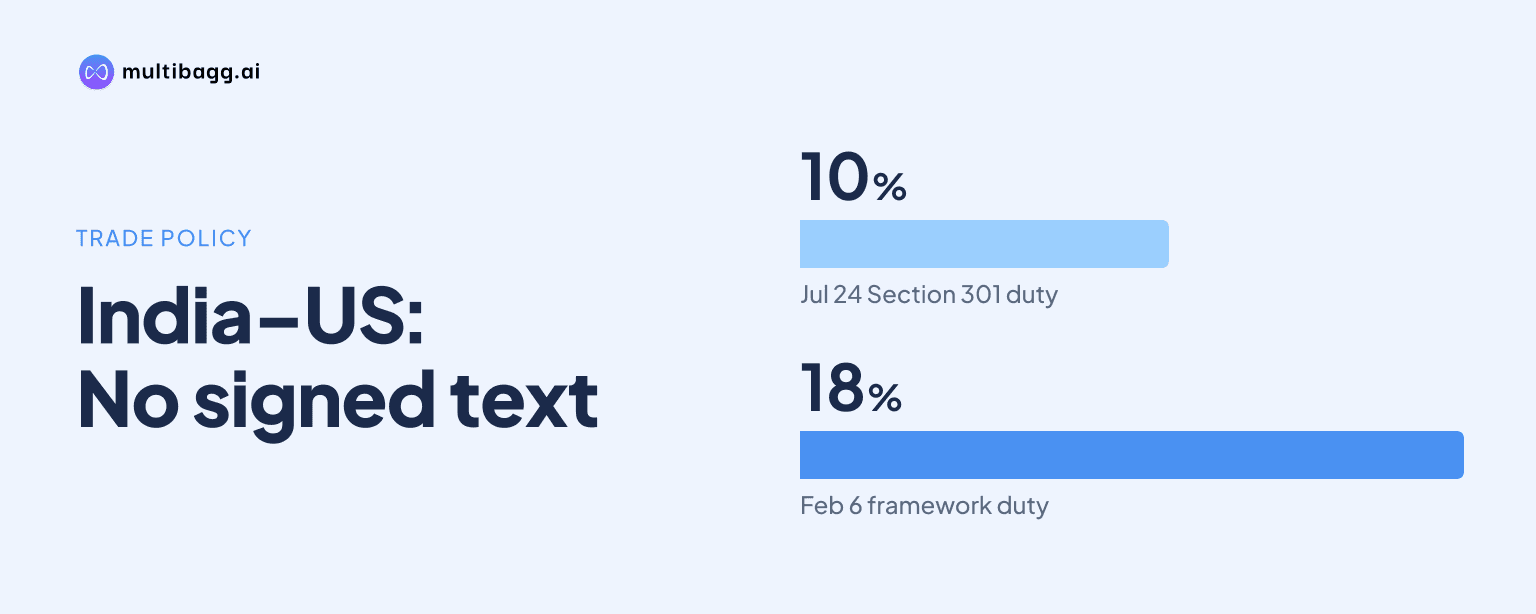
As of 3 November 2026, India and the US have no signed trade deal. The 18% US tariff rate announced in the 6 February framework was never applied, according to law firm ATB Legal. Most Indian goods now face a 10% duty in force since 24 July, and duties under a Russian-oil tariff law have been waived since 16 October.
What did India and the US agree in February, and was the 18% rate ever applied?
They agreed a framework for an interim trade agreement, not a signed deal, and ATB Legal says the 18% rate was never applied. The joint statement of 6 February 2026, published by the White House, said the US would apply a reciprocal tariff of 18% to Indian goods such as textiles, leather and footwear, and organic chemicals. A reciprocal tariff is a country-specific duty the US says matches barriers it faces abroad. The rate rested on the International Emergency Economic Powers Act (IEEPA), a 1977 law that lets the President regulate trade during a declared national emergency.
On 6 February an executive order (a directive signed by the President with legal force), number 14384, also removed an extra 25% duty on Indian goods, imposed over India's Russian oil purchases. It took effect on 7 February. The White House fact sheet of 9 February described India's intention to buy over $500 billion of US goods, including energy and technology products.
What changed after the Supreme Court ruling?
The legal basis for the 18% rate disappeared. On 20 February 2026 the US Supreme Court ruled 6-3 in Learning Resources v. Trump that IEEPA does not authorise tariffs, according to ATB Legal. The US then turned to Section 122 of the Trade Act of 1974. The law text allows a temporary surcharge of up to 15% for no more than 150 days, unless Congress extends the period. ATB Legal says a 10% global surcharge applied from 24 February and expired on 24 July without extension.
On 24 July a Section 301 duty took its place, according to ATB Legal. Section 301 lets the US Trade Representative (USTR), the US trade negotiator, impose duties after investigating another country's practices. USTR's 23 July announcement lists India among the economies at 10%, in a case about countries that had not banned imports made with forced labour. India got 10% rather than the proposed 12.5%, ATB Legal says, after its 13 July forced-labour import ban.
Goods under Section 232 (a separate national-security tariff) are excluded, according to ATB Legal. USTR's page does not state an end date. Sector effects, such as on jewellery and textiles, are covered in a separate article.
Does the Russian-oil tariff law apply to India?
Not at present. President Trump signed the Lindsey O. Graham Sanctioning Russia and Iran Act of 2026 (Public Law 119-111) on 18 September 2026. According to Business Today, citing the trade think tank GTRI, it allows tariffs of up to 100% on imports from the five largest buyers of Russian crude oil and gas, and India and China were named as at direct risk. ATB Legal says USTR sets the rate between 0% and 100% and the President may waive it.
On 16 October 2026 the President did waive it. Executive Order 14436 waives (suspends) the duties under sections 112 and 113 of the Act. The waiver is general and does not name India or any other country. It says the waiver stays until the President or the Secretary of State decides further action is appropriate, and that a certification went to Congress. There is no end date, so the waiver can be withdrawn. While it stands, the law's duties are not in force.
The February order still directs the US Commerce Department to monitor whether India resumes buying Russian oil, and allows further action if it does. ATB Legal notes that the US says India committed to stop buying Russian oil, while India has published no instrument saying so.
Got a follow-up? Ask IRIS
What is still unresolved in the talks?
Most of the deal. ATB Legal, as of 12 October 2026, says there is no signed text, no tariff schedule and no entry-into-force date, and no Indian customs notice cutting duties on US goods. Agriculture legal text and a rules-of-origin chapter are unpublished.
Officials have signalled progress without a date. After meeting Commerce Minister Piyush Goyal in Milwaukee in early October, USTR Jamieson Greer said the sides had identified the set of sticking points and that nothing was imminent, according to Business Today, which attributed the remarks to Reuters. ATB Legal records that the Finance Minister described talks on 5 October as at a plateau, and that on 9 October Goyal said fine print remained.
Court cases remain open. ATB Legal says the government appealed on 2 June a 4 March order to refund IEEPA duties.
What can Congress do on trade, and what can it not do?
Congress can pass trade laws, but much tariff power already sits with the President. Jefferies, an investment bank, says in a 4 October report, as covered by Business Today, that much of the authority to impose tariffs rests with the executive branch. Congress used its own power by passing the Russia law, which the President signed on 18 September. It could also extend a Section 122 surcharge by an Act, as the statute allows, though the surcharge lapsed in July without one.
Duties under Section 301 and Section 232 are set by the executive branch. Jefferies says international investment agreements can largely proceed without fresh congressional approval. ATB Legal reasons that a signed India deal would need a US legal vehicle, such as a modified Section 301 action, Section 232 carve-outs or legislation, and presents this as inference.
Results are not known. Jefferies expects Democrats to be favoured to win the House, and says such a House could hold hearings on the impact of tariffs on consumer prices. It does not expect Congress to pass legislation that materially reduces tariffs, and expects the average effective US tariff rate to stay between 10% and 20% even under divided government.
Conclusion
Taken together, the record shows a framework without a legal text. The 18% rate lost its footing on 20 February, a 10% Section 122 surcharge and then a 10% Section 301 duty applied instead, and the Russian-oil law's threat of up to 100% is suspended by an order that can be reversed. Congress has few direct levers over these duties.
Vote counting follows the 3 November election day, and the Federal Reserve meets on 8 and 9 December 2026. No trade-deal deadline is public. Exporters and Indian markets are watching for a signed interim text, changes to the Section 301 annexes, any withdrawal of the 16 October waiver, Commerce Department findings on Russian oil, and the pending appeals on duty refunds.