










Why Indian Pharma Is Safer From US Tariffs Than You Think
Key highlights
- About 90% of India's pharma exports to the US are generics, which are exempt from the 100% patented-drug tariff (GTRI, April 2026).
- The US took $2.50 billion of India's pharma exports in April to June 2026, 30.89% of the $8.10 billion total (Pharmexcil).
- Sun Pharma's innovative medicines sales were $351 million in April to June 2026, 21.9% of consolidated sales.
- A 22 July 2026 post by President Trump proposed generic tariffs of 0% for two years, then 100% for one year and 200% after. No formal order has been reported.
powered by IRIS
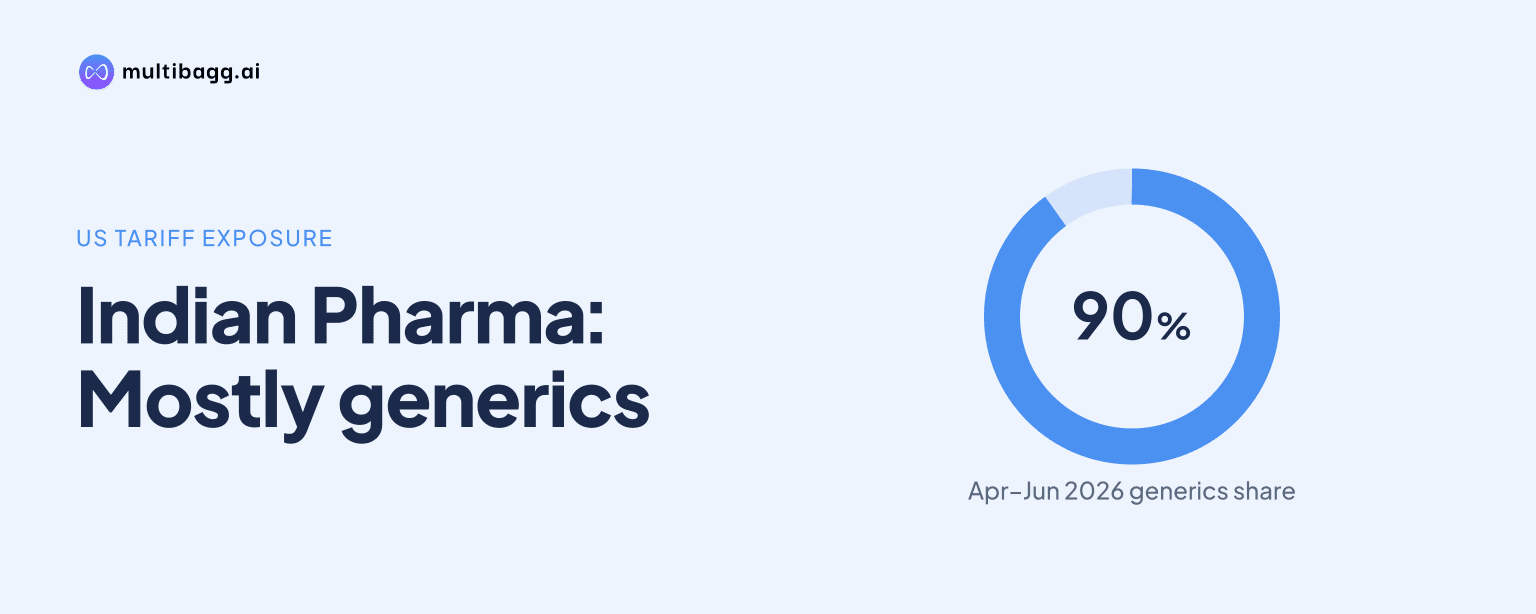
Generic medicines, about 90% of India's pharma exports to the US according to GTRI (Global Trade Research Initiative), are exempt from the 100% US tariff on patented drugs announced on 2 April 2026. The exemption is temporary. A July post from President Trump proposed 100% tariffs on generics from August 2028, but no formal order has been reported.
What does the US tariff on patented drugs actually cover?
The tariff is 100% on patented drugs and their ingredients. It is imposed under Section 232 of the Trade Expansion Act of 1962, a law that lets the US President tax imports on national-security grounds. India Briefing, citing a White House fact sheet, reports it was announced on 2 April 2026. Generics (copies of drugs whose patents and exclusivity have ended), biosimilars (near-copies of biological medicines) and related inputs are exempt for now. Large companies had 120 days to comply and smaller ones 180 days, according to India Briefing.
The rate drops for companies that make deals with Washington, according to Arnold & Porter, a law firm.
Arnold & Porter says the tariff started on 31 July 2026 for named large companies and on 29 September 2026 for all others. Specialty medicines such as rare-disease drugs, fertility treatments and cell and gene therapies can qualify for a zero rate. LawStreet reported on 1 October that India and 19 other jurisdictions are on the zero-rate list.
How much of India's US pharma trade is exposed?
Only a small share, if the generic estimate holds. The figure most often cited for India's pharma exports to the US is $9.7 billion, but sources disagree on the period. India Briefing says it covers FY2024-25 (April 2024 to March 2025). Business Today, citing GTRI, gives it for 2025 without saying which kind of year, equal to 38% of India's global pharma exports of $25.8 billion. Bloomberg Tax puts FY2024-25 at $10.5 billion.
GTRI founder Ajay Srivastava said around 90% of India's pharma exports to the US are generics, which remain exempt, according to Business Today on 3 April 2026. Applied to $9.7 billion, that leaves roughly $1 billion that is not generic, a rough calculation and not a reported figure. The newest data is from Pharmexcil, the pharma export promotion council. The US took $2.50 billion of India's pharma exports in April to June 2026, or 30.89% of the $8.10 billion total, Indian Pharma Post reported on 12 August 2026.
Which Indian companies have branded or specialty exposure in the US?
Sun Pharma is the clearest example in the data available. Its global innovative medicines (branded specialty products) sales were $351 million in April to June 2026, up 12.8% and 21.9% of consolidated sales, Business Today reported on 31 July 2026. The same report put its US formulation sales at $427 million, down 9.7%. These figures do not show where the branded products are made or how many are covered by the tariff.
Srivastava warned that Indian firms making branded or specialty drugs, or supplying inputs for patented medicines, could face pressure. Inputs are a grey area. Arnold & Porter says an ingredient's tariff status depends on the finished product it will go into, so the same ingredient can be taxed differently depending on its US use.
Got a follow-up? Ask IRIS
Has the US also threatened tariffs on generics?
Yes. In a Truth Social post reported on 22 July 2026, President Trump said generic drugs would stay at a zero tariff for two years from 1 August 2026, then face 100% for one year and 200% after that, according to Business Today. He said the aim was to bring generic production back to the US, and that companies not building plants within the given period would face a penalty. If carried out, the plan could reach the generics that make up about 90% of India's US pharma exports.
Bloomberg Tax described only the post and mentioned no formal order or notice, and LawStreet's 1 October report still listed generics as outside the tariff. The Association for Accessible Medicines, a US generics industry group, said it was hard to tell what the 100% tariff might mean. Analyst Spencer Perlman of Veda Partners said the plan was unlikely to take effect, while Vishal Manchanda of Systematix said a new US plant would take at least three years to build. The Nifty Pharma index fell as much as 1.9% that day, according to Bloomberg Tax.
The February 2026 US-India trade pact promised India negotiated outcomes on generics and their ingredients, so the rate Indian firms would face is unclear, according to Bloomberg Tax. The same report said pills made by Glenmark and Lupin filled about 65% of US birth control pill prescriptions in 2024.
Could Congress change the picture, and what risks remain?
The patented-drug tariff came by presidential proclamation, so Congress does not have to vote on it, but Congress shapes US drug pricing and health spending. Holland & Knight, a law firm, wrote on 14 September 2026 that a Democratic Congress would likely seek to expand Medicare drug price negotiation, while a House-only win would focus on investigating the administration's most-favoured-nation pricing deals. It also expects Medicaid (US public health insurance for low-income people) oversight. FDA user-fee programmes, including those for generic drugs and biosimilars, expire on 30 September 2027. As of 3 November 2026, the results are not known.
The main risk is generics. The Commerce Department's report on generics is due within a year of the April order, and the July post puts dates on possible tariffs.
Conclusion
The direct tariff on patented drugs touches a narrow part of India's US pharma exports, because about 90% are generics, which are exempt for now. The exemption has limits. Commerce must report on generics within a year of 2 April 2026, President Trump's July post named dates from August 2028, and the rate for Indian generics under the trade pact is unclear. Branded exposure sits with specific companies such as Sun Pharma, and sources disagree on the base year of the $9.7 billion figure.
Next, results counting will show which party controls each chamber. The stopgap funding law runs to 11 December 2026, and Holland & Knight says healthcare extenders expiring on 31 December 2026 will likely ride on the next funding vehicle. The FDA plans to send final user-fee commitment letters to Congress in January 2027. The Commerce report on generics is due by about April 2027, and the first reported generic tariff step is August 2028.