










How Indian Stocks Reacted to Every US Election Since 2016
Key highlights
- The Nifty 50 fell about 7% in the two weeks after the 2016 US election, according to ICICI Direct.
- On 4 November 2024, the day before the US vote, the Nifty closed down 1.27% at 23,995.35.
- Foreign portfolio investors sold a net Rs 94,017 crore of Indian shares in October 2024, a monthly record.
- On 2 November 2026, the day before the US midterms, the Nifty closed up 1.68% at 23,440.
powered by IRIS
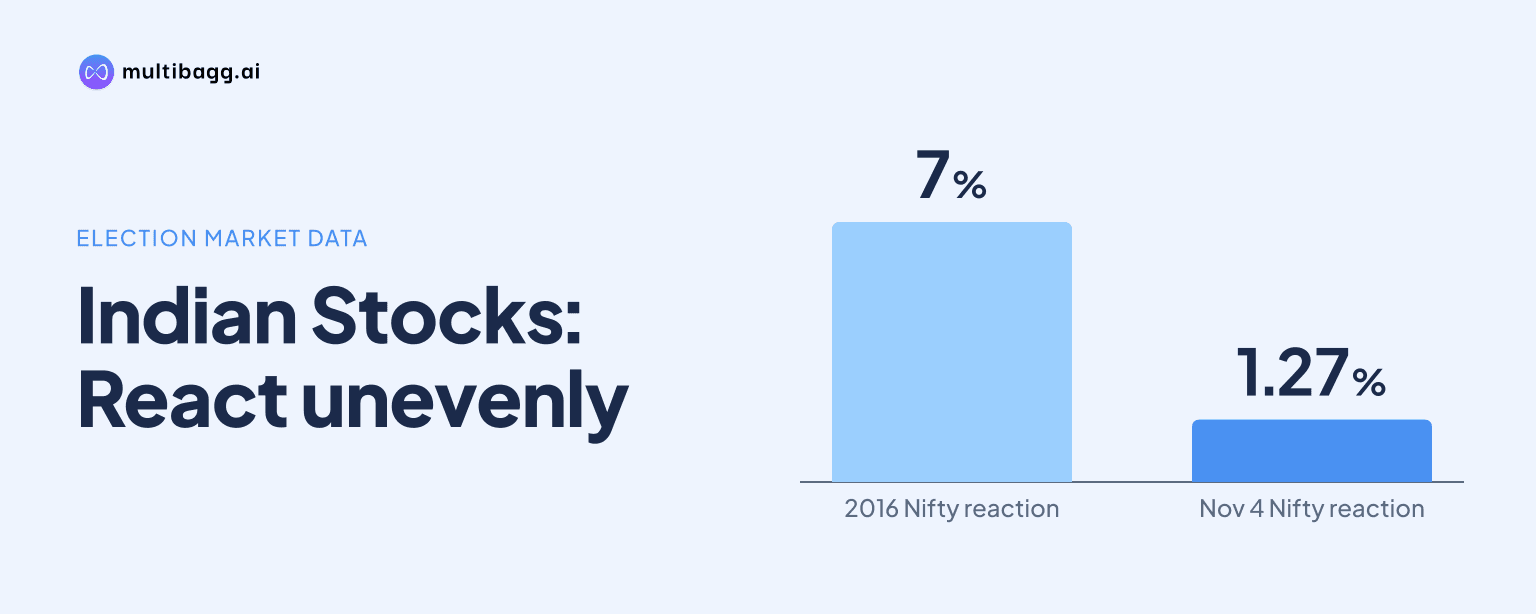
Indian stocks have reacted differently to each US election since 2016. The Nifty 50 (India's benchmark index of 50 large companies) fell about 7% in the two weeks after Donald Trump's 2016 win, according to ICICI Direct. In 2024 it fell 1.27% the day before the vote and rose 1.12% the day after. Each move came with other news.
How did Indian stocks react to the 2016 US election?
The Nifty fell about 7% in the two weeks after Trump's win, according to an ICICI Direct note dated 6 November 2024. A second shock came on the same day as the US vote. On 8 November 2016, India banned high-value currency notes, a step known as demonetisation, according to IBTimes India. The two events overlapped, so the figures below cannot split the fall between them.
On 9 November, the day the US result came in, Business Today reported that the Sensex (India's 30-stock benchmark index) opened about 1,600 points lower at 25,902 and recovered about 1,350 points to end lower. The Nifty fell 111 points to 8,432, it added. It named two causes: Trump's win, which unsettled traders who had bet on Hillary Clinton, and a sell-off in real estate shares after the note ban. IBTimes India reports the Sensex fell 3.4% in November 2016, from 27,591 on 8 November to 26,652 on 30 November.
What happened around the 2018, 2020 and 2022 elections?
The 2018 and 2022 midterms left no clear trace in the figures found, while the 2020 presidential vote came with a large rally. In 2018, FPIs (foreign portfolio investors, overseas funds that buy Indian shares and bonds) put a net Rs 12,260 crore into Indian markets in November, a 10-month high, according to Business Today. It credited lower crude oil prices and a sharp rise in the rupee. In 2022, the Nifty rose 4.1% in November, according to Kotak Mutual Fund, which pointed to cooling inflation, in-line GDP growth and foreign buying. Neither page mentions the US vote.
On 5 November 2020 the Nifty closed up 1.78% at 12,120.30, according to Outlook Business, as early signs pointed to a Biden win with Republicans likely to keep the Senate. The same report cited hopes of Federal Reserve support, strong earnings and rising foreign inflows. The Nifty gained 11.4% in November 2020, according to Capitalmind and Business Standard. Business Today listed five drivers of the late-November record highs, including US recognition of Biden as the apparent winner, AstraZeneca's vaccine trial results and record foreign buying.
Got a follow-up? Ask IRIS
How did the Nifty react to the 2024 US election?
It fell the day before the vote and rebounded the day after. On 4 November 2024 the Nifty closed down 1.27% at 23,995.35 and the Sensex down 1.18% at 78,782.24, according to Angel One. Business Today named the close Trump and Kamala Harris race, cuts to earnings estimates, a rupee near 84.1 per dollar, higher oil prices and heavy FPI selling. FPIs sold a net Rs 94,017 crore of Indian shares in October 2024, a monthly record, according to Business Today. Its 4 November piece gave a higher figure, Rs 1,13,858 crore, without naming its data source. The lower figure comes from depository data.
On 6 November the Nifty closed up 1.12% at 24,484.05 and the Sensex up 1.13% at 80,378.13, according to Angel One, which credited Trump's clear lead. The gain faded. By 11:30 am on 7 November, Outlook Money reported both indices down about 1.07%, citing foreign selling, caution before the US Federal Reserve's rate meeting and a drag from Hindalco after its US unit Novelis reported lower profit. On 8 November, the rupee fell to a record low of 84.38 per dollar before closing at 84.3750, its worst weekly fall since May, according to Reuters. Foreign investors had pulled over $1.5 billion from Indian stocks in November so far, after about $11 billion in October, it added. FundsIndia put the Nifty's change for November 2024 at -0.31%.
How do the six elections compare, and what happened before the 2026 vote?
Where percentages were found, single-day Nifty moves stayed between -1.27% and +1.78%, and each came with other news. The table lists every figure found. Not found means no source checked stated the figure.
On 2 November 2026, the day before the US midterms, the Sensex closed at 75,692.78, up 1.66%, and the Nifty at 23,440, up 1.68%, a third straight daily gain, according to Kotak Neo. The page gives no specific reason for the gain. In a separate item, it reports crude oil down over 2% on diplomatic talks between Iran and Qatar. It does not mention the midterms. As of 3 November 2026, voting is under way and no result is known.
Conclusion
Taken together, the figures show a US election as one input among several. In 2016 a currency-note ban overlapped with the US result. In 2020 vaccine news and record foreign buying overlapped with the vote. In 2024 foreign selling, earnings cuts and the weak rupee overlapped with it. The 2018 and 2022 November moves were credited by the pages cited to oil, the rupee and inflation.
Counting of the 2026 US vote is the next item to follow. The Federal Reserve's next policy meeting is on 8 and 9 December 2026, and the US stopgap funding law runs to 11 December 2026. Monthly FPI data for November will show whether foreign selling or buying changed after the vote. This article records past moves and does not forecast the result or the market's reaction.