










How the Midterms Could Change US Tariffs Around the World
Key highlights
- The Supreme Court ruled 6-3 on 20 February 2026 that IEEPA does not authorise tariffs.
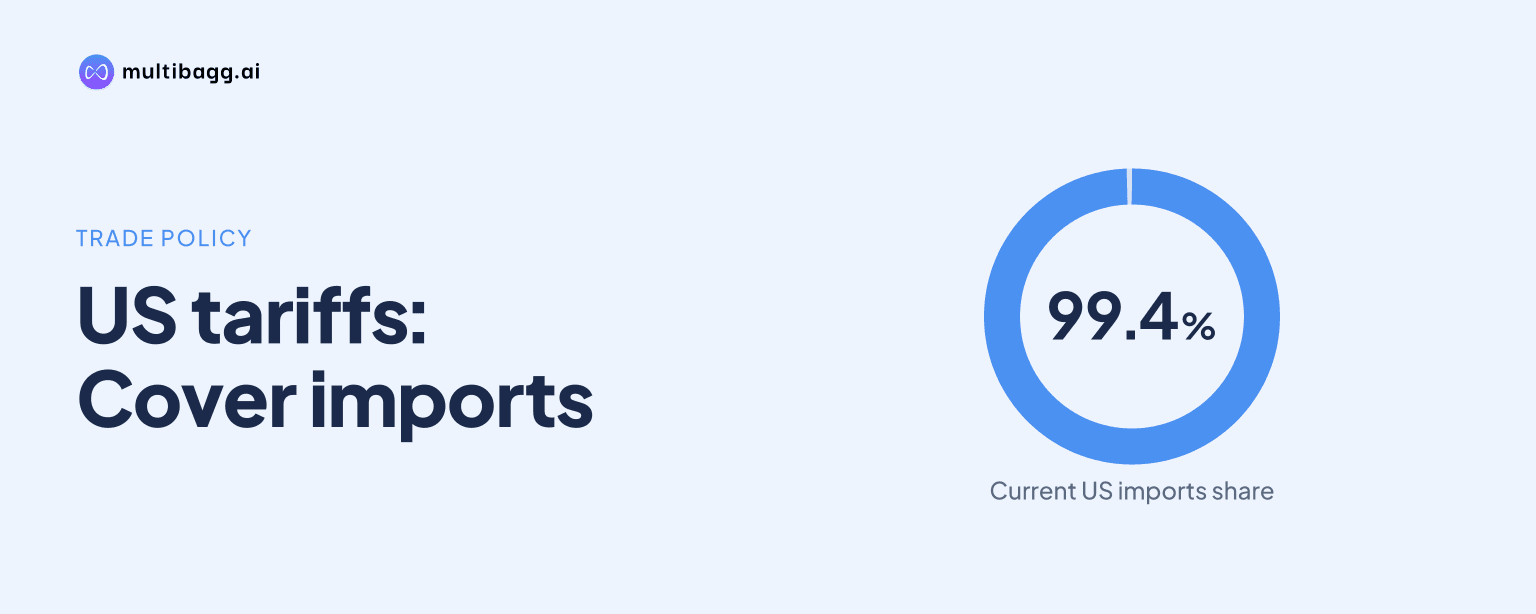
- Section 301 duties of 10% or 12.5% now cover 60 economies, which account for 99.4% of US imports.
- The House passed a resolution against Canada tariffs 219-211 on 12 February 2026, short of the two-thirds needed to override a veto.
- Goldman Sachs expects new tariffs to lift the effective rate by a little under 2 percentage points if Democrats gain influence in Congress.
powered by IRIS
Most US tariffs need no new act of Congress, so midterms may change little. After the Supreme Court struck down emergency tariffs on 20 February 2026, a temporary 10% surcharge lapsed in July and 10% or 12.5% duties on 60 economies followed. Goldman Sachs expects new tariffs lifting the effective rate nearly 2 points if Democrats gain influence in Congress.
What did the Supreme Court change in 2026?
It removed the emergency-law basis for the broadest tariffs. On 20 February 2026 the Court ruled 6-3 that IEEPA (the International Emergency Economic Powers Act) does not authorise tariffs, according to Anadolu Agency. Hours later the White House used Section 122 of the Trade Act of 1974 to set a 10% surcharge on imports for 150 days.
The Court of International Trade ruled 2-1 on 7 May that the surcharge was unlawful but limited relief to three plaintiffs, and the Federal Circuit (the US appeals court for trade cases) paused that ruling on 11 June (Anadolu). Covington & Burling dates the surcharge from 24 February to 23 July 2026.
Refunds are still in progress. Skadden reported a trade court order of 4 March for refunds of about $165 billion, out of roughly $166 billion collected. As of 2 October, US Customs had sent $126 billion to the Treasury for payment, Supply Chain Dive reported on 8 October. The Justice Department's appeal is pending at the Federal Circuit.
Which tariffs apply to the world today?
Section 301 duties now form the broadest layer. Section 301 of the Trade Act of 1974 lets the US Trade Representative (USTR) act against unfair trade practices after an investigation. USTR's fact sheet says partners that have committed to adopt and enforce a ban on forced-labour imports face 10%, and partners that have not face 12.5%. The 60 partners cover 99.4% of US imports, and goods already under Section 232 are exempt. Covington dates the duties from 24 July 2026.
Section 232 covers specific sectors for national security reasons, after a Commerce Department investigation. Wiley (6 April 2026) lists rates of 50% or 25% of full product value on steel, aluminium and copper products, depending on the product list. It also lists 100% on patented drugs, with generics excluded and 15% for the EU, Japan and Switzerland. The drug duties started on 31 July for listed companies and on 29 September for all others.
Other actions sit on top. Covington reports a 25% Section 301 tariff on Brazil from 22 July and a pending probe of excess capacity in 16 economies, with no rates announced.
Who holds tariff power, the President or Congress?
The Constitution gives Congress the power to levy tariffs, but Congress has handed much of it to the President by law, the Tax Foundation explains. Each delegation has its own limits.
Only Section 122 needed Congress to act to keep going. Congress did not extend it, and it lapsed on 24 July, the day the Section 301 duties began, according to Covington's dates.
Got a follow-up? Ask IRIS
What could a Democratic Congress do, and what could it not?
These are scenarios, not forecasts, and the result is not known. A Democratic House could hold hearings and press officials to justify tariffs. Jefferies said in an October report, cited by Business Today on 10 October, that such hearings could focus on consumer prices, but it does not expect legislation that materially lowers tariffs.
Votes are possible. On 12 February 2026 the House passed 219-211 a resolution to overturn tariffs on Canada, with six Republicans joining Democrats, Anadolu reported, and called it largely symbolic because it lacked a veto-proof margin. Overriding a veto needs two-thirds of those voting in each chamber, or 290 House members and 67 senators if all members vote.
Goldman economists Alec Phillips and Abhay Duggirala said, as reported by Fortune on 3 November, that Democratic efforts to reverse some tariffs would likely have a limited effect, because they would aim at a few countries or products. They expect new increases after the election that would more than offset such reversals.
Funding is a second pressure point. The stopgap spending law runs to 11 December 2026. ING's James Smith argued, per Fortune, that fiscal gridlock is likely to push attention back to trade policy as a source of revenue.
How exposed are trading partners?
Exposure depends on which layer applies. Jefferies expects the effective tariff rate (the average duty paid across all imports) to stay within 10% to 20% even under divided government.
China has a truce running to 10 January 2027, after Treasury Secretary Scott Bessent said on 23 September that it would be extended by two months, Supply Chain Dive reported, noting the White House had not yet documented it. Mexico and Canada face an unresolved trade pact: USTR said on 1 July 2026 that the US did not agree to renew USMCA (the US-Mexico-Canada trade agreement), which stays in force meanwhile. India is one of the 16 economies in USTR's pending excess-capacity probe, according to Covington; the India-US trade deal is covered in a separate article.
Conclusion
The Supreme Court removed the emergency-law tariffs, but Sections 301 and 232 let the executive branch rebuild a broad tariff wall through agency investigations. Congress holds the constitutional power but has delegated most of it, so hearings, votes and funding talks are its main tools. Both Goldman and Jefferies expect limited effects from efforts to reverse tariffs.
Dates to watch: votes are counted from 3 November, and some Section 301 exclusions on Chinese goods run until 9 November, according to Covington. The Fed meets on 8 and 9 December, and the stopgap funding law runs to 11 December. The China truce ends on 10 January 2027. The Federal Circuit refund appeal and USTR's excess-capacity decision have no announced dates.