










Niva Bupa lifted under-30-minute cashless claims to 90.6%
Key highlights
- Niva Bupa processed 90.6% of cashless claims within 30 minutes in H1'FY2027, versus 73.6% in H1'FY2026.
- Cashless-claims auto-adjudication reached 39.1% in H1'FY2027 on an exit basis, up from 12.5% in H1'FY2026.
- Retail policies auto-decisioned increased to 50.8% in H1'FY2027 from 47.8% in H1'FY2026.
- Niva Bupa's cashless-discharge NPS rose to 74 in H1'FY2027 from 70 in FY2026.
powered by IRIS
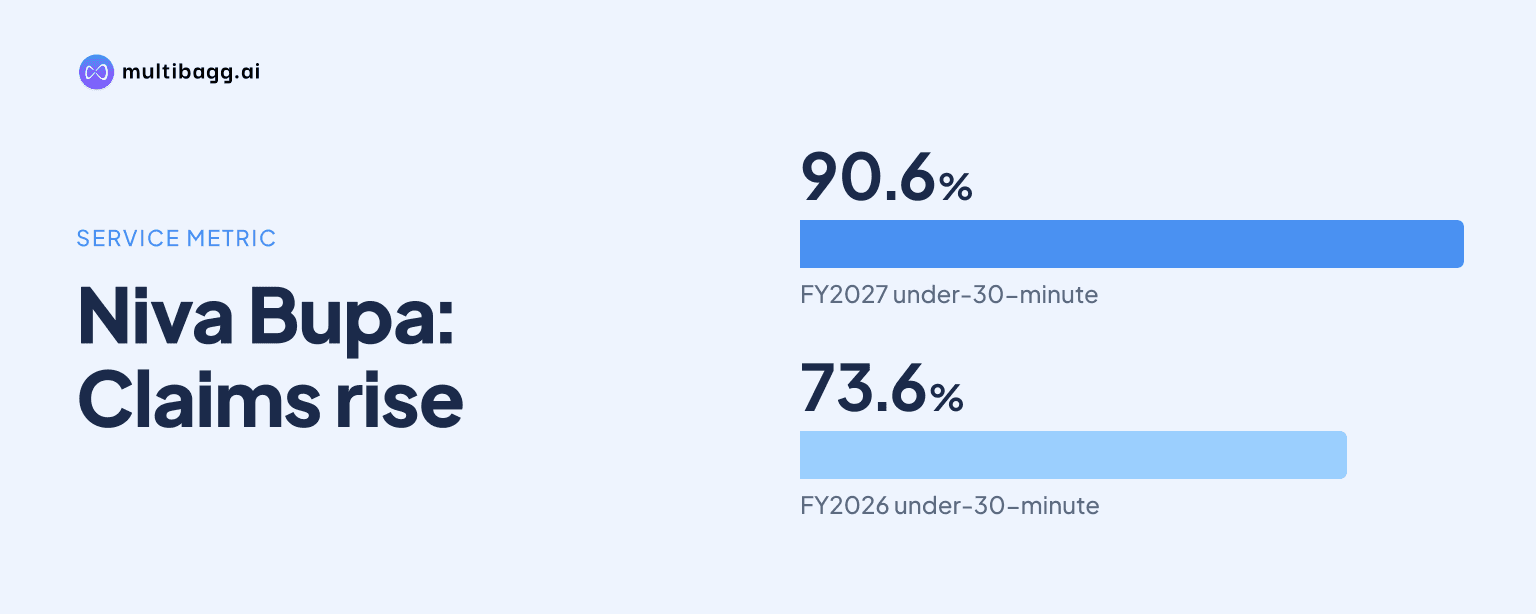
Niva Bupa Health Insurance processed 90.6% of cashless claims within 30 minutes in H1'FY2027, compared with 73.6% in H1'FY2026, while cashless-claims auto-adjudication reached 39.1% on an exit basis. The operating data show Niva Bupa using digital submission, automated decisions and claims analytics across its insurance value chain.
Know Niva Bupa Health Insurance Company inside out
Results, valuation, peers and who's buying, in one view.
How quickly did Niva Bupa process cashless claims?
Niva Bupa processed 90.6% of cashless claims in less than 30 minutes in H1'FY2027. That was 17.0 percentage points above the 73.6% recorded in H1'FY2026 and 6.3 percentage points above FY2026's 84.3%; it also exceeded FY2025's 86.0%.
The improvement coincided with cashless-claims auto-adjudication rising to 39.1% in H1'FY2027 on an exit basis. Auto-adjudication was 12.5% in H1'FY2026, 32.1% in FY2026 and 27.3% in FY2025. Niva Bupa says auto-adjudication was on hold during Q1'FY2026 for information-security assurance reviews across third parties, providing context for the H1'FY2026 result.
Digital claims submission was 90.1% in H1'FY2027, below 91.6% in H1'FY2026 and 92.1% in FY2026. The faster cashless-processing result therefore accompanied a lower reported digital-submission share than in the preceding comparable half year, rather than a higher share of digital claim submissions.
Which parts of the claims process are automated at Niva Bupa?
Niva Bupa's claims system includes digital claims submission, real-time fraud detection, an outlier-detection tool for billing review and cashless-claims auto-adjudication. The company also describes a paperless auto-adjudication portal, with random checks and case-specific triggers used in billing review to identify anomalies.
The claims workflow is linked to a hospital-network strategy. Niva Bupa had 10,780 network hospitals at H1'FY2027, up from 10,566 at FY2026, and 1,132 Preferred Partner Network, or PPN, hospitals, compared with 1,116 at FY2026. Claims contribution in PPN cities rose to 22% in H1'FY2027 from 21% in FY2026 and 13% in FY2024.
Niva Bupa identifies disease, treatment provider, location and policy seller as dimensions for real-time outlier detection in claims. Its case-management process reviews cost components claim by claim with medical providers, while PPN hospitals provide free ambulance services and designated relationship managers for customers. These disclosed mechanisms operate alongside, rather than replace, automated adjudication.
How digital are Niva Bupa's sales, underwriting and renewals?
Niva Bupa reported that 100.0% of new policies were applied for through its website and mobile apps in H1'FY2027. This matched FY2026 and improved marginally from 99.9% in H1'FY2026 and FY2025, while digital payments increased to 96.9% from 96.2% in H1'FY2026.
Retail policies auto-decisioned rose to 50.8% in H1'FY2027 from 47.8% in H1'FY2026 and 48.2% in FY2026. Niva Bupa says its underwriting uses rule-based automated decisioning and an LTV-based approach, where LTV means lifetime value, to identify upsell and cross-sell opportunities. The company also uses real-time lead scoring supported by a product-recommendation engine in customer sourcing.
Renewals completed without human intervention reached 88.1% in H1'FY2027, up from 84.4% in H1'FY2026 and 86.2% in FY2026, but slightly below FY2025's 88.3%. For renewals, Niva Bupa says it uses a predictive machine-based learning model to target cases with a high probability of lapse.
Got a follow-up? Ask IRIS
What artificial intelligence projects has Niva Bupa put into operation?
Niva Bupa lists artificial intelligence, or AI, projects in operation across sales, claims, renewals, investments, marketing, technology, human resources and support functions in FY2027. In claims, auto-adjudication and fraud prediction are in operation, while its document-forgery capability was operationalized in Q2'FY2027.
The company says voice agents were operationalized in Q2'FY2027 for customer service and renewals. It also operationalized a budget allocator in marketing, competitor analysis in investments, software development in technology and a legal copilot in support functions during Q2'FY2027.
Several AI projects remain planned for FY2027 rather than operational. These include Sales Copilot, Underwriter Copilot, document summarization, risk prediction, next-best-action tools for renewals, personalization, enterprise search, systems reliability, resume screening and employee-claims automation. The presentation does not provide adoption rates or financial outcomes for these individual projects.
How does Niva Bupa customer feedback compare with claims operations?
Niva Bupa's cashless-discharge Net Promoter Score, or NPS, was 74 in H1'FY2027, up from 70 in FY2026 and 67 in FY2025. NPS is a customer-feedback measure; the company separately reports that its weighted episodal NPS reached 63, compared with 60 in FY2026.
The weighted measure combines critical touch points including claims discharge, service, policy issuance and renewal using a weighted average by response method. Niva Bupa reached more than 24 lakh customers for feedback in H1'FY2027 and received more than 1.9 lakh responses, giving the reported scores a disclosed response base across those touch points.
The customer-facing app also expanded in the same period. App downloads reached 15.3 million in H1'FY2027, versus 14.2 million in FY2026, while monthly average active users rose to 6.2 lakh from 5.3 lakh. Monthly average health check-ups increased to 63,000 from 51,000, and doctor consultations rose to 7,300 from 6,600.
Conclusion
Niva Bupa's H1'FY2027 operating measures indicate a more automated insurance workflow: 90.6% of cashless claims were processed within 30 minutes, 50.8% of retail policies were auto-decisioned and 88.1% of renewals were completed without human intervention. The comparison with H1'FY2026 is most pronounced in claims, where auto-adjudication increased from 12.5% to 39.1% and rapid cashless processing increased from 73.6% to 90.6%.
What to watch next is delivery of the projects Niva Bupa has planned for FY2027, including Underwriter Copilot, risk prediction, next-best-action renewal tools and employee-claims automation. The presentation also leaves open whether the 39.1% exit-basis auto-adjudication level can be sustained after the Q1'FY2026 third-party information-security assurance reviews that had put the process on hold.