










Niva Bupa barred from new locations after FY25 EOM breach
Key highlights
- IRDAI barred Niva Bupa from opening new business locations for six months from its August 19, 2026 order.
- Niva Bupa's FY25 1/n EOM ratio was 39.22%, above the 35.55% permitted maximum.
- Niva Bupa's September 2026 quarter EOM ratio was 34.26%, below the 35.98% limit.
- Year-to-date September 2026 gross written premium was Rs 4,634.01 crore, compared with Rs 3,474.97 crore a year earlier.
powered by IRIS
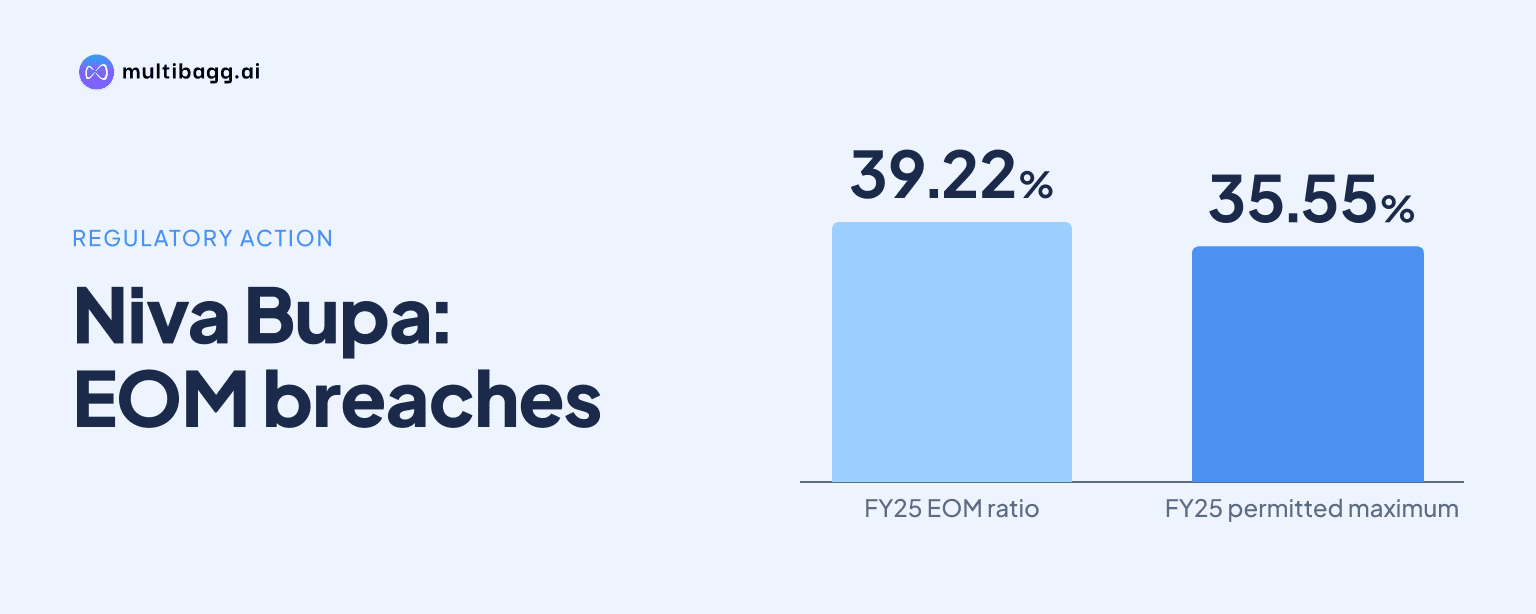
Niva Bupa Health Insurance Company Limited was barred by the Insurance Regulatory and Development Authority of India from opening new business locations for six months after its FY25 expenses-of-management ratio reached 39.22%, exceeding the permitted 35.55% ceiling. Niva Bupa has accepted the August 19, 2026 order and says it will not appeal.
Know Niva Bupa Health Insurance Company inside out
Results, valuation, peers and who's buying, in one view.
Why was Niva Bupa barred from opening new business locations?
Niva Bupa was barred because the regulator found that it had not complied with applicable expenses-of-management, or EOM, limits for FY 2024-25. The Insurance Regulatory and Development Authority of India, or IRDAI, issued its order on August 19, 2026, warning Niva Bupa and directing it not to open a new place of business for six months from that date. The restriction is specifically linked to FY25 compliance rather than to the September 2026 quarter.
Niva Bupa had previously received an EOM forbearance letter dated December 27, 2024. It submitted a quarterly EOM reduction plan to IRDAI on March 26, 2025, intended to bring EOM within prescribed limits by FY 2025-26, and filed an FY25 EOM forbearance application with the General Insurance Council on April 25, 2025.
Niva Bupa has accepted the August 19, 2026 order and stated that it does not intend to contest or appeal it. The filing does not disclose a monetary penalty, a direction to close existing locations, or a change in the six-month duration. It instead sets out a restriction on opening new places of business, alongside the insurer's subsequent EOM compliance disclosures.
What was Niva Bupa's FY25 expenses-of-management breach?
Niva Bupa's FY25 EOM ratio was 39.22% under the 1/n methodology, which was 3.67 percentage points above the maximum allowed ratio of 35.55%, including applicable additional allowances. On the non-1/n basis, its FY25 EOM ratio was 37.41%. The disclosed 1/n comparison is the measure directly paired with the stated regulatory maximum in the filing.
The comparison shows a shift from an FY25 excess to ratios below the applicable limit in both disclosed FY26 periods. The FY25 maximum was 35.55%, while the permitted ratios for the September 2026 quarter and year to date were 35.98% and 36.10%, respectively, each including applicable additional allowances. Niva Bupa did not disclose the components behind the FY25 ratio or a quantified effect of the location restriction on future business.
The regulatory sequence also matters. Niva Bupa submitted its reduction plan in March 2025 and a forbearance application in April 2025, but IRDAI's warning and location-opening direction came on August 19, 2026. The filing characterises the order as a response to non-compliance with EOM limits in FY 2024-25, while separately reporting compliance in the financial year ended March 31, 2026 and through September 30, 2026.
Got a follow-up? Ask IRIS
Is Niva Bupa complying with EOM rules now?
Niva Bupa says it complied with the IRDAI EOM regulations for the full year ended March 31, 2026, the quarter ended September 30, 2026 and the year to date ended September 30, 2026. For the September quarter, its 1/n EOM ratio was 34.26%, below the 35.98% maximum. For the year to date, the ratio was 34.67%, below the 36.10% ceiling.
Niva Bupa also said it was not required to transfer any excess EOM amount from the Revenue Account to the Profit and Loss Account for the September 2026 quarter or year to date. That statement is based on financial information prepared under accounting standards specified under Section 133 of the Companies Act, 2013, read with the Companies (Accounting Standards) Rules, 2021. It confirms the filing's position that the disclosed FY26 periods did not generate management expenses over the allowable limit.
The September 2026 result is reported after Niva Bupa implemented Indian Accounting Standards, or Ind AS, from April 1, 2026 without using the one-year forbearance available under IRDAI transition provisions. Niva Bupa said its current and previous-period financial results could require adjustments if reporting requirements, standards, IRDAI or tax guidelines, or optional Ind AS 101 exemptions change. That accounting disclosure is separate from its statement of regulatory compliance with the EOM framework.
What financial indicators changed as Niva Bupa returned to compliance?
Niva Bupa reported gross written premium of Rs 4,634.01 crore for the year to date ended September 30, 2026, compared with Rs 3,474.97 crore for the year to date ended September 30, 2025. Net profit after tax for the same periods was Rs 273.44 crore and Rs 131.96 crore, respectively. These are reported financial results and do not establish that the EOM change caused the premium or profit movement.
The insurer's sector-specific expense ratio was 30.32% for the year to date ended September 30, 2026, versus 31.60% in the corresponding prior-year period. Its claims ratio was 63.05%, compared with 65.92%, while the combined operating ratio was 93.37%, compared with 97.52%. These operating ratios are distinct from the EOM ratios used in the regulatory warning, so they should not be treated as interchangeable measures.
At September 30, 2026, Niva Bupa reported total assets of Rs 12,127.83 crore, compared with Rs 11,485.56 crore at March 31, 2026. Total equity rose to Rs 3,843.16 crore from Rs 3,589.27 crore over the same dates, while insurance contract liabilities increased to Rs 6,938.56 crore from Rs 6,562.62 crore. Niva Bupa also allotted 21,87,932 equity shares during the period ended September 30, 2026 following exercises of employee stock options.
Conclusion
The August 19, 2026 IRDAI order creates a defined six-month restriction on Niva Bupa opening new business locations because its FY25 1/n EOM ratio of 39.22% exceeded the 35.55% permitted level. Niva Bupa has accepted the order without appeal. Its later disclosures show 34.26% for the September 2026 quarter and 34.67% year to date, both below their respective permitted thresholds.
The next disclosed point to watch is whether Niva Bupa maintains its EOM reduction plan and remains within applicable limits after September 30, 2026, while the six-month location-opening direction runs from the August 19, 2026 order date. Niva Bupa also cautioned that quarterly results are not indicative of full-year performance because of industry seasonality, and that Ind AS reporting figures may require adjustments as standards or regulatory guidance evolve.