










Niva Bupa says 2.03x solvency needs no equity capital
Key highlights
- Niva Bupa said its H1 '26 solvency ratio was 2.03x under Indian GAAP.
- Niva Bupa has board approval to raise up to Rs 500 crore of debt capital if required.
- Niva Bupa's total loss ratio declined to 63.1% in H1 '26 from 65.9% a year earlier.
- Niva Bupa said new-business combined ratio is about 102% to 103%, versus 97% to 98% for renewals.
powered by IRIS
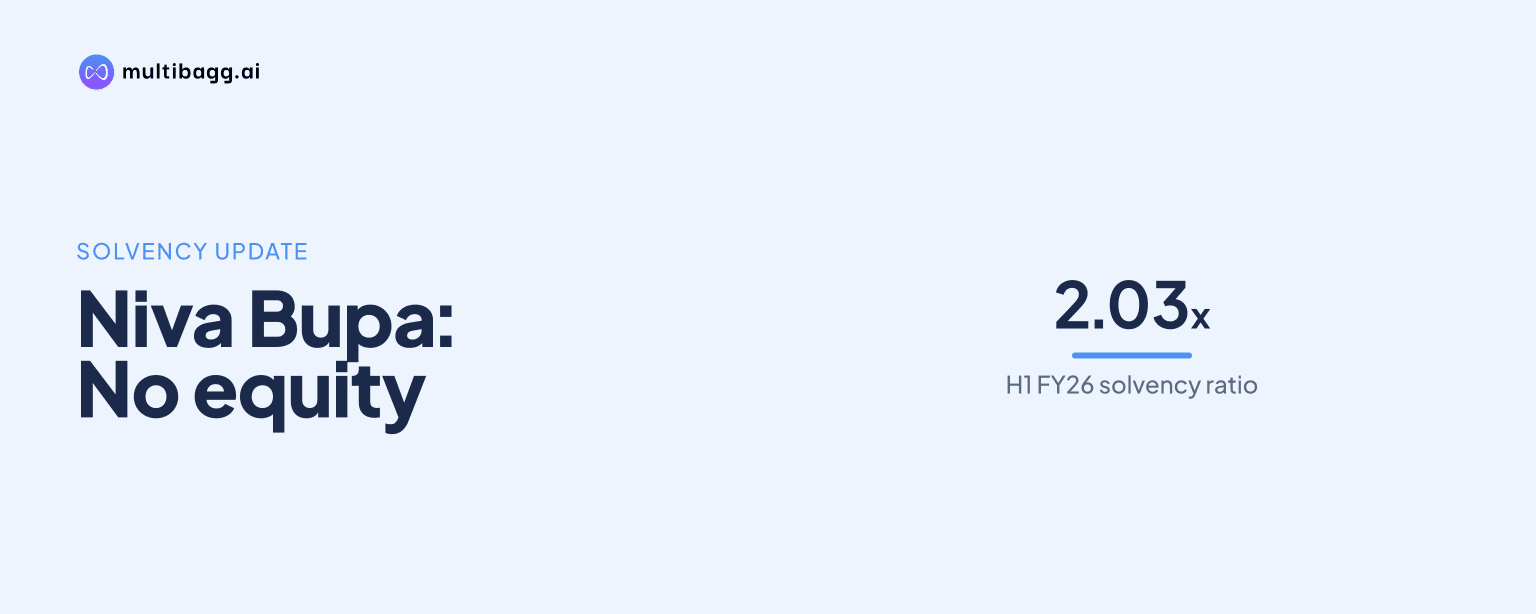
Niva Bupa said its H1 '26 solvency ratio of 2.03x does not require an equity-capital raise, citing the seasonal weighting of profit towards H2 and particularly Q4 under Indian GAAP, or Indian Generally Accepted Accounting Principles. Management also has board approval to raise up to Rs 500 crore of debt capital if a requirement emerges.
Know Niva Bupa Health Insurance Company inside out
Results, valuation, peers and who's buying, in one view.
Why is Niva Bupa's solvency ratio declining?
Niva Bupa said its H1 '26 solvency ratio of 2.03x is lower partly because Indian GAAP creates a seasonal pattern, with more profit arriving in H2 and especially Q4. Management acknowledged that the ratio has declined, while an analyst described the downward trend as lasting seven to eight quarters. The company said its modelling accounts for the expected H2 profit contribution.
The current regulatory calculation remains based on Indian GAAP rather than Indian Accounting Standards, or Ind AS, according to Niva Bupa. In the analyst's framing, rapid premium growth can absorb capital before policy cohorts mature because acquisition costs are recognised upfront for solvency purposes. Management confirmed that the available solvency margin is currently calculated using premium rather than claims, making net-premium growth a key input in the existing framework.
Niva Bupa did not disclose a quarterly history of the 2.03x ratio or give a numerical H2 solvency forecast. Its position was that the H1 measure should be assessed alongside the Indian GAAP profit seasonality. Management also said Niva Bupa has higher net worth under Ind AS, although the reported solvency measure continues to use Indian GAAP.
Does Niva Bupa need to raise equity capital?
Niva Bupa said it does not expect to need an equity-capital raise at the current H1 '26 solvency level of 2.03x. Vishwanath Mahendra said management had modelled the position and was comfortable with both growth and solvency. This was management's assessment rather than a disclosed capital target or a projection under a specified growth scenario.
Niva Bupa has board approval to raise debt capital of up to Rs 500 crore. Management said it could use that capacity if a requirement arose, but did not say a debt issue was planned, scheduled or necessary. The Rs 500 crore approval is therefore a contingency funding mechanism alongside management's statement that equity is not expected to be required.
Niva Bupa linked its capital approach to a target return on equity, or ROE, in the mid- to high-teens. Management said it would seek to pass any amount above that target to customers after distribution regulations take effect. It did not quantify the capital impact of this approach and said it was premature to assess how a claims-based solvency trigger could affect requirements.
How could risk-based capital change Niva Bupa's solvency calculation?
Niva Bupa expects the solvency framework to move eventually from Indian GAAP to risk-based capital, or RBC, which management said would align with Ind AS. Management based that expectation on discussions with the regulator but provided no implementation date. The H1 '26 ratio of 2.03x remains calculated under the current Indian GAAP framework.
Management said the regulator is expected to release an exposure draft for a quantitative impact study, or QIS, and Niva Bupa would share the resulting impact on solvency and capital requirements at that point. The company did not disclose its internally calculated RBC or International Financial Reporting Standards-based solvency range when asked. The size and direction of any transition effect therefore remain unresolved pending the QIS material.
An analyst raised the possibility that lower premiums under proposed distribution rules could shift the binding solvency measure towards claims if claims do not fall proportionately. Niva Bupa said it had undertaken broader modelling under both Indian GAAP and Ind AS and was comfortable with current solvency. However, management said RBC would use a different formula, making conclusions about future claims-based requirements premature.
Got a follow-up? Ask IRIS
How could distribution reforms affect Niva Bupa's capital plan?
Niva Bupa said it intends to pass benefits to customers when new distribution regulations are in place while maintaining its mid- to high-teens ROE target. The proposed rules discussed on the call could reduce commissions, either through lower premiums or higher sum insured for the same premium. Management did not quantify the likely customer benefit or the resulting effect on the 2.03x solvency ratio.
Management said expenses of management, including acquisition cost, matter alongside claims when assessing reforms. It said a combined measure of claims and costs of 98% to 99% was the range readers should continue to expect. This was a management expectation rather than guidance for a particular financial year, and no timetable for final rules was disclosed.
Niva Bupa said it needs more regulatory clarity before estimating the effect of commission restrictions on its acquisition ratio. An analyst referred to an acquisition ratio of around 29%, while management said the current figure was 21-point-something percent. Management said channel mix and possible price reductions could influence the final outcome, so it did not provide a post-reform ratio.
What operating trends support Niva Bupa's capital position?
Niva Bupa said its total loss ratio improved to 63.1% in H1 '26 from 65.9% a year earlier, a reduction of almost 300 basis points. Management said the retail loss ratio improved by 77 basis points to 67.4%. It attributed the wider improvement partly to business mix, as group business was flat or declining where pricing did not meet combined-ratio requirements.
The renewal book's claims ratio remained around 75%, while management said fresh-business claims experience improved. Niva Bupa attributed the fresh-business change partly to a greater share of higher-sum-insured policies and the ReAssure 3.0 product. Management also said the new book's age profile was similar to earlier years, while age-based pricing adjusts premiums for claims experience across age cohorts.
Niva Bupa said new business has a combined ratio of roughly 102% to 103%, compared with about 97% to 98% for renewal business. Management attributed the difference to expenses involved in acquiring new policies. These figures show why renewal economics and the pace of new-business growth are relevant to internal capital generation, though Niva Bupa did not quantify their effect on the H1 '26 solvency ratio of 2.03x.
Conclusion
Niva Bupa's stated position is that its H1 '26 solvency ratio of 2.03x remains adequate despite its decline because Indian GAAP produces lower first-half solvency and more profit in H2, particularly Q4. Management said it does not expect an equity raise, while the Rs 500 crore board-approved debt option provides an additional funding route if required. Lower loss ratios and more favourable renewal economics provide operating context for that view.
The next disclosed milestone is the regulator's expected exposure draft for a QIS on risk-based capital. Niva Bupa said it would share the effect on solvency and capital requirements once that material is released. Final distribution rules also remain important because management has not quantified how commission changes, pricing and channel mix could affect acquisition costs, customer benefits or the future solvency calculation.