










Niva Bupa retail health share hits 11% as mix reaches 75.2%
Key highlights
- Niva Bupa reported retail health market share of 11.0% in H1'FY2027, up from 9.9% in H1'FY2026.
- Retail health accounted for 75.2% of Niva Bupa's H1'FY2027 GWP, compared with 68.2% a year earlier.
- Retail health GWP rose 46.9% year on year to Rs 3,483.5 crore in H1'FY2027 on the 1/n basis.
- Niva Bupa's retail health indemnity renewal rate reached 96.3% in H1'FY2027, up from 92.3%.
powered by IRIS
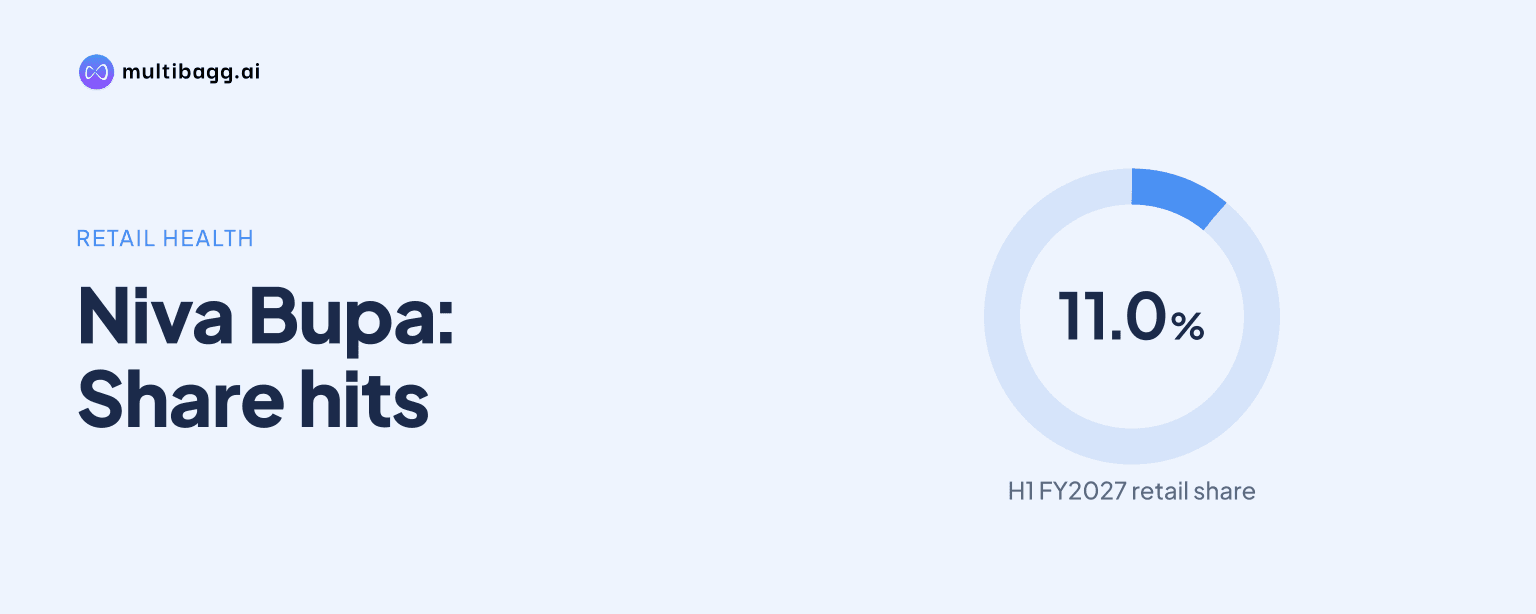
Niva Bupa Health Insurance reported an 11.0% retail health market share in H1'FY2027, up from 9.9% a year earlier, as retail health accounted for 75.2% of gross written premium (GWP) and rose 46.9% to Rs 3,483.5 crore on the 1/n accounting basis.
Know Niva Bupa Health Insurance Company inside out
Results, valuation, peers and who's buying, in one view.
How fast did Niva Bupa's retail health premium grow in H1 FY2027?
Niva Bupa reported retail health GWP growth of 46.9% year on year to Rs 3,483.5 crore in H1'FY2027 on the 1/n basis, from Rs 2,371.8 crore in H1'FY2026. Total GWP rose 33.4% to Rs 4,634 crore from Rs 3,475 crore over the same periods. The faster reported growth rate for retail health coincided with its larger share of the total premium base.
On the basis excluding 1/n accounting, retail health GWP increased 37.1% to Rs 3,853.7 crore in H1'FY2027 from Rs 2,809.9 crore a year earlier. Total GWP without 1/n rose 25.6% to Rs 5,004.1 crore from Rs 3,982.7 crore. Niva Bupa reports both series, while its retail health market-share disclosure uses the 1/n basis.
The presentation states that long-term products have been accounted for on a 1/n basis from October 1, 2024, following a mandate by the Insurance Regulatory and Development Authority of India (IRDAI). It also states that H1'FY2027 and FY2026 figures are not comparable with prior periods. The company nevertheless reports year-on-year growth rates for both its with-1/n and without-1/n premium measures.
How did Niva Bupa's premium mix change?
Niva Bupa's retail health share of GWP rose to 75.2% in H1'FY2027 from 68.2% in H1'FY2026, an increase of 7.0 percentage points. Retail health therefore made up more than three quarters of the company's reported premium mix in the latest half year, compared with just over two thirds a year earlier.
Group health moved in the opposite direction, falling to 23.4% of GWP in H1'FY2027 from 30.2% in H1'FY2026, a 6.8-percentage-point reduction. Personal accident and travel represented 1.4% of GWP, compared with 1.6% in the prior-year half. The movement in these three segments accounts for the disclosed shift in Niva Bupa's product composition.
The change continued a longer-term movement toward retail health. Retail health represented 65.5% of GWP in FY2025 and 66.9% in FY2026, before reaching 75.2% in H1'FY2027. Group health declined from 32.3% in FY2025 to 31.6% in FY2026 and then 23.4% in the latest half-year period.
How did Niva Bupa gain retail health market share?
Niva Bupa increased its retail health market share to 11.0% in H1'FY2027 from 9.9% in H1'FY2026 on the 1/n basis. The 1.1-percentage-point increase also put the half-year figure above the 9.4% reported for FY2025 and the 10.1% reported for FY2026.
Management said the health segment, including personal accident, grew 20.7% in H1'FY2027, accelerating from 9.5% in H1'FY2026. Against that sector figure, Niva Bupa reported 46.9% growth in retail health GWP on the 1/n basis. The presentation does not disclose the retail health market denominator or provide a market-share target.
Niva Bupa's Q2'FY2027 retail health market share was 10.9%, compared with 9.8% in Q2'FY2026. Retail health GWP in the quarter was Rs 1,876.3 crore with 1/n accounting, up from Rs 1,279.4 crore in Q2'FY2026. The H1'FY2027 market-share figure was therefore slightly above the second-quarter result.
Got a follow-up? Ask IRIS
Which customer and policy indicators accompanied retail health growth?
Niva Bupa's retail health indemnity renewal rate, measured by premium value without 1/n accounting, rose to 96.3% in H1'FY2027 from 92.3% in H1'FY2026. The company defines the rate as total premium realised from policies renewed in the relevant fiscal period. Its Q2'FY2027 rate was 95.6%, compared with 92.2% a year earlier.
The share of GWP from new retail health indemnity policies with sum insured of at least Rs 10 lakh increased to 93.2% in H1'FY2027 from 83.8% in H1'FY2026. Average ticket size per policy in the agency channel rose to Rs 30,349 from Rs 25,215. Niva Bupa lists products including ReAssure, GoActive, smart+ HEALTH, Aspire and SENIOR FIRST across customer segments.
Weighted Episodal Net Promoter Score (NPS) was 63 in H1'FY2027, compared with 57 in H1'FY2026. Cashless-discharge NPS was 74 in H1'FY2027, versus 70 for FY2026. Niva Bupa said it contacted more than 24 lakh customers for feedback and received more than 1.9 lakh responses in H1'FY2027.
How did Niva Bupa's profitability and claims measures change?
Niva Bupa reported profit after tax of Rs 273.4 crore in H1'FY2027 under Indian Accounting Standards (Ind AS), compared with Rs 132 crore in H1'FY2026. Its combined insurance service ratio (CISR) improved to 99.5% from 103.1%. Niva Bupa defines CISR as insurance service expenses, net expenses from reinsurance contracts and other operating expenses divided by insurance revenue.
The claims ratio, including claim-handling expenses, declined to 63.1% in H1'FY2027 from 65.9% a year earlier. The retail claims ratio fell to 67.4% from 68.1%, while the expense ratio decreased to 36.4% from 37.2%. These measures were reported alongside retail health GWP of Rs 3,483.5 crore and a 75.2% retail health product mix.
Solvency ratio was 2.03 times in H1'FY2027, compared with 2.85 times in H1'FY2026. Annualised return on average net worth was 14.7%, up from 7.8%. The presentation does not allocate the changes in profit, claims or expenses to individual products, distribution channels or customer cohorts.
Conclusion
Niva Bupa's H1'FY2027 disclosures show that reported premium growth became more concentrated in retail health. Retail health GWP increased 46.9% to Rs 3,483.5 crore on the 1/n basis, market share reached 11.0%, and the segment's premium contribution increased to 75.2%, while group health's contribution fell to 23.4%.
The next disclosures will show whether retail health maintains this larger mix contribution through the remaining FY2027 quarters. Relevant reported measures include the 96.3% retail health indemnity renewal rate, the 93.2% share of new indemnity GWP carrying at least Rs 10 lakh of sum insured, and the continuing use of 1/n accounting for long-term products. Niva Bupa does not disclose a future retail health market-share or premium target in the presentation.