










NRL targets March 2027 completion, FY29 full added-capacity use
Key highlights
- NRL targets March 2027 to complete its 6 MMT addition and lift refinery capacity from 3 MMT to 9 MMT.
- NRL targets 50%-60% utilisation of added capacity by Q3 of the next financial year and 100% in 2028-2029.
- The 1,640-kilometre PNCPL was 95% complete, with 1,600 kilometres finished as of November 13, 2026.
- NRL had drawn about Rs 20,500 crore of debt against Rs 28,000 crore of financing tie-ups.
powered by IRIS
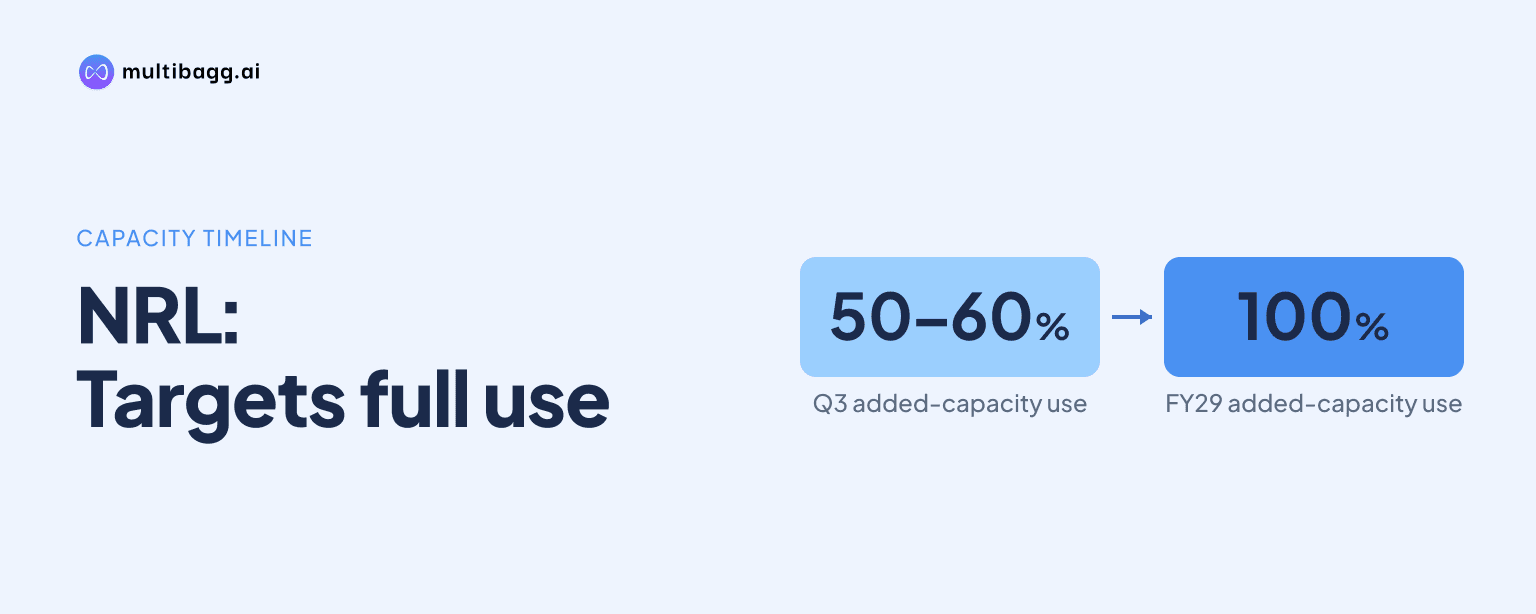
Numaligarh Refinery expects its 6 million metric tonne addition to be completed in March 2027, lifting capacity from 3 million metric tonnes to 9 million metric tonnes, while management targets 50%-60% use of the added capacity by Q3 of the next financial year and 100% in FY29, or 2028-2029.
Know Oil India inside out
Results, valuation, peers and who's buying, in one view.
When will NRL's refinery expansion be completed?
NRL is targeting March 2027 for completion of the NREP project, which adds 6 million metric tonnes (MMT) of annual capacity to its existing 3 MMT refinery. Sachidananda Maharana, NRL's Director of Finance, gave the target during Oil India Limited's November 13, 2026 earnings call.
The project would take NRL's stated refining capacity to 9 MMT when the new 6 MMT facility is commissioned. Management described March 2027 as the completion target, rather than reporting the project as complete at the date of the call.
The associated PNCPL crude-oil pipeline was about 95% complete. Of its 1,640-kilometre length, 1,600 kilometres had been completed and 40 kilometres were still under construction, according to management.
Management had previously indicated a December pipeline date, but said small land-related issues would cause some spillover. It now expects mechanical completion in Q4 of the current financial year, ahead of the refinery project's March 2027 completion target.
Will NRL shut its existing refinery during commissioning?
NRL says it will not need to shut its existing 3 MMT refinery to commission the new 6 MMT capacity. Management said the current refinery is standalone and the existing and additional facilities have been configured to operate separately.
This configuration means the 3 MMT refinery can continue operating while the new 6 MMT unit is brought online. Management did not provide a commissioning-related throughput-loss estimate because it said an outage of the existing refinery would not be required for that purpose.
A separate regular maintenance shutdown is planned for October 2027. Management said the existing 3 MMT refinery would undergo a turnaround lasting about one month, an activity it described as occurring every four years.
The timing distinguishes the routine turnaround from the expansion programme. The March 2027 NREP completion target precedes the October 2027 maintenance event, while the new unit is scheduled to ramp gradually rather than operate at full capacity on commissioning.
Got a follow-up? Ask IRIS
How quickly will NRL use the new refinery capacity?
NRL targets 50%-60% utilisation of the additional 6 MMT capacity by Q3 of the next financial year and 100% utilisation in 2028-2029. The plan sets out a ramp-up period after the March 2027 completion target rather than immediate full use of the added capacity.
At 50%-60% utilisation, the additional refinery would operate at an annualised 3.0 MMT to 3.6 MMT. That range relates only to the new 6 MMT unit and is separate from the existing 3 MMT refinery that management expects to remain operational during commissioning.
The 100% target for 2028-2029 applies to the additional capacity, not to an explicitly stated consolidated utilisation rate for the combined 9 MMT system. NRL did not disclose a utilisation forecast for the existing refinery during FY29.
The existing refinery was operating above nameplate capacity before the expansion. NRL reported refinery capacity utilisation of 107.02% and distillate yield of 87.01% in Q2 FY27, when operating revenue was Rs 7,991 crore, up 24% from Q2 FY26.
What funding and operating metrics has NRL disclosed?
NRL had drawn about Rs 20,500 crore of debt against total financing tie-ups of Rs 28,000 crore as of the November 2026 call. Management said its capital-expenditure target for the current financial year was Rs 7,500 crore and that it remained on target.
For FY 2028, management expects capital expenditure of about Rs 6,000 crore, below the Rs 7,500 crore current-year target. It attributed the lower expected spending to projects being completed and brought online.
NRL's quarterly earnings before interest, tax, depreciation and amortisation were Rs 1,108 crore in Q2 FY27, compared with Rs 988 crore in Q2 FY26. Profit after tax was Rs 701 crore, down from Rs 724 crore a year earlier, even as Q2 operating revenue rose 24% year on year.
Gross refinery margin, or GRM, declined sequentially to US$20.71 per barrel in Q2 from US$35.95 per barrel in Q1, while the half-year GRM was US$28.24 per barrel versus US$7.73 per barrel in the previous half year. Management attributed the Q2 decline primarily to lower free-on-board product prices: motor spirit fell to US$110 per barrel from US$129, and high-speed diesel fell to US$138 from US$175.
Conclusion
NRL's disclosed expansion plan combines a March 2027 target for the 6 MMT addition with a phased utilisation schedule that reaches 50%-60% by Q3 of the following financial year and 100% in 2028-2029. The existing 3 MMT refinery is designed to operate through commissioning, although its separate one-month turnaround is scheduled for October 2027.
The next milestones are PNCPL mechanical completion in Q4 of the current financial year, NREP completion in March 2027 and the October 2027 turnaround. Management's FY29 target for 100% use of the added 6 MMT capacity, alongside planned FY 2028 capital expenditure of about Rs 6,000 crore, will be the key disclosed measures of the ramp-up's progress.