










Oil India writes off Rs 2,350 crore on two Andaman wells
Key highlights
- Oil India wrote off two Andaman wells costing around Rs 2,350 crore, comprising about Rs 1,400 crore and Rs 950 crore.
- Oil India retained the third Andaman well, for which a possible future write-off is around Rs 850 crore to Rs 900 crore.
- Oil India is acquiring 600 square kilometres of 3D seismic data before deciding on re-entry or a write-off for the third well.
- Oil India plans to drill a fourth Andaman well by December 2026 and complete it within FY27.
powered by IRIS
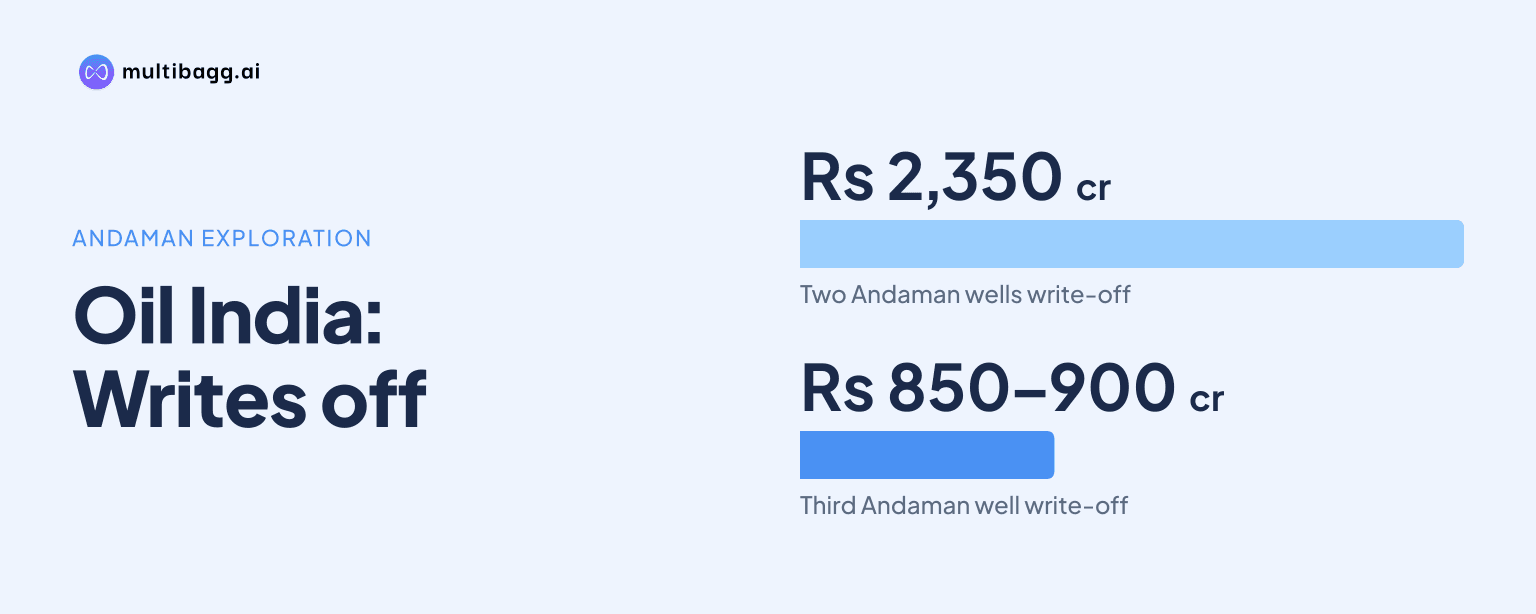
Oil India Limited wrote off two Andaman exploration wells costing Rs 2,350 crore, as disclosed in its November 13, 2026 Q2 FY27 call, while retaining a third for review of 600 square kilometres of three-dimensional seismic data and planning a fourth well by December 2026.
Know Oil India inside out
Results, valuation, peers and who's buying, in one view.
What has Oil India written off in Andaman?
Oil India has written off two of the three wells drilled in its initial four-well Andaman programme. Management put the first written-off well at around Rs 1,400 crore and the second at about Rs 950 crore, taking the disclosed combined charge to around Rs 2,350 crore as of the November 13, 2026 call.
The company had initially planned four Andaman wells and had drilled three by Q2 FY27. Management did not provide a consolidated investment total for the campaign or disclose commercial hydrocarbon volumes from the first two wells, but it confirmed that the drilling programme would continue with a fourth well.
The Rs 2,350 crore amount applies only to the first two wells already written off. It does not include the third well, for which management cited a possible charge of around Rs 850 crore to Rs 900 crore only if the ongoing seismic studies ultimately lead to a write-off decision.
Why is Oil India retaining the third Andaman well?
Oil India is retaining the third well because management said it could be used for re-entry after analysis of new seismic information. The company said it had provisioned the well, rather than written it off, leaving its accounting treatment dependent on the outcome of the technical review.
Management said it is acquiring 600 square kilometres of 3D seismic data and will interpret the data thoroughly before deciding whether to write off the third well. The stated mechanism is that seismic interpretation could improve understanding of the subsurface structure and determine whether re-entering the existing well is justified.
The third well therefore remains an unresolved financial and operational item. If Oil India decides it cannot be reused, management estimated the potential write-off at Rs 850 crore to Rs 900 crore; if the seismic work supports re-entry, the well could instead remain part of further evaluation.
What will Oil India do next in Andaman?
Oil India plans to drill the fourth well in the initial programme by December 2026 and expects to complete it within FY27, which ends in March 2027. Management did not disclose the fourth well's cost, exact location, hydrocarbon target or criteria for judging its result during the Q2 FY27 call.
The company may also drill two appraisal wells after reviewing the new 3D seismic data, with one linked to Vijayapuram-2 and another to Vijayapuram-3. Management said these wells might be drilled to delineate the structure further, making them conditional on the seismic interpretation rather than a confirmed drilling commitment.
The fourth well is the nearer-term activity because management gave a December 2026 drilling timetable. The possible appraisal drilling has a different purpose from the original four-well programme: it would test the extent of structures associated with Vijayapuram-2 and Vijayapuram-3 after the 600 square kilometres of data are assessed.
Got a follow-up? Ask IRIS
How do Andaman charges compare with other write-offs?
The Rs 2,350 crore written off for two Andaman wells was larger than the Rs 280 crore of other incremental write-offs management discussed on the same Q2 FY27 call. The separate Rs 280 crore figure related to provisions and write-offs in assets outside the two major Andaman well charges.
Management identified around Rs 168 crore for a western satellite field, Rs 65 crore in central fields, Rs 44 crore for another well in Chandmari, and around Rs 20 crore for the Ashoknagar joint-venture block in West Bengal. These were described as major components, so their amounts should not be treated as a full line-by-line reconciliation of the Rs 280 crore total.
The comparison clarifies that the Rs 280 crore was not an additional charge for the two written-off Andaman wells. Oil India did not disclose a total campaign cost for Andaman beyond the Rs 1,400 crore and Rs 950 crore write-offs, plus the Rs 850 crore to Rs 900 crore possible future charge on the retained third well.
How does Andaman fit Oil India's wider drilling plan?
Oil India said it drilled 74 wells in the previous year and has an internal target to drill 100 wells in the current year, supported by 29 operating rigs and five to six additional rigs in the pipeline. Management described a run rate of about 100 to 110 wells a year as its business-as-usual target in coming years.
Management said the wider programme is moving into deeper and more complex drilling, with current wells at depths of 5,500 metres to 6,000 metres and planned wells at 6,500 metres. It cited an 82% exploration success ratio and a 100% development-well success ratio, figures that apply to the broader drilling activity rather than specifically to Andaman.
Oil India also referred to a Cambay Basin discovery involving high-pour-point oil at shallow depth, where management said oil had been physically observed and monetisation work was under way. Separately, management said a discovery in the KG-DSF area would be reported shortly, showing that the Andaman programme is one element of exploration across several basins.
Conclusion
Oil India has recorded around Rs 2,350 crore of write-offs on two Andaman wells but has not closed the campaign after three drilling attempts. The retained third well, the acquisition of 600 square kilometres of 3D seismic data, and the possibility of appraisal wells show that management is still assessing whether the basin contains structures worth further work.
The next disclosed milestone is drilling the fourth Andaman well by December 2026 for completion within FY27. Management's subsequent decision on the third well, following the seismic interpretation, remains the key unresolved accounting matter because it could result in a further charge of around Rs 850 crore to Rs 900 crore or support a re-entry programme.