










Oil India Limited targets oil output above 4 million tonnes
Key highlights
- Oil India said 11,100-11,200 tonnes of daily oil output equates to an annual rate of about 4.05 million tonnes.
- Management said it is confident of reaching 4 million tonnes of oil production in FY27 and sees 4.2-4.3 million tonnes thereafter.
- Oil India drilled 42 wells in the half year ended September 30, 2026, including 26 development wells.
- Q2 FY27 crude oil production rose 20% year on year to 1.021 million tonnes.
powered by IRIS
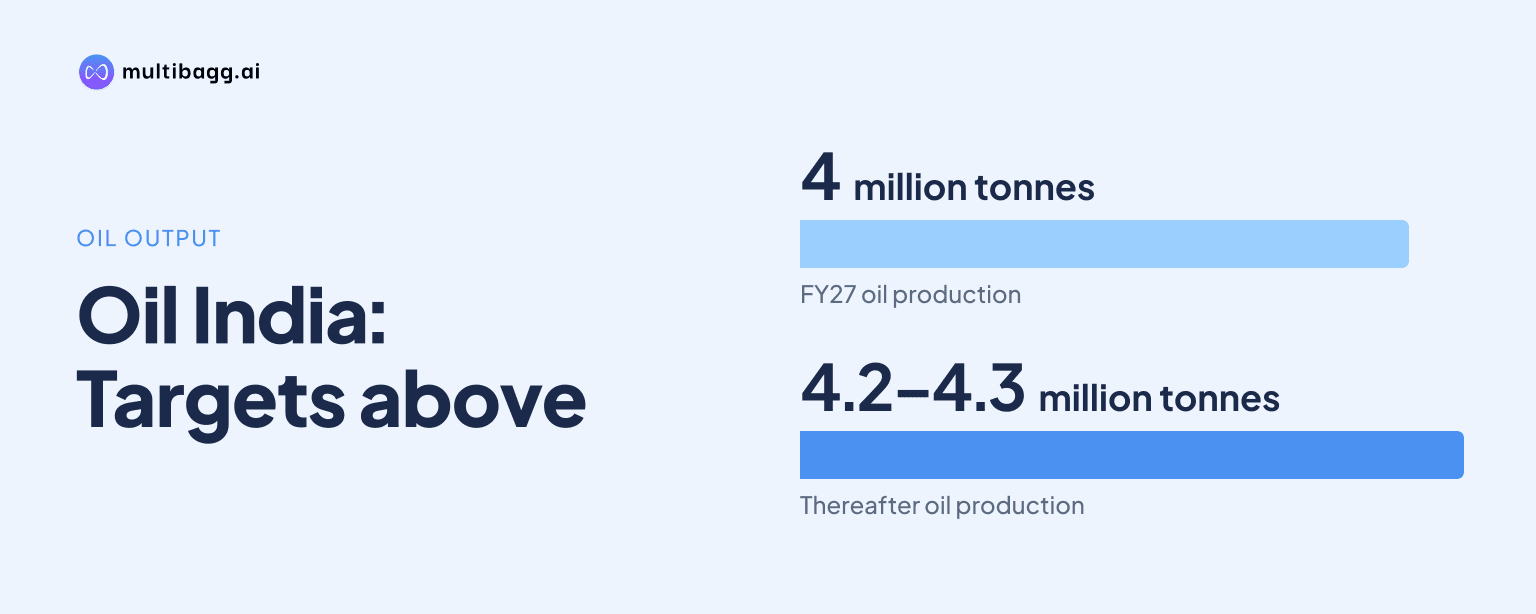
Oil India Limited said on November 13, 2026 that it expects FY27 oil production to reach about 4 million tonnes, supported by a current daily rate of 11,100-11,200 tonnes that management equated to 4.05 million tonnes annually. Management said it aims to hold that level and sees scope for 4.2 million to 4.3 million tonnes.
Know Oil India inside out
Results, valuation, peers and who's buying, in one view.
Can Oil India sustain oil output above 4 million tonnes?
Yes, Oil India management said it is confident of achieving 4 million tonnes in FY27 and expects production to remain around that level after it is reached. Director Operations Trailukya Borgohain said the company should remain at 4 million tonnes, move to 4.2 million to 4.3 million tonnes, and continue growing, while describing this as the current outlook rather than formal multi-year guidance.
Oil India reported daily oil production of 11,300 tonnes on September 30, 2026, followed by a peak of 11,347 tonnes. Output was subsequently hovering around 11,000-11,200 tonnes a day, which management said translates to an annual rate of about 4.05 million tonnes. Management said FY27 output by March 31, 2027 could be around 4 million tonnes on a plus-or-minus basis.
The current rate marks a change from the earlier operating level cited on the call. Management said the maximum daily rate was about 9,700 tonnes in the year before last, compared with more than 11,000 tonnes currently. It also said the oil production rate had increased by about 15.9% in FY27 to date, while Q2 FY27 crude oil production rose 20% year on year to 1.021 million tonnes.
How will Oil India counter declines in mature fields?
Oil India plans to counter mature-field declines through production work in existing fields and near-field exploration that can be monetised quickly. Management said it was trying to increase production from mature fields while arresting decline, and said nearby discoveries offered new opportunities because they could be brought into production faster.
The drilling programme is central to that approach. Oil India drilled 42 new wells in the half year ended September 30, 2026, comprising 16 exploratory wells and 26 development wells. Development wells are directed at established producing areas, while exploratory wells can identify additional resources near existing operations, according to the mix disclosed on the call.
Management said Oil India was already producing from near fields on and off and could monetise those volumes rapidly. The transcript did not provide field-level production forecasts, reserve estimates or a specific number of wells planned for FY27. It nevertheless linked the 4 million-tonne oil outlook to both mature-field activity and the faster development potential of near-field discoveries.
Condensate was not a material factor in the oil target. For the half year ended September 30, 2026, Oil India reported 1.968 million tonnes of normal crude production and 0.003 million tonnes of condensate. In Q2 FY27, condensate was 0.002 million tonnes against total crude production of 1.021 million tonnes, and management said its price treatment was the same as crude.
Got a follow-up? Ask IRIS
What is Oil India's gas production outlook?
Oil India does not expect a large gas-production increase in FY27 because connectivity constraints remain unresolved. Management said gas output could be only slightly higher than the previous year, rather than immediately advancing from the roughly 3.2 billion cubic metres, or BCM, annualised rate referred to by the analyst toward 5 BCM.
The company identified customer and infrastructure connectivity as the key limitation. Management said a fertilizer customer had taken a shutdown because of its requirement, affecting gas offtake, and added that Oil India was working to complete required connections in another 18 to 20 months. The call did not give a revised date for reaching 5 BCM of gas production.
Oil India produced 0.786 BCM of natural gas in Q2 FY27, alongside 1.021 million tonnes of crude oil. Combined oil and gas production was 1.807 million metric tonnes in Q2 FY27 and 3.514 million metric tonnes in the half year ended September 30, 2026. The company’s stated oil outlook is therefore more specific than its near-term gas outlook, which depends on connectivity completion.
What did higher oil output mean for Oil India's results?
Higher oil output coincided with record standalone half-year earnings, although higher crude-price realisation also contributed. For the half year ended September 30, 2026, Oil India reported standalone operating revenue of Rs 16,029 crore, earnings before interest, tax, depreciation and amortisation, or EBITDA, of Rs 8,450 crore, and profit after tax of Rs 5,130 crore.
Crude realisation averaged $95.38 a barrel in the half year, compared with $67.22 a barrel in the corresponding previous-year period. EBITDA margin increased to 48.58% from 34.32%, while profit before tax was Rs 6,609 crore and earnings per share were Rs 31.54. These results combined a 20% year-on-year increase in Q2 FY27 crude output with a $28.16-per-barrel increase in half-year crude realisation.
Oil India also reported consolidated operating revenue of Rs 24,801 crore and consolidated profit after tax of Rs 6,547 crore for the same half-year period. The company did not quantify how much of the earnings change came separately from additional production, crude prices or other operating factors, so the transcript supports both higher volumes and higher realisation as contributors.
Conclusion
Oil India’s production outlook rests on converting an annualised rate of about 4.05 million tonnes into a sustained oil base of at least 4 million tonnes. The move from a prior 9,700-tonne daily peak to a current 11,100-11,200-tonne range, together with 42 wells drilled in the first half of FY27, underpins management’s stated expectation of eventual production in the 4.2-million-to-4.3-million-tonne range.
The next milestone is whether Oil India completes FY27 at about 4 million tonnes by March 31, 2027 while keeping daily production near its November 2026 range. For gas, the unresolved matter is connectivity: management expects work to take another 18 to 20 months and forecast only a small FY27 increase over the preceding year.