










Oil India reviews KG plan after new gas discovery, oil flow
Key highlights
- Oil India said on November 13, 2026 that it would revisit the KG-DSF development plan after a new gas discovery and oil test.
- The KG-DSF appraisal well found gas in a completely new zone, while another zone was producing oil at a very good rate.
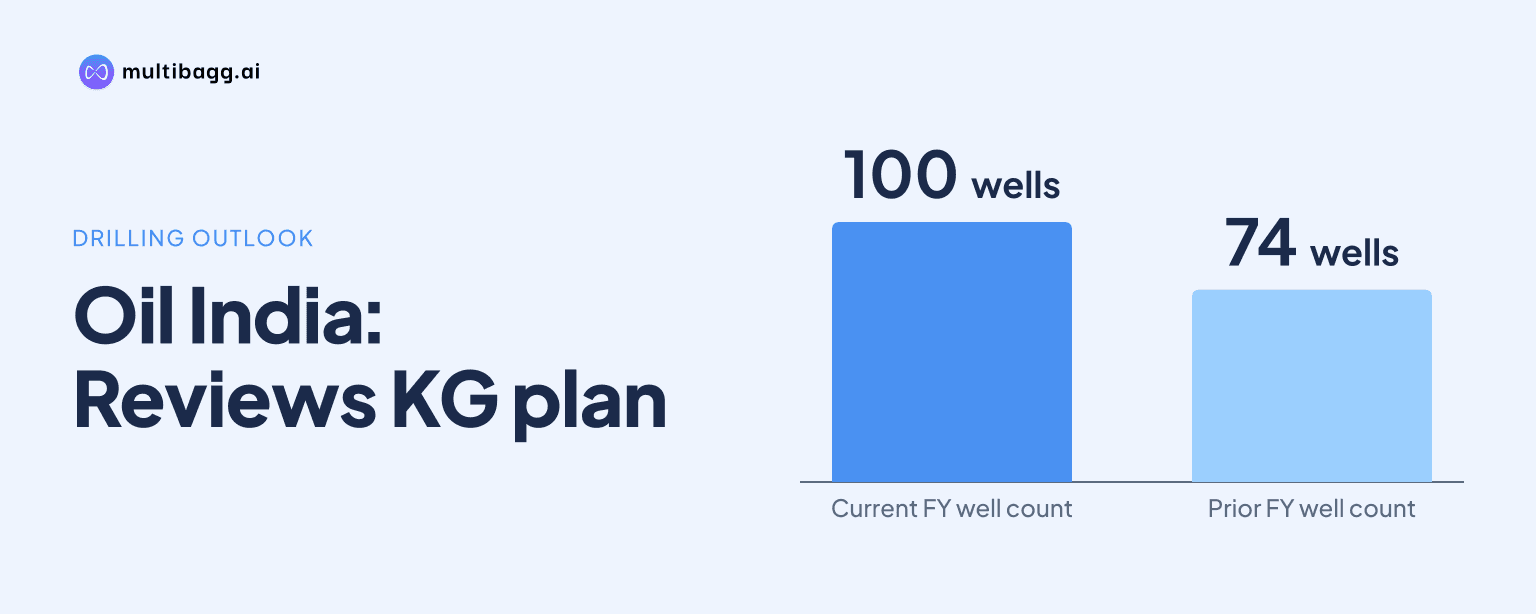
- Oil India targeted about 100 wells in the current financial year, versus 74 wells drilled in the prior year.
- Oil India expected current-year capex of about Rs 13,500 crore to Rs 14,000 crore, including Rs 4,000 crore for exploration and development drilling.
powered by IRIS
On November 13, 2026, Oil India Limited said it would review the KG-DSF field-development plan after an appraisal well recorded a new gas discovery and oil flow from a separate tested zone, although management did not disclose the oil rate, reserves, commerciality or development timetable.
Know Oil India inside out
Results, valuation, peers and who's buying, in one view.
Why is Oil India reviewing the KG development plan?
Oil India is reviewing the KG-DSF plan because the appraisal well tested previously unknown sands and produced results beyond the company’s earlier expectations. Management said the well had delivered “very good surprises,” including gas in a zone that had not been discovered earlier, requiring a fresh assessment of both field development and exploration strategy.
The decision follows testing in two zones of the same appraisal well as of November 13, 2026. One zone had already received a notice of discovery for gas, while a second zone was producing oil during the call. Management said it would issue a detailed press release and statement within a couple of days, but it gave no production-rate figure for the oil test.
A development-plan review does not by itself establish commercial production or reserves. Oil India’s stated basis was evidence from new sands that had been unexplored until this appraisal activity, rather than a quantified revision to the field’s recoverable resources. Management said its KG-DSF exploration strategy would be reviewed “very shortly.”
The KG result comes while Oil India is increasing drilling activity across its portfolio. Management said it drilled 74 wells in the prior year and had an internal target of 100 wells in the current financial year, with 29 drilling rigs already operating and another five to six rigs in the pipeline. That higher activity level provides the operational context for reassessing prospects after new subsurface information emerges.
What did the KG appraisal well find?
Oil India reported a new gas discovery in one zone of the KG-DSF appraisal well, while testing of another zone was producing oil at a very good rate on November 13, 2026. The gas-bearing interval was described as a completely new zone, meaning it had not been identified in the field previously.
Management distinguished the gas result from the oil test: the gas discovery had already been announced through a notice of discovery, while the oil-zone result remained under testing. It said a fuller disclosure would follow after testing, so the transcript does not provide oil volume, gas volume, pressure data, fluid properties, commerciality assessment or expected production start date.
The notable element was the testing of unknown sands rather than only confirmation of an established reservoir. Management said these hitherto unexplored sands prompted the rethink of the field-development plan. This means Oil India is considering whether the well results alter its geological model and the locations or sequence of future work.
Oil India’s wider gas output provides context but is not a measure of the KG discovery. Management said total company gas production was about 8 million standard cubic metres a day to 8.5 million standard cubic metres a day, while about 0.5 million standard cubic metres a day came from a pre-New Exploration Licensing Policy block with pricing outside the administered ceiling. No KG-DSF contribution was identified within those totals.
Got a follow-up? Ask IRIS
How does the KG result compare with Oil India’s other exploration work?
Oil India’s KG result differs from its Kerala-Konkan programme because KG had a notified new gas zone and an oil-producing test zone, whereas the Kerala-Konkan well was still testing five identified objects. The first Kerala-Konkan well was drilled in 60 metres of water to a depth of 6,250 metres, and management planned a second well reaching about 6,500 metres.
The company said the rig drilling and testing in KG would move to Andaman after the current work. Management expected to spud the fourth Andaman well on the west side of the island by the middle of December 2026 and complete it within the financial year. That schedule makes the rig move, rather than a disclosed KG development schedule, the immediate operational milestone.
Andaman illustrates why Oil India is using additional seismic information before making further appraisal decisions. The company acquired about 600 square kilometres of additional three-dimensional, or 3D, seismic data after positive testing at Vijayapuram-2 and Vijayapuram-3, which had originally been drilled using two-dimensional seismic data. Management said 3D imaging could improve appraisal-well placement around those wells.
Oil India had drilled three of its initially planned four Andaman wells as of the call date and had written off two. Management said the first written-off well cost about Rs 1,400 crore and the second about Rs 950 crore, while the third remained provisioned because it could potentially be re-entered or deepened. It expected the new seismic interpretation by January before deciding whether to retain or write off Vijayapuram-3, and planned at least two appraisal wells in that area.
What spending and drilling activity support Oil India’s programme?
Oil India said actual capital expenditure, or capex, was Rs 6,000 crore as of September 30, 2026, and management expected full-year capex to rise to about Rs 13,500 crore to Rs 14,000 crore. The plan included about Rs 1,200 crore for surveys, Rs 4,000 crore for exploration and development drilling, and about Rs 4,500 crore for normal capital equipment.
Management linked the larger drilling programme to deeper and more complex wells. It said Oil India had previously drilled around 38 to 45 wells a year, compared with 74 in the prior year, and was now targeting roughly 100 to 110 wells a year. New wells are being drilled at depths of about 5,500 metres to 6,000 metres, with some planned at 6,500 metres.
The production rationale cited by management was that exploratory wells had an 82% success ratio and development wells a 100% success ratio. Management also said mature fields face average decline rates of 12% to 15%, but the company was producing 20% more from those fields through reservoir management. These company-wide metrics do not quantify the potential output or economics of the KG-DSF discovery.
Conclusion
Oil India’s KG-DSF appraisal outcome has moved beyond a routine exploration update because one new zone has a notified gas discovery and another was flowing oil during testing on November 13, 2026. The combination has led management to revisit the development plan and exploration strategy, while the absence of disclosed flow rates, resource estimates and commerciality data leaves the scale of the result unresolved.
The next points to watch are management’s promised detailed release on the KG oil test, the near-term review of the KG-DSF strategy, and the rig’s planned Andaman spud by mid-December 2026. The January interpretation of 600 square kilometres of new 3D seismic data will also inform management’s decision on Vijayapuram-3 and possible appraisal drilling around Vijayapuram-2 and Vijayapuram-3.