










Patel Retail: UK, Sri Lanka and Italy accounted for 63%
Key highlights
- The UK, Sri Lanka and Italy accounted for 63% of Patel Retail’s H1 FY27 export revenue.
- Patel Retail reported Rs 177.8 crore of export revenue in H1 FY27 across 35+ countries.
- Sri Lanka’s export share fell from 34% in Q1 FY27 to 7% in Q2 FY27, while Italy’s rose from 8% to 26%.
- Own private labels accounted for 36% of H1 FY27 export sales, or Rs 63.53 crore.
powered by IRIS
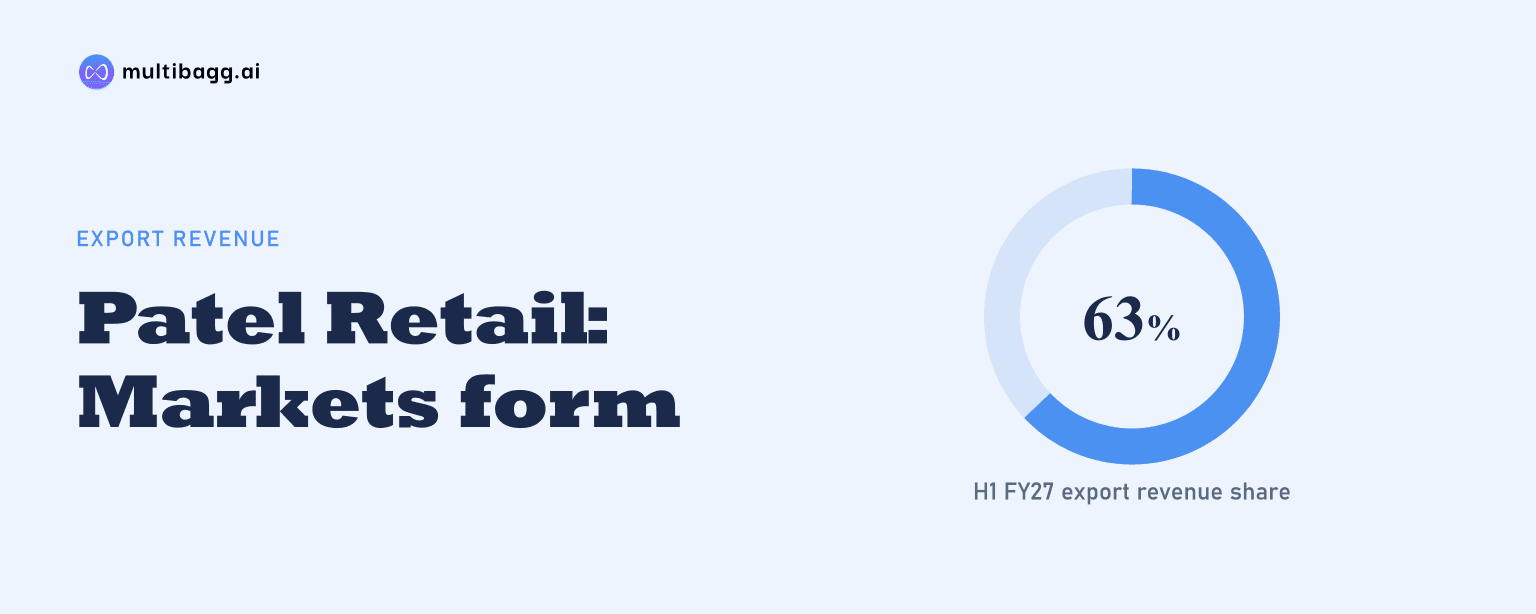
Patel Retail Limited’s UK, Sri Lanka and Italy markets accounted for 63% of Rs 177.8 crore H1 FY27 export revenue, while its Q2 FY27 country mix changed sharply: Sri Lanka’s share fell to 7% from 34% in Q1 FY27 and Italy’s rose to 26% from 8%.
Know Patel Retail inside out
Results, valuation, peers and who's buying, in one view.
How concentrated was Patel Retail’s H1 FY27 export revenue?
Patel Retail’s three largest disclosed H1 FY27 export destinations, the UK, Sri Lanka and Italy, represented 63% of export revenue. The UK was the largest individual market at 26%, followed by Sri Lanka at 20% and Italy at 17%, according to the company’s H1 country-mix disclosure.
Canada accounted for 10% of Patel Retail’s H1 FY27 export revenue, while all other markets together represented 27%. Patel Retail said it exported staples, pulses, spices and processed foods to more than 35 countries, so the Others category covers markets beyond the four individually listed destinations.
The country disclosure identifies percentage contributions rather than destination-level rupee revenue. Patel Retail reported Rs 177.8 crore of export revenue for H1 FY27, but did not disclose the revenue amount generated in the UK, Sri Lanka, Italy, Canada or the Other markets category.
The 63% combined share shows that three named markets led the half-year result despite Patel Retail’s 35+ country reach. Patel Retail exports under its Patel Fresh and Indian Chaska brands as well as third-party labels, using its Ambernath and Kutch facilities for supply, packaging and processing.
Why did Patel Retail’s export country mix change in Q2 FY27?
Patel Retail’s Q2 FY27 export mix shifted away from Sri Lanka and towards the UK and Italy. Sri Lanka’s share declined by 27 percentage points, from 34% in Q1 FY27 to 7% in Q2 FY27, while Italy’s share increased by 18 percentage points, from 8% to 26%.
The UK’s share increased by 9 percentage points, to 31% in Q2 FY27 from 22% in Q1 FY27. Canada was comparatively stable at 10% in Q2 versus 9% in Q1, while the Others category declined to 26% from 28%.
The Q1 and Q2 disclosures differ from the H1 FY27 mix because the half-year shares combine both quarters. Sri Lanka remained the second-largest listed H1 market at 20% despite its 7% Q2 share, while Italy’s Q2 share of 26% was above its 17% contribution for H1 FY27.
Patel Retail’s presentation does not provide reasons for Sri Lanka’s 27-percentage-point decline or Italy’s 18-percentage-point increase. The data therefore establishes a change in sales mix between Q1 FY27 and Q2 FY27, rather than identifying the commercial drivers behind it.
How has Patel Retail’s export revenue moved since FY24?
Patel Retail’s export revenue declined from Rs 403.28 crore in FY24 to Rs 272.27 crore in FY25, then increased to Rs 319.31 crore in FY26. It reported Rs 177.8 crore for H1 FY27, a six-month figure that is not directly comparable with the three full-year periods.
Export revenue decreased by Rs 131.01 crore between FY24 and FY25, before rising by Rs 47.04 crore in FY26. The FY26 total remained Rs 83.97 crore below the FY24 level, based on the reported annual figures.
Exports contributed about 52% of Patel Retail’s Manufacturing & Processing revenue in Q2 FY27. This measure relates to that operating segment rather than to Patel Retail’s total company revenue, and the presentation does not disclose the corresponding segment share for FY24, FY25 or FY26.
Got a follow-up? Ask IRIS
What share of Patel Retail’s exports came from its own labels?
Patel Retail said its own private labels generated 36% of H1 FY27 export sales, or Rs 63.53 crore, while third-party brands generated 64%, or Rs 114.27 crore. Third-party labels therefore accounted for the larger disclosed portion of half-year export sales.
In Q2 FY27, own private labels represented 32% of export sales, valued at Rs 28.52 crore, and third-party brands represented 68%, valued at Rs 60.82 crore. Compared with H1 FY27, the own-label share was 4 percentage points lower in Q2 and the third-party share was 4 percentage points higher.
The Q2 FY27 figures total Rs 89.34 crore, comprising Rs 28.52 crore from own private labels and Rs 60.82 crore from third-party brands. The H1 FY27 figures total the reported Rs 177.8 crore export revenue, with Rs 63.53 crore from own labels and Rs 114.27 crore from third-party brands.
Patel Retail identifies Patel Fresh and Indian Chaska as export brands and also exports third-party labels. Indian Chaska reported sales of more than Rs 7 crore in H1 FY27 and had 57+ stock-keeping units, or SKUs, across spices, staples, flours and processed foods, although the presentation does not separate its export sales from domestic sales.
What export expansion is Patel Retail planning?
Patel Retail plans to strengthen its presence in 35+ countries, with a focus on South Asia, the Middle East and North America. It also plans to scale bulk agri-commodity exports to emerging global markets, which is a company plan rather than a quantified export-revenue forecast.
Management plans to optimise utilisation of the Ambernath and Kutch facilities to 80% to 85% to support domestic and export demand. Patel Retail also said it intends to expand pulses, spices and mango pulp capacity, while investing in automation and technology to improve productivity and cost efficiency.
The export plan accompanies wider distribution work for Indian Chaska. The brand had 350+ distributors and reached 50,000+ retailers in Q2 FY27, compared with 145+ distributors and 27,865+ retailers in FY26, while retaining an eight-state distribution footprint.
Conclusion
Patel Retail’s H1 FY27 export profile combined broad geographic reach with concentration in the UK, Sri Lanka and Italy, which together accounted for 63% of the Rs 177.8 crore reported for the half year. The quarterly data also shows significant movement in country mix, with Sri Lanka falling from 34% in Q1 FY27 to 7% in Q2 FY27 and Italy rising from 8% to 26%.
The next points to watch are Patel Retail’s stated plans to deepen its presence in South Asia, the Middle East and North America, and to raise Ambernath and Kutch facility utilisation to 80% to 85%. Its future disclosures may also show whether own private labels, which accounted for 36% of H1 FY27 export sales, gain share against third-party brands.