










Patel Retail turns cash flow positive at Rs 31.01 crore in H1 FY27
Key highlights
- Patel Retail reported Rs 31.01 crore of operating cash flow in H1 FY27 versus negative Rs 83.47 crore in FY26.
- Management said Patel Retail recovered more than Rs 29 crore from debtors during H1 FY27.
- Patel Retail's inventory increased by Rs 22.59 crore to Rs 282.19 crore at September 2026.
- Current borrowings fell by Rs 19.70 crore to Rs 89.30 crore at September 2026.
powered by IRIS
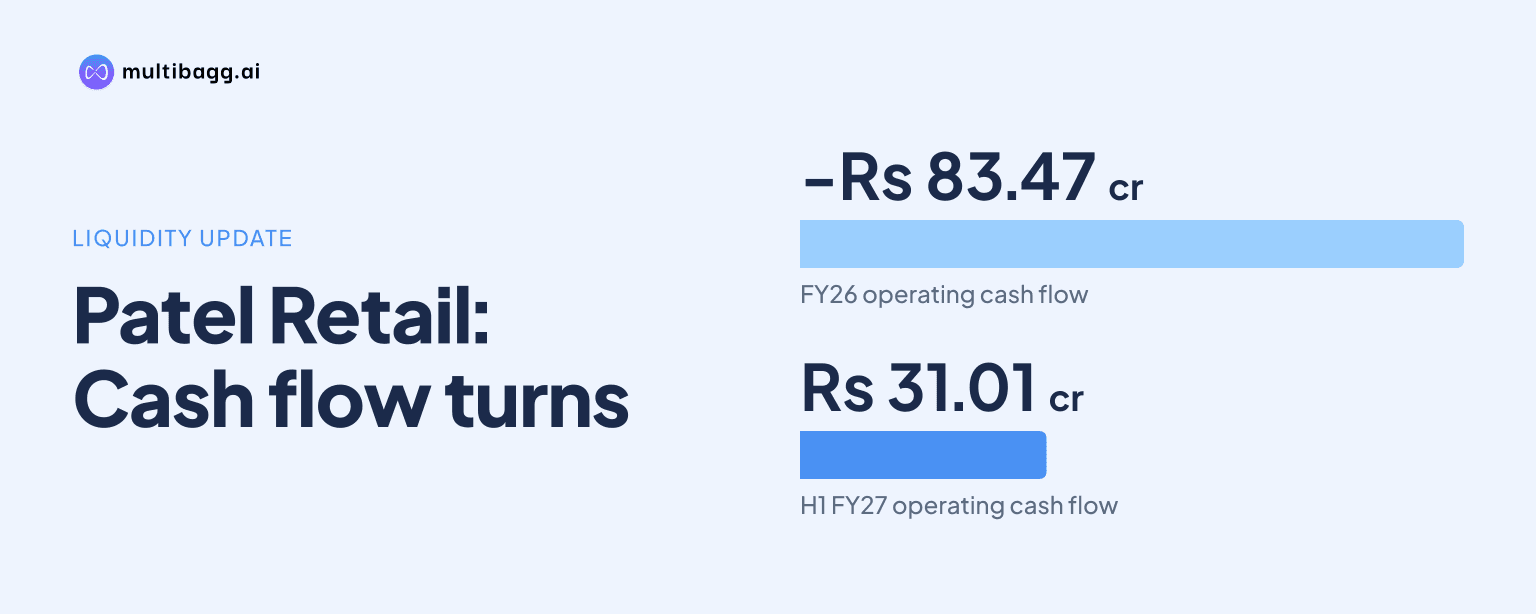
Patel Retail Limited generated Rs 31.01 crore of operating cash flow in H1 FY27, reversing the negative Rs 83.47 crore reported for FY26, after recovering more than Rs 29 crore from debtors and improving working-capital rotation. The reversal occurred even as inventory increased to Rs 282.19 crore at September 2026.
Know Patel Retail inside out
Results, valuation, peers and who's buying, in one view.
How did Patel Retail turn cash flow positive?
Patel Retail turned operating cash flow positive through debtor recoveries and faster working-capital rotation, according to management. Operating cash flow was Rs 31.01 crore in H1 FY27, compared with negative Rs 83.47 crore for full-year FY26. As the comparison is between six months and a full year, it shows a change in the reported cash-flow direction rather than a like-for-like period comparison.
Management said on the November 6, 2026 earnings call that it recovered more than Rs 29 crore from debtors during the six-month period. It also said more efficient working-capital rotation generated additional liquidity. The company did not provide a full reconciliation between profit, debtor movements, inventory movements and operating cash flow.
The cash-flow improvement came during a period of higher reported income. H1 FY27 total income rose 49.6% year on year to Rs 611.10 crore, while earnings before interest, tax, depreciation and amortisation, or EBITDA, increased 13.6% to Rs 40.20 crore. Profit after tax, or PAT, rose 13.9% to Rs 19.40 crore, but management specifically identified collections and working-capital rotation as the main cash-flow drivers.
What changed in Patel Retail's working capital?
Patel Retail improved liquidity despite holding more inventory at September 2026. Inventory increased by Rs 22.59 crore to Rs 282.19 crore from Rs 259.60 crore at FY26, meaning the cash-flow reversal was not driven by reducing stock on the balance sheet.
Management said its non-retail business requires inventory-intensive capital because it procures at particular times to meet scheduled deliveries. It said working capital is normally rotated more than four to five times a year. This model can require higher inventory while cash generation improves if receivables are collected and stock moves through the operating cycle more efficiently.
The more-than-Rs-29-crore debtor recovery exceeded the Rs 22.59 crore increase in inventory between the cited reporting dates. That comparison is not a complete cash-flow bridge, but it is consistent with management’s explanation that receivable collections and faster rotations offset the liquidity tied up in higher inventory.
Management said prudent working-capital management remains a priority alongside store expansion, manufacturing utilisation and wider private-label distribution. Indian Chaska had more than 350 distributors and reached more than 50,000 retailers as of H1 FY27, making inventory and receivables management relevant as distribution volumes increase.
Did Patel Retail reduce borrowings as cash flow improved?
Patel Retail reduced current borrowings by Rs 19.70 crore to Rs 89.30 crore at September 2026, from Rs 109.00 crore at March 2026. The company did not state how much of that decline was directly funded by operating cash flow, rather than by other financing, operating or balance-sheet movements.
The borrowing reduction coincided with four store additions at Rasayani, Bhiwandi, Uran and Kalyan East, taking the network to 54 stores. Patel Retail also added 20,000 square feet of covered space at its Ambernath distribution centre, increasing its area from 64,000 square feet to about 84,000 square feet.
Management said the enlarged Ambernath facility could accommodate around 10 to 15 additional stores in the existing cluster. It also said a typical 6,000 to 7,000 square foot store requires initial cash outflow of Rs 2 crore or more, including capital expenditure of about Rs 1,500 to Rs 1,600 per square foot and inventory of Rs 2,000 to Rs 2,100 per square foot.
Management described a new-store payback period of about 24 months. It said stores opened over the past two years, including more than 12 to 15 additions, were still in their maturity phase, which leaves cash deployment dependent on store ramp-up as well as collections and inventory rotations.
Got a follow-up? Ask IRIS
What do Patel Retail's earnings say about the reversal?
Patel Retail generated positive operating cash flow while its H1 FY27 EBITDA margin fell to 6.6% from 8.6% in H1 FY26. Management attributed the decline to a higher cost of goods sold as a percentage of revenue, which compressed gross margin, although absolute EBITDA increased to Rs 40.20 crore from Rs 35.40 crore.
In Q2 FY27, total income increased 33.5% year on year to Rs 300.90 crore and EBITDA rose 5.2% to Rs 20.50 crore. Quarterly PAT declined to Rs 9.90 crore from Rs 10.10 crore, while PAT margin declined to 3.3% from 4.5%. The H1 cash outcome therefore improved even as quarterly net profit moved lower.
Management said other operating expenses declined as a percentage of revenue and partly offset the increase in cost of goods sold. It cited procurement efficiency, higher private-label contribution and product-mix changes as its measures to support EBITDA, but did not quantify their individual effects on H1 FY27 operating cash flow.
Management said manufacturing capacity utilisation was about 55% to 60% and that it expects to lift utilisation to 80% to 85% in the coming period. This is a management target without a specified deadline, rather than a reported outcome, and it could affect how efficiently existing assets and inventory are used.
What will determine Patel Retail's future cash generation?
Patel Retail said future cash generation will depend on continued working-capital discipline while it expands stores, distribution and private labels. Management expects to add around eight to 10 stores a year and has finalised locations at Ghoti in Nashik district and Mangaon in the Raigad region after the close of H1 FY27.
Indian Chaska is part of the company’s plan to use existing capacity and rotate inventory more efficiently, according to management. The brand generated nearly Rs 7 crore in H1 FY27, according to an analyst’s question, and management said it was adding products after launching whole spices in October alongside its blended-spice range.
Private labels accounted for 17.6% of Q2 FY27 retail revenue, and management said it is targeting around 22% over time. Management also said its focus is to deepen Indian Chaska’s presence in its existing eight states and one union territory before expanding more widely, rather than disclosing a revenue target.
The planned stores and broader product range will require inventory deployment, while the September 2026 borrowing balance was Rs 89.30 crore. Future operating cash flow will therefore depend on whether Patel Retail maintains debtor collections and working-capital rotation while new outlets approach the stated 24-month payback period.
Conclusion
Patel Retail’s Rs 31.01 crore operating cash flow in H1 FY27 marked a reversal from the negative Rs 83.47 crore recorded in FY26. Management attributed the change chiefly to more than Rs 29 crore of debtor recoveries and faster working-capital rotation, while inventory rose by Rs 22.59 crore and margins declined year on year.
The next measures to watch are progress toward management’s 80% to 85% manufacturing-utilisation aim, the planned addition of eight to 10 stores annually, and the rollout of the Ghoti and Mangaon locations. The Ambernath centre’s stated capacity to support 10 to 15 more stores and the 24-month store payback period will indicate how expansion affects working-capital needs.