










Patel Retail FY26 debt reset met Rs 83.47 crore cash outflow
Key highlights
- Patel Retail reported FY26 debt-to-equity of 0.34 times, down from 1.34 times in FY25.
- FY26 working-capital changes used Rs 148.47 crore and resulted in negative operating cash flow of Rs 83.47 crore.
- Net IPO proceeds were Rs 190.34 crore in FY26, while net borrowings declined by Rs 59.96 crore.
- H1 FY27 operating cash flow was positive Rs 31.01 crore despite a Rs 1.24 crore working-capital outflow.
powered by IRIS
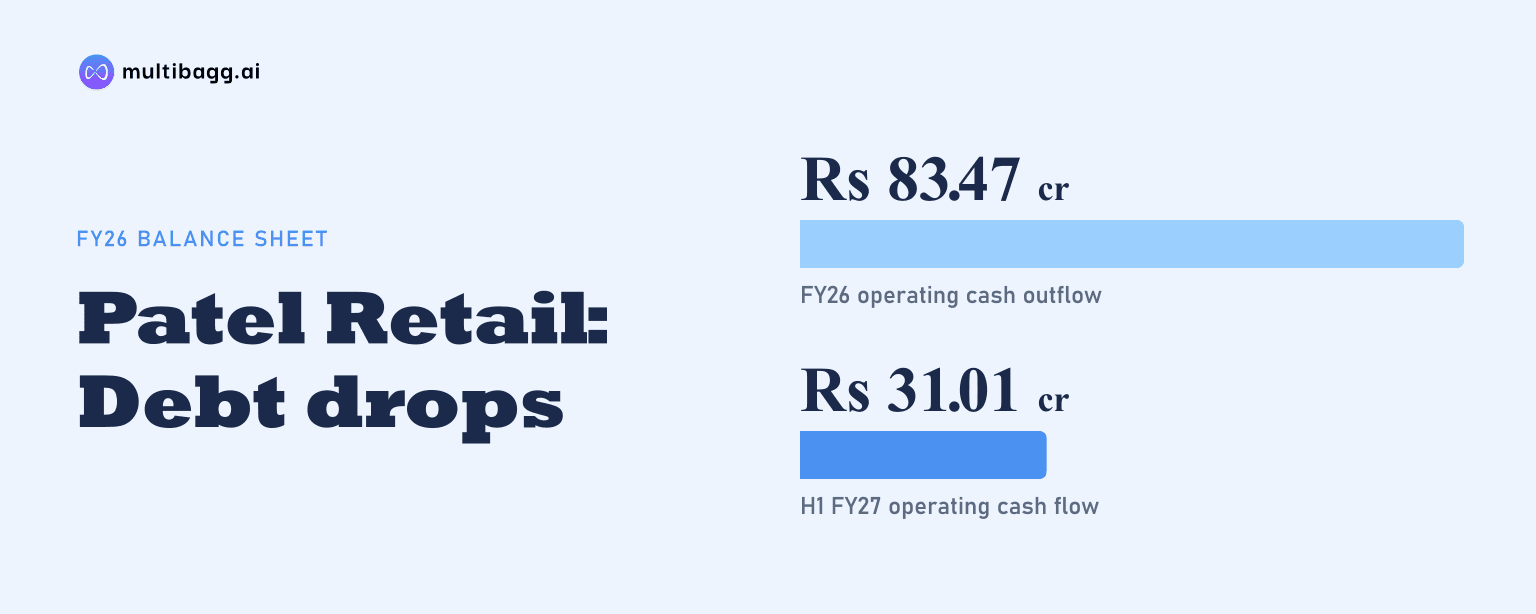
Patel Retail Limited reduced debt-to-equity to 0.34 times in financial year 2026 (FY26) following Rs 190.34 crore of net initial public offering (IPO) proceeds, but a Rs 148.47 crore working-capital cash use resulted in Rs 83.47 crore of net cash used in operations for the year.
Know Patel Retail inside out
Results, valuation, peers and who's buying, in one view.
How did Patel Retail’s capital structure change in FY26?
Patel Retail’s capital structure changed in FY26 as total equity rose to Rs 363.89 crore from Rs 134.57 crore in FY25 and debt-to-equity fell to 0.34 times from 1.34 times. The company recorded Rs 190.34 crore of net IPO proceeds in FY26 financing cash flow, and management says those proceeds were earmarked for debt reduction and working capital.
Borrowings declined while lease liabilities increased. Non-current borrowings fell to Rs 14.22 crore in FY26 from Rs 20.16 crore in FY25, and current borrowings declined to Rs 109.03 crore from Rs 160.38 crore. Combined reported borrowings therefore fell Rs 57.29 crore to Rs 123.25 crore, while non-current and current lease liabilities rose to Rs 29.56 crore and Rs 10.68 crore, respectively.
The reduction in reported borrowings continued in the first half of FY27. At 30 September 2026, Patel Retail reported total equity of Rs 383.19 crore, non-current borrowings of Rs 12.91 crore and current borrowings of Rs 89.35 crore. Combined reported borrowings were Rs 102.26 crore, down Rs 20.99 crore from FY26.
What caused Patel Retail’s FY26 operating cash outflow?
Patel Retail’s FY26 operating cash outflow principally reflected a Rs 148.47 crore working-capital cash use, which exceeded its Rs 80.79 crore pre-working-capital operating profit. After Rs 15.79 crore of taxes paid, net cash from operations was negative Rs 83.47 crore despite profit before tax of Rs 52.42 crore.
Operating cash flow had been positive at Rs 24.82 crore in FY24 and Rs 27.72 crore in FY25 before turning negative in FY26. Financing cash flow simultaneously shifted to an inflow of Rs 111.23 crore in FY26, compared with outflows of Rs 12.83 crore in FY24 and Rs 8.40 crore in FY25, because of the IPO proceeds.
Investing activities used Rs 25.78 crore in FY26, including Rs 17.35 crore of capital expenditure and Rs 8.43 crore for fixed deposits, interest and other items. Financing activities included Rs 190.34 crore of net IPO proceeds, offset partly by Rs 59.96 crore of net borrowing reduction and Rs 19.15 crore of lease and interest payments.
How did working capital move by H1 FY27?
Patel Retail’s working-capital movement was a Rs 1.24 crore cash outflow in H1 FY27, far below the Rs 148.47 crore outflow for FY26. Pre-working-capital operating profit was Rs 38.59 crore for the six months to 30 September 2026, taxes paid were Rs 6.34 crore, and net cash from operations was positive Rs 31.01 crore.
Inventory increased Rs 22.59 crore from Rs 259.60 crore at FY26 to Rs 282.19 crore at H1 FY27. Trade receivables moved in the opposite direction, declining Rs 28.74 crore to Rs 133.21 crore, while trade payables fell Rs 4.85 crore to Rs 83.93 crore. Total current assets declined to Rs 459.29 crore from Rs 475.13 crore and current liabilities decreased to Rs 188.78 crore from Rs 211.58 crore.
Cash flow after operations still reflected debt reduction and capital expenditure. Patel Retail spent Rs 11.73 crore on capital expenditure in H1 FY27, while investing cash flow was negative Rs 0.28 crore after Rs 11.45 crore from fixed deposits, interest and other items. Financing cash flow was negative Rs 31.62 crore, including Rs 21.02 crore of net borrowing reduction and Rs 10.40 crore of lease and interest payments.
Got a follow-up? Ask IRIS
How did Patel Retail’s earnings and cash conversion differ?
Patel Retail’s FY26 profit increased while operating cash flow reversed: profit after tax rose to Rs 39.05 crore from Rs 25.28 crore in FY25, while operating cash flow moved from an inflow of Rs 27.72 crore to an outflow of Rs 83.47 crore. Total income increased Rs 233.30 crore to Rs 1,059.29 crore.
Earnings before interest, tax, depreciation and amortisation (EBITDA) increased to Rs 83.08 crore in FY26 from Rs 62.43 crore in FY25, while EBITDA margin rose to 7.84% from 7.56%. Profit-after-tax margin increased to 3.69% from 3.06%, and finance costs declined to Rs 12.30 crore from Rs 16.38 crore. Interest coverage was 5.26 times in FY26, compared with 3.10 times in FY25.
H1 FY27 showed income growth with lower margins than a year earlier. Total income rose 49.6% year on year to Rs 611.19 crore and EBITDA increased 13.6% to Rs 40.24 crore, but EBITDA margin declined by 209 basis points to 6.58%. Profit after tax increased 13.9% to Rs 19.43 crore, while its margin declined by 100 basis points to 3.18%.
What do Patel Retail’s liquidity indicators show?
Patel Retail reported a current ratio of 2.25 times in FY26, up from 1.31 times in FY25 and 1.16 times in FY24. The ratio accompanied current assets of Rs 475.13 crore and current liabilities of Rs 211.58 crore at FY26, compared with Rs 296.02 crore and Rs 226.21 crore, respectively, a year earlier.
Receivable turnover declined to 6.47 times in FY26 from 6.58 times in FY25 and 8.43 times in FY24. Trade receivables increased to Rs 161.95 crore in FY26 from Rs 124.64 crore in FY25, while inventories increased to Rs 259.60 crore from Rs 143.72 crore.
The presentation reports two FY26 cash measures that are not reconciled. The balance sheet lists cash and bank balance of Rs 24.06 crore at FY26, while the cash-flow statement lists closing cash of Rs 4.73 crore. It similarly reports Rs 12.15 crore of cash and bank balance at H1 FY27 and Rs 3.84 crore of closing cash, without explaining the differences.
Conclusion
Patel Retail’s FY26 figures show a balance-sheet reset alongside a cash-flow strain. Net IPO proceeds increased total equity, reduced reported borrowings and lowered debt-to-equity to 0.34 times, but working-capital changes outweighed pre-working-capital operating profit and produced an Rs 83.47 crore operating cash outflow.
The next disclosed indicator is whether the Rs 31.01 crore H1 FY27 operating cash inflow can continue while inventory, at Rs 282.19 crore, is managed and reported borrowings decline further. Management identifies debt reduction and working capital as IPO-proceeds uses, while the difference between balance-sheet cash and cash-flow closing cash remains unresolved in the presentation.