










Patel Retail H1 income rose 50% but EBITDA margin fell 209 bp
Key highlights
- Patel Retail H1 FY27 total income increased 49.6% year on year to Rs 611.19 crore.
- Patel Retail H1 FY27 EBITDA margin fell 209 basis points to 6.58% from 8.67%.
- Patel Retail H1 FY27 PAT rose 13.9% to Rs 19.43 crore, while PAT margin declined to 3.18%.
- Patel Retail had 54 stores after additions in July and September 2026 and targets more than 75 stores.
powered by IRIS
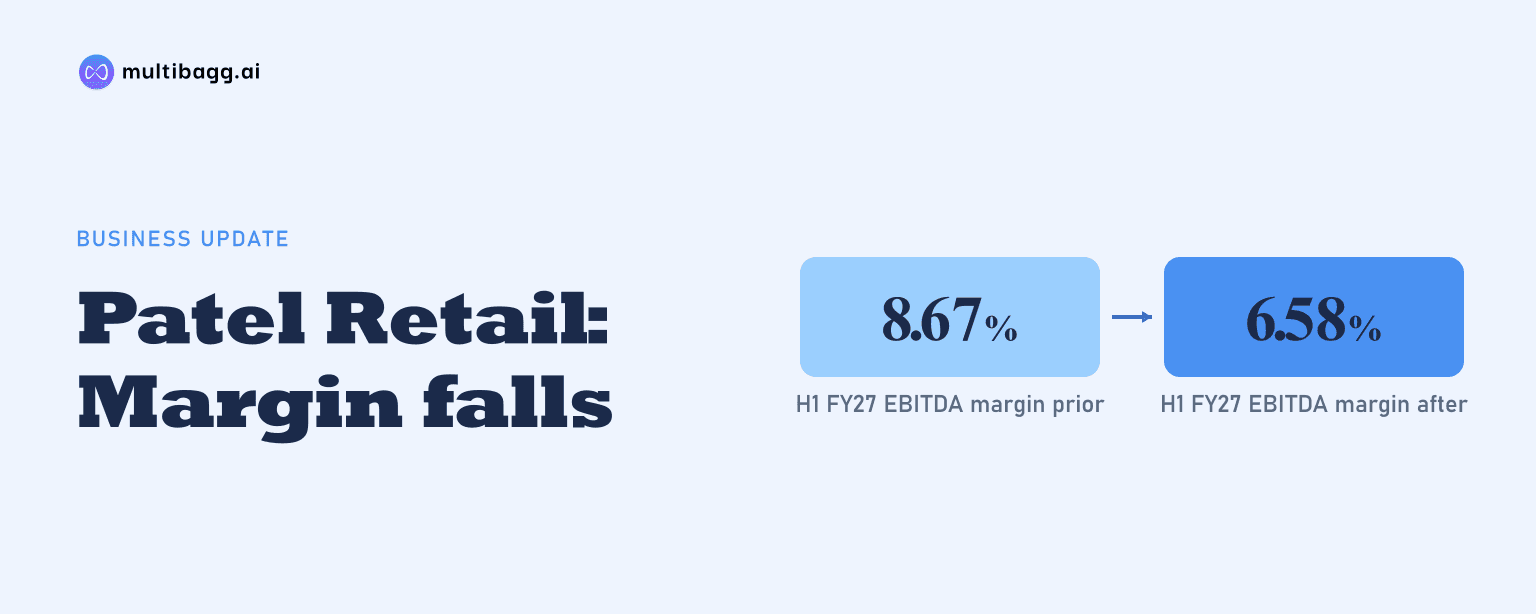
Patel Retail Limited reported H1 FY27 total income of Rs 611.19 crore, up 49.6% year on year, but EBITDA margin fell 209 basis points to 6.58%, as EBITDA rose 13.6% to Rs 40.24 crore and profit after tax increased 13.9% to Rs 19.43 crore.
Know Patel Retail inside out
Results, valuation, peers and who's buying, in one view.
What were Patel Retail's H1 FY27 earnings?
Patel Retail's H1 FY27 income growth outpaced its operating and net-profit growth. Total income rose to Rs 611.19 crore from Rs 408.63 crore in H1 FY26, while earnings before interest, tax, depreciation and amortisation, or EBITDA, increased to Rs 40.24 crore from Rs 35.43 crore. Profit after tax, or PAT, rose to Rs 19.43 crore from Rs 17.06 crore.
The difference is reflected in the margin movement. Total income increased by Rs 202.56 crore, whereas EBITDA increased by Rs 4.81 crore. A basis point is one-hundredth of a percentage point, making the 209-basis-point change a decline from 8.67% in H1 FY26 to 6.58% in H1 FY27. PAT margin similarly declined by 100 basis points to 3.18%.
Why did Patel Retail's H1 FY27 EBITDA margin decline?
Patel Retail's presentation shows total expenditure rose nearly as much as total income, but does not identify a single cause for the margin decline. Total expenditure increased to Rs 570.95 crore in H1 FY27 from Rs 373.19 crore in H1 FY26, an increase of Rs 197.76 crore against the Rs 202.56 crore increase in total income.
Raw-material expenses, the largest cost line, increased to Rs 507.51 crore from Rs 322.02 crore. Employee costs rose to Rs 23.47 crore from Rs 17.50 crore, while other expenses rose to Rs 39.96 crore from Rs 33.67 crore. These movements left EBITDA growth at 13.6%, compared with 49.6% growth in total income.
Below EBITDA, finance costs fell to Rs 4.99 crore from Rs 6.72 crore, while depreciation increased to Rs 9.22 crore from Rs 5.92 crore. Profit before tax rose to Rs 26.03 crore from Rs 22.79 crore, tax increased to Rs 6.60 crore from Rs 5.73 crore, and PAT reached Rs 19.43 crore.
How did Patel Retail's Q2 FY27 result compare with H1?
Patel Retail's Q2 FY27 had a lower year-on-year PAT despite income growth, whereas H1 PAT increased. Q2 total income rose 33.5% to Rs 300.95 crore from Rs 225.43 crore, EBITDA increased 5.2% to Rs 20.56 crore, and PAT fell 2.3% to Rs 9.91 crore from Rs 10.14 crore.
Q2 EBITDA margin declined by 184 basis points to 6.83% from 8.67%, while PAT margin fell by 120 basis points to 3.29% from 4.50%. In comparison, the H1 EBITDA margin declined 209 basis points to 6.58%, and the H1 PAT margin declined 100 basis points to 3.18%.
Q2 revenue excluding other income rose to Rs 298.60 crore from Rs 222.44 crore, while other income declined to Rs 2.35 crore from Rs 2.99 crore. Raw-material expenses increased to Rs 248.31 crore from Rs 178.58 crore, and depreciation rose to Rs 4.85 crore from Rs 3.14 crore, while finance costs fell to Rs 2.50 crore from Rs 2.89 crore.
Got a follow-up? Ask IRIS
What changed in Patel Retail's balance sheet and cash flow?
Patel Retail's total assets declined to Rs 611.54 crore at September 30, 2026, from Rs 620.10 crore at March 31, 2026, while total equity increased to Rs 383.19 crore from Rs 363.89 crore. Reserves and surplus rose to Rs 349.79 crore from Rs 330.49 crore, and equity remained Rs 33.40 crore.
Borrowings were lower at the H1 close. Current borrowings declined to Rs 89.35 crore from Rs 109.03 crore, and non-current borrowings declined to Rs 12.91 crore from Rs 14.22 crore. Inventories increased to Rs 282.19 crore from Rs 259.60 crore, while trade receivables declined to Rs 133.21 crore from Rs 161.95 crore.
The cash-flow statement reported Rs 31.01 crore of net cash from operations for the six months to September 30, 2026, compared with negative Rs 83.47 crore for FY26. H1 FY27 capital expenditure was Rs 11.73 crore, net borrowings were negative Rs 21.02 crore, and closing cash in the cash-flow statement was Rs 3.84 crore, compared with Rs 4.73 crore at FY26.
What is Patel Retail planning after H1 FY27?
Patel Retail is targeting more than 75 stores, private-label contribution above 22% in the medium term, and 80% to 85% utilisation at its Ambernath and Kutch facilities. Management said it plans to expand beyond Thane, Raigad and Palghar into western suburbs and other Maharashtra cities, while exploring central and western India.
The network reached 54 stores after additions in July and September 2026. During Q2, Patel Retail opened its 51st store in Rasayani, Raigad, and 52nd store in Bapgaon, Bhiwandi; management also said locations at Ghoti in Nashik and Mangaon/Mahad in Raigad had been finalised.
Management plans to increase private-label contribution from 17.50% of retail revenue in FY26 and scale Patel Fresh, Indian Chaska and Patel Essential. It also plans to use its existing app infrastructure for quick commerce, expand processing capacity for pulses, spices and mango pulp, pursue exports across 35-plus countries, and focus on working-capital efficiency and debt reduction.
Conclusion
Patel Retail's H1 FY27 figures show that income expansion did not translate proportionately into operating profitability. Total income increased 49.6% to Rs 611.19 crore, but EBITDA rose 13.6% to Rs 40.24 crore and the EBITDA margin declined to 6.58%; PAT rose 13.9% to Rs 19.43 crore while its margin fell to 3.18%.
The next disclosed measures to watch are progress toward more than 75 stores, private-label contribution above 22% in the medium term, and 80% to 85% utilisation at the Ambernath and Kutch facilities. Management's stated focus on automation, working capital and debt reduction is also relevant after current borrowings declined to Rs 89.35 crore at September 30, 2026.