










Patel Retail Plans Margin Recovery Without Price Increases
Key highlights
- Patel Retail's H1 FY27 EBITDA margin declined to 6.58% from 8.67% in H1 FY26.
- Patel Retail reported H1 FY27 EBITDA of Rs 40.24 crore, up 13.62% on approximately 50% revenue growth.
- Patel Retail aims to raise processing utilisation from 55% toward 80%-85%.
- Patel Retail targets private-label mix of around 22%, from 17.6% of Q2 FY27 retail revenue.
powered by IRIS
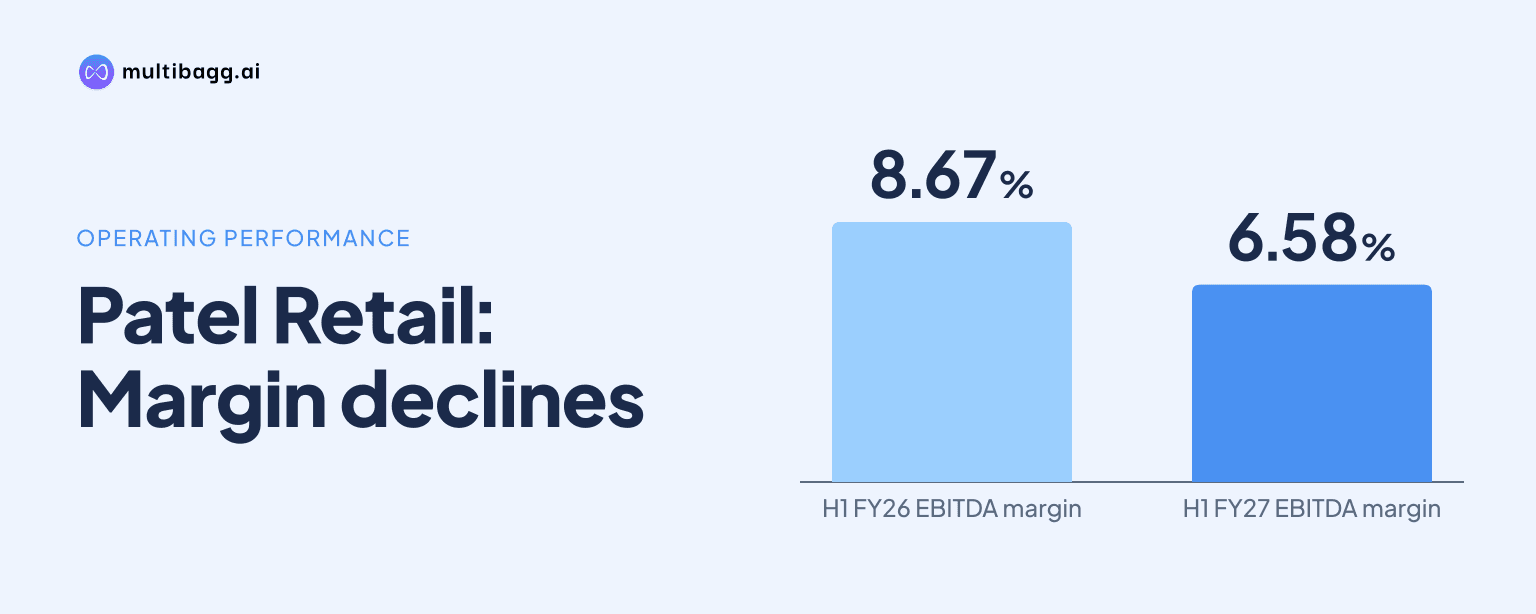
Patel Retail Limited said it is not planning selling-price increases to restore margins after H1 FY27 EBITDA margin fell to 6.58% from 8.67% a year earlier. Management instead cited procurement efficiency, private-label mix, operating leverage and lifting processing utilisation from about 55% toward 80%-85% as its recovery levers.
Know Patel Retail inside out
Results, valuation, peers and who's buying, in one view.
Why did Patel Retail's EBITDA margin decline in H1 FY27?
Patel Retail said its H1 FY27 EBITDA margin declined because cost of goods sold rose as a percentage of revenue and compressed gross margin. EBITDA margin was 6.58% in H1 FY27, compared with 8.67% in H1 FY26, a decline of 2.09 percentage points.
The margin decline came despite higher profit in absolute terms. H1 FY27 EBITDA increased 13.62% to Rs 40.24 crore, supported by revenue growth of approximately 50%, according to management. This means revenue growth did not prevent the higher cost of goods sold from reducing the proportion of sales converted into EBITDA.
Management said other expenses declined in the same proportion as the increase in cost of goods sold, partly offsetting the gross-margin pressure. It said procurement teams monitor market rates, buy inventory at seasonal points and use forward contracts and derivatives when required, although it did not specify the quantity hedged or a fixed procurement-cost threshold.
The revenue mix also differed between business lines in H1 FY27. Manufacturing and processing contributed 63% of revenue, while retail contributed 37%; management placed non-retail operating margin at about 7.5%-8% and retail operating margin at about 6.5%-7%, a gap of roughly 100 basis points.
Will Patel Retail raise prices to restore margins?
Patel Retail said it is not looking to increase selling prices as its primary response to higher procurement costs. Management said it intends to maintain operating ratios through better procurement, product mix and operating leverage, while acknowledging that market conditions and competition influence pricing decisions.
The company said it had inventory of about Rs 282 crore and above, which it described as sufficient to meet demand for the coming 12 months. Management said seasonal procurement is particularly important for spices because buying quality raw material during the season helps maintain consistency in finished goods through much of the year.
Patel Retail confirmed that it hedges commodities but did not disclose a percentage of exposure, a volume or a pass-through formula for higher input costs. Management said a dedicated team assesses ground-market prices, market conditions and geopolitical developments before deciding when and how much exposure to hedge.
Management also said Q3 and Q4 should show better margin growth than Q1 and Q2, without giving a numerical EBITDA-margin target. It linked that expectation to seasonality in retail, stating that the period before Diwali was non-seasonal and that the third quarter should be more favourable.
How can processing utilisation improve Patel Retail's margins?
Patel Retail said increasing processing utilisation from about 55% toward 80%-85% can improve margins from its existing asset base. Management said the company has installed processing capacity of more than 1,50,000 metric tonnes annually and expects greater utilisation to lift EBITDA margin by 100 basis points or more over time.
The stated mechanism is operating leverage, with higher production spreading facility costs across a larger volume of output. Patel Retail also plans to use in-house capacity more efficiently and rotate inventory faster in its non-retail business, where management said working capital normally turns more than four to five times a year.
Indian Chaska is one route for using that capacity. The private-label brand generated almost Rs 7 crore in H1 FY27 and had distribution through more than 350 distributors and 50,000 retailers across eight states and one union territory.
Management said its immediate Indian Chaska strategy is to deepen sales in existing markets rather than expand geographically first. The brand, previously focused on blended spices, has introduced whole spices and is expected to add further stock-keeping units, or SKUs, although management did not disclose a revenue target.
Got a follow-up? Ask IRIS
How much can private labels contribute to Patel Retail's recovery?
Patel Retail aims to increase private-label products from 17.6% of Q2 FY27 retail revenue to around 22% over time. Management said a larger private-label mix would increase overall business margin, but it did not provide a target date for reaching the 22% level.
The portfolio includes Indian Chaska spices and Patel Fresh pulses, alongside recently introduced household-category brands. Management said customer reviews and references indicated that the household products were being picked from shelves, though it provided no sales figure for those newer labels.
The private-label plan is proceeding alongside physical retail expansion. Patel Retail had 54 stores in its existing cluster, and management said its 84,000-square-foot Ambernath distribution centre could support about 10 to 15 additional stores without a newly announced distribution-centre investment.
New stores have a separate payback profile. Management said a typical 6,000-7,000-square-foot retail outlet requires initial cash outflow of about Rs 2 crore or more, including capex of Rs 1,500-Rs 1,600 per square foot and inventory of Rs 2,000-Rs 2,100 per square foot, with a 24-month payback period.
What metrics did management say investors should track?
Patel Retail said management considers cash flow, profit after tax margin, EBITDA growth and revenue growth relevant measures of execution. Operating cash flow was positive at Rs 31.01 crore in H1 FY27, compared with negative Rs 83.47 crore in FY26, chiefly because more than Rs 29 crore was recovered from debtors and working capital was rotated more efficiently.
Store maturity is another disclosed execution measure because management said more than 12 to 15 stores added over the past two years had yet to mature. It expects these stores to reach maturity in the coming six months, while reporting same-store sales growth of about 7%-8%, average per-store revenue of Rs 12 crore-Rs 15 crore and store operating margin of about 7%.
Management said its cluster-based expansion strategy starts with underserved locations around its current network. It identified potential opportunities on the Western Line around Virar, Vasai and Bhayander, additional locations near Nashik and Ghoti after opening its first Nashik store, and areas around Pimpri-Chinchwad Municipal Corporation, or PCMC.
Conclusion
Patel Retail's margin-recovery plan relies on operational actions rather than a stated price increase. The company is seeking procurement gains and selective hedging to manage input costs, a private-label mix of around 22%, and higher processing utilisation from the current 55% level, while H1 FY27 EBITDA margin remained at 6.58% despite approximately 50% revenue growth.
The next disclosed milestones are management's expectation of improved retail margins in Q3 and Q4, maturity of more than 12 to 15 recently opened stores in the coming six months, and use of the Ambernath distribution centre for 10 to 15 more stores. Progress toward 80%-85% processing utilisation and the indicated 100-basis-point-or-more EBITDA-margin improvement remains dependent on execution of those plans.