










Patel Retail processing delivers 63% of H1 FY27 revenue mix
Key highlights
- Patel Retail generated Rs 376.29 crore from manufacturing and processing in H1 FY27, equal to 63% of revenue.
- Patel Retail operates more than 150,000 MTPA of installed capacity across three Maharashtra and Gujarat facilities.
- Domestic processing sales were Rs 198.49 crore and export sales were Rs 177.80 crore in H1 FY27.
- Patel Retail's Indian Chaska brand had more than 57 SKUs and more than Rs 7 crore of H1 FY27 sales.
powered by IRIS
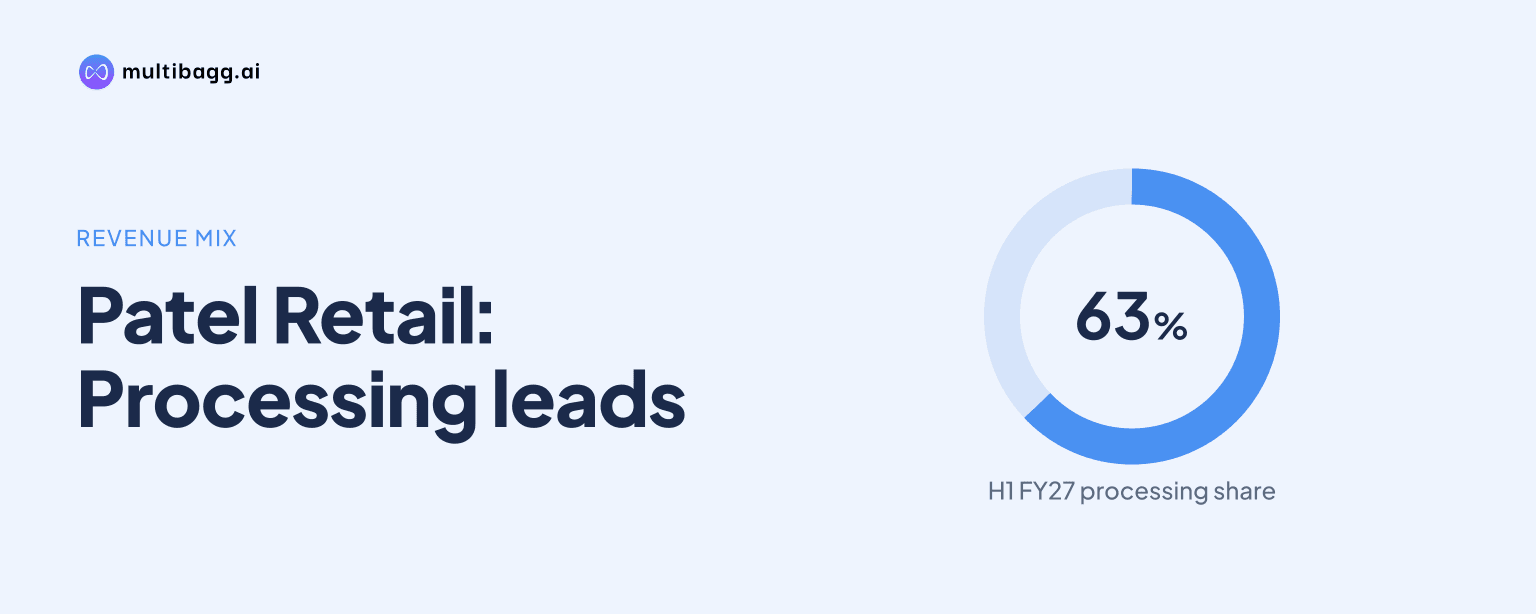
Patel Retail Limited generated Rs 376.29 crore from manufacturing and processing in H1 FY27, representing 63% of revenue, with more than 150,000 metric tonnes per annum (MTPA) of installed capacity across three facilities in Maharashtra and Gujarat. The network serves domestic distribution, private-label production and exports.
Know Patel Retail inside out
Results, valuation, peers and who's buying, in one view.
How large is Patel Retail's processing business?
Patel Retail's manufacturing and processing business contributed Rs 376.29 crore in H1 FY27, or 63% of company revenue. The presentation describes the platform as two processing units and one agri-processing cluster, with functions spanning retail supply, private labels and export operations.
The segment's revenue changed across the reported full financial years. It was Rs 531.72 crore in FY24, fell to Rs 444.34 crore in FY25, and rose to Rs 619.22 crore in FY26. The presentation identifies the FY26 contribution as 59% of company revenue, compared with 63% in H1 FY27, an increase of 4 percentage points in the reported revenue contribution.
H1 FY27 covers six months, whereas FY24 through FY26 are full-year periods, so the presentation does not provide a like-for-like annual comparison for FY27. It also does not disclose a full-year FY27 processing-revenue target or capacity-utilisation level for the more than 150,000 MTPA network.
Where is Patel Retail's processing capacity located?
Patel Retail operates more than 150,000 MTPA of installed capacity across Ambernath in Maharashtra and two sites in Kutch, Gujarat. Ambernath has 14,400 MTPA capacity, while the two Kutch facilities have 43,200 MTPA and 93,000 MTPA, respectively.
The Ambernath facility occupies 7,678 square feet and carries out cleaning, grading, sorting, packaging, deshelling and roasting. Patel Retail says the site is within 60 kilometres of major stores, providing a stated supply-chain link between processing and its retail operations.
The 43,200 MTPA Kutch facility occupies 7,461 square metres and uses automated shelling, roasting and packaging lines for peanuts and whole spices. Patel Retail says its proximity to Kandla and Mundra ports supports export efficiency, while the 93,000 MTPA Kutch cluster serves domestic distribution and exports to more than 35 countries.
The larger Kutch cluster spans 15.9 acres and includes 3,040 metric tonnes of dry warehousing and 3,000 metric tonnes of cold storage. Its 93,000 MTPA capacity is the largest among the three sites, exceeding the combined 57,600 MTPA capacity of Ambernath and the other Kutch facility.
Got a follow-up? Ask IRIS
What was Patel Retail's domestic and export revenue mix?
Patel Retail generated Rs 198.49 crore of domestic manufacturing and processing revenue and Rs 177.80 crore of export revenue in H1 FY27. Domestic sales represented 53% of the Rs 376.29 crore segment total, while exports accounted for 47%, leaving domestic revenue Rs 20.69 crore higher.
The sales mix differed in Q2 FY27. Export revenue was Rs 89.34 crore, or 52% of manufacturing and processing sales, compared with domestic revenue of Rs 82.15 crore, or 48%. Exports were therefore 5 percentage points higher in Q2 FY27 than in the H1 FY27 mix, while domestic sales were 5 percentage points lower.
Within domestic manufacturing and processing sales, Patel Retail's own private labels generated Rs 86.08 crore in H1 FY27, or 43% of domestic revenue. Third-party brands contributed Rs 112.42 crore, or 57%, showing that third-party brands produced the larger share of reported domestic processing sales.
How do private labels and packaged brands use the facilities?
Patel Retail reported own-private-label domestic processing revenue of Rs 86.08 crore in H1 FY27, compared with Rs 33.68 crore in Q2 FY27. The own-label share was 43% in H1 FY27 and 41% in Q2 FY27, while third-party brands accounted for 57% and 59%, respectively, of domestic sales in those periods.
The facilities process categories beyond basic grocery distribution. Ambernath handles pulses, spices and groceries; the smaller Kutch facility focuses on peanuts and whole spices; and the larger Kutch cluster processes spices, flour, peanuts, sesame and mango pulp. These categories form the disclosed production base for retail supply, private labels, third-party brands and exports.
Patel Retail also identifies Indian Chaska as a packaged-food brand supported by in-house manufacturing. Indian Chaska had more than 57 stock-keeping units (SKUs) across staples, spices, flours and processed foods, and recorded sales of more than Rs 7 crore in H1 FY27. Its distribution footprint included more than 350 distributors, more than 50,000 retailers and eight states.
Indian Chaska's product range and trade network expanded between FY26 and Q2 FY27. SKUs increased from more than 27 to more than 57, distributors from more than 145 to more than 350, and retailers from more than 27,865 to more than 50,000. Management identifies wider product range, trade-led reach and entry into seasonings as growth levers, but the presentation does not state Indian Chaska's share of the Rs 376.29 crore processing revenue.
Conclusion
The disclosed figures show that Patel Retail's business model combines a 150,000-plus MTPA processing network with domestic, export, private-label and third-party sales channels. In H1 FY27, domestic manufacturing and processing revenue accounted for 53% of segment sales and exports 47%, while the 93,000 MTPA Kutch cluster provided the largest part of installed capacity.
The next reported periods will indicate whether the Q2 FY27 export-led mix, in which exports represented 52% of processing sales, persists. Management's disclosed plan includes expanding Indian Chaska's range and entering seasonings, while the presentation leaves unresolved the network's utilisation, any additional-facility timetable and a full-year FY27 processing-revenue target.