










Patel Retail targets 8-10 stores annually after hub expansion
Key highlights
- Patel Retail operates 54 stores and is working toward eight to 10 store additions each year.
- Patel Retail expanded its Ambernath distribution centre by 20,000 square feet to approximately 84,000 square feet.
- Q2 FY27 total income rose 33.5% to Rs 300.9 crore, while EBITDA margin declined to 6.8% from 8.6%.
- H1 FY27 operating cash flow was positive Rs 31 crore, compared with negative Rs 83.4 crore for full FY26.
powered by IRIS
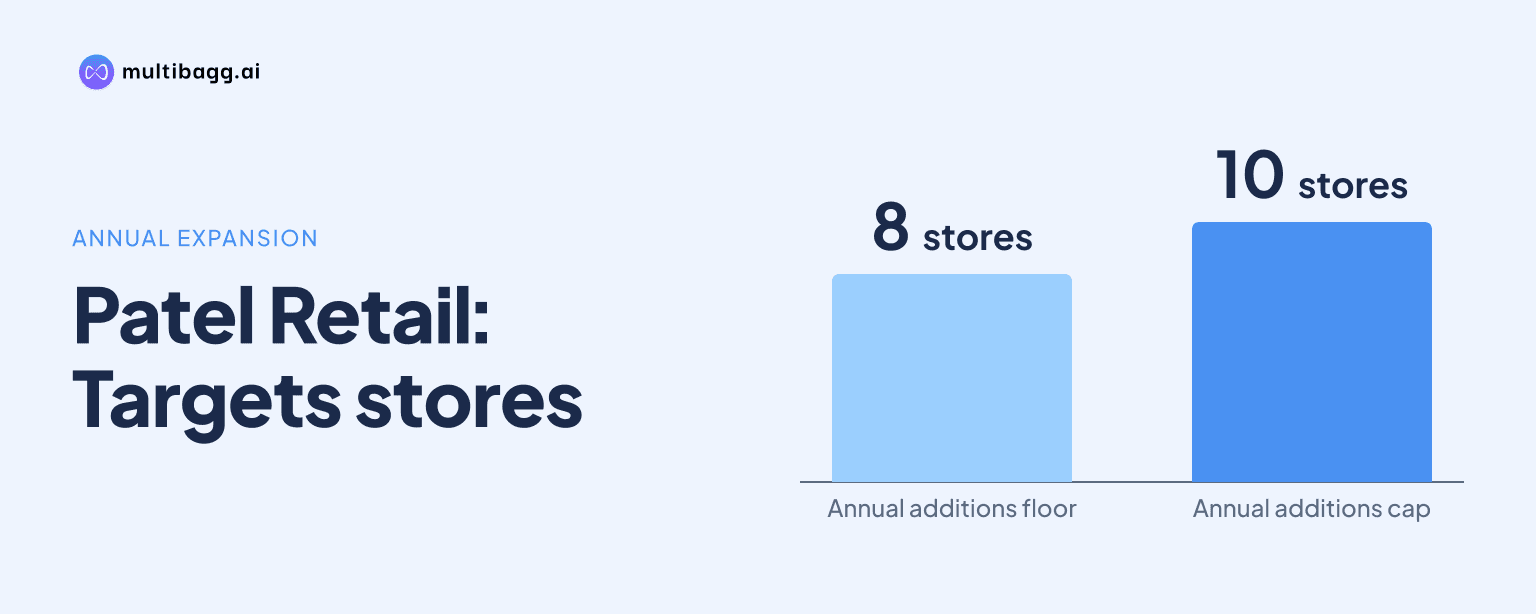
Patel Retail Limited said it is working to add around eight to 10 stores a year from its 54-store network, supported by a 20,000-square-foot expansion of its Ambernath distribution centre to about 84,000 square feet. Management disclosed the expansion pace during its November 6, 2026, Q2 and H1 FY27 earnings call.
Know Patel Retail inside out
Results, valuation, peers and who's buying, in one view.
How fast will Patel Retail add new stores?
Patel Retail is working toward adding around eight to 10 stores each year, management said when asked about the route from its 54-store network to 75-plus outlets. Management said location selection governs the pace because it opens stores only where it is confident of performance, and it said it has not closed a store after opening one.
The annual target follows four store additions at Rasayani, Bhiwandi, Uran and Kalyan East reported in H1 FY27. These stores extended coverage across the Mumbai metropolitan region and surrounding markets, particularly in emerging residential and semi-urban areas. Management said it was finalising or discussing multiple further sites in nearby clusters, but gave no date for reaching 75 stores.
Where will Patel Retail open its next stores?
Patel Retail has finalised locations at Ghoti in Nashik district and Mangaon in the Mahad region of Raigad district. The proposed Ghoti store would mark Patel Retail's entry into Nashik and take its retail presence to four districts in Maharashtra, while Mangaon would add to its existing presence in Raigad.
The planned locations extend a network that began with one grocery store in 1990 and now has 54 stores under the Patel's R Mart brand. The four additions reported in FY27 were concentrated around the Mumbai market, whereas Ghoti would enter a new district. Management also said it was identifying locations in Navi Mumbai, without disclosing a site or opening date on the November 6 call.
How much extra capacity does Patel Retail's Ambernath hub provide?
Patel Retail expanded its Ambernath distribution centre from 64,000 square feet to approximately 84,000 square feet by adding 20,000 square feet of covered space. Management said the facility had been operating at full utilisation and that the addition is intended to improve warehouse capacity, inventory management, product availability and supply-chain efficiency as the retail network expands.
Management did not quantify how many additional stores the enlarged 84,000-square-foot facility could support. The disclosed evidence is the 20,000-square-foot addition and the centre's previous full utilisation, rather than a stated capacity for 10 to 15 further outlets. The logistics investment accompanies the expansion of private-label products including Indian Chaska, Patel Fresh, Tidymax and Blixo.
Got a follow-up? Ask IRIS
Is Patel Retail's retail growth translating into higher earnings?
Patel Retail reported Q2 FY27 total income of Rs 300.9 crore, up 33.5% year on year from Rs 225.4 crore, while earnings before interest, tax, depreciation and amortisation, or EBITDA, rose 5.2% to Rs 20.5 crore. Profit after tax declined to Rs 9.9 crore from Rs 10.1 crore, and EBITDA margin fell to 6.8% from 8.6%.
Management said cost of goods sold had increased proportionately from the prior period, while other operating expenses declined as a share of revenue and partly offset the effect. In H1 FY27, total income rose 49.6% to Rs 611.1 crore, EBITDA increased 13.6% to Rs 40.2 crore and profit after tax grew 13.9% to Rs 19.4 crore from Rs 17 crore in H1 FY26. However, H1 EBITDA margin declined to 6.6% from 8.6%, and profit-after-tax margin fell to 3.2% from 4.1%.
What store economics and operating levers did Patel Retail disclose?
Patel Retail said a new store requires an initial outlay of roughly Rs 1.75 crore to Rs 2 crore, based on capital expenditure of about Rs 1,500 per square foot and inventory of about Rs 2,000 per square foot. Management estimated a recovery period of around 24 months, with initial gross margin in a 16% to 17% range that rises to 20% and above later in a store's development.
At the retail-business level, management cited utility costs of about 2% of revenue, staff costs of 3.5% to 4%, and other expenses of 4.5% to 5%, resulting in EBITDA of 7% and above. It also said manufacturing capacity utilisation was 55% to 60%, and that growing Indian Chaska could raise utilisation. Indian Chaska had more than 350 distributors serving over 50,000 retailers after its August expansion into Madhya Pradesh took distribution to eight states and one union territory.
Conclusion
Patel Retail's expansion plan combines a selective target of eight to 10 annual store additions with additional logistics space at Ambernath and broader distribution of private-label goods. The company has 54 stores, four additions reported in H1 FY27 and two finalised sites at Ghoti and Mangaon, while Q2 income growth of 33.5% outpaced EBITDA growth of 5.2%.
The next disclosures to watch are opening timelines for Ghoti and Mangaon and any identified Navi Mumbai location. Management also plans to increase manufacturing utilisation from 55% to 60%, improve operating efficiency and extend Indian Chaska's distribution network, which exceeded 350 distributors in H1 FY27.