










Redington Arena posts Rs 115 crore quarterly loss in Q2 FY27
Key highlights
- Redington reported a Rs 115 crore share of loss from Arena in Q2 FY27.
- Arena’s Q2 FY27 loss included a Rs 40 crore exceptional impairment of intangible assets.
- Arena revenue fell 37% year on year after the VDF-contract exit and lira-business transition.
- Arena recorded about Rs 135 crore of receivables provisioning in Q2 FY27.
powered by IRIS
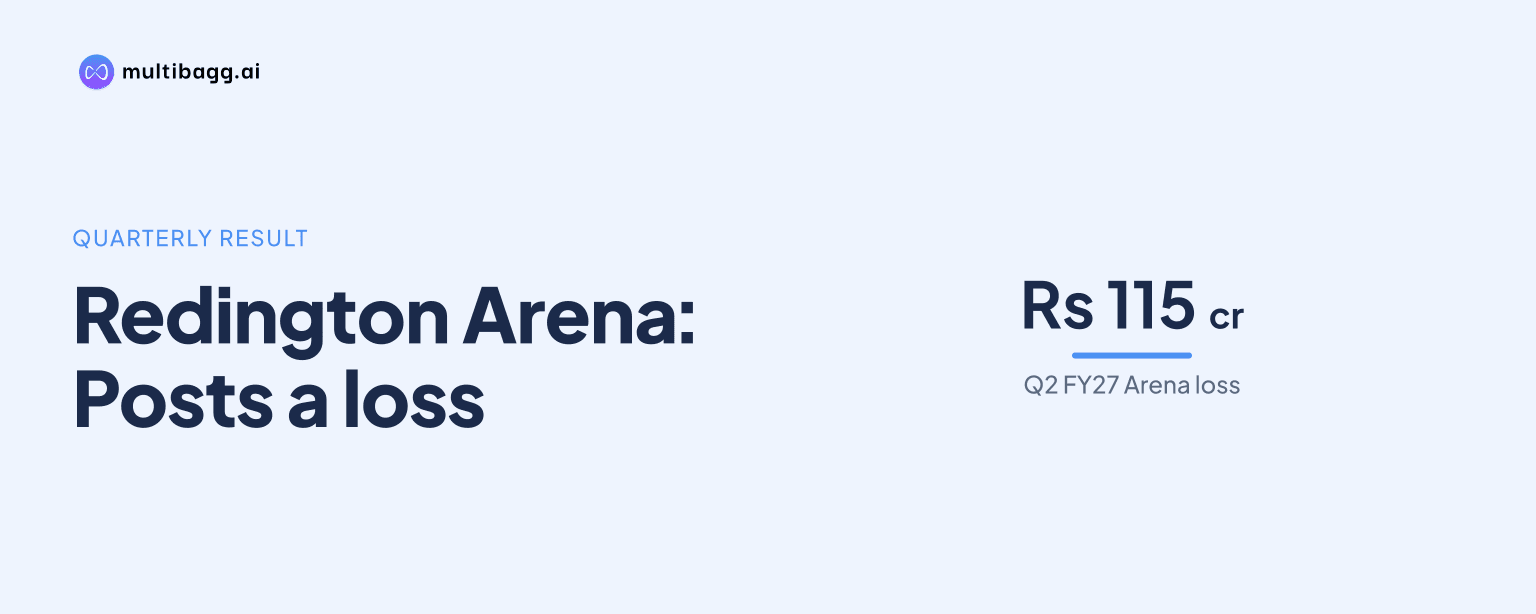
Redington Limited reported a Rs 115 crore share of loss from Arena in Q2 FY27, comprising business losses, Turkish-lira business transition costs and a Rs 40 crore exceptional impairment of intangible assets. Arena revenue fell 37% year on year after its VDF-contract exit and the resizing of Turkey operations.
Know Redington inside out
Results, valuation, peers and who's buying, in one view.
Why did Redington report a Rs 115 crore Arena loss?
Redington reported the Rs 115 crore Q2 FY27 Arena loss because the subsidiary incurred three costs: an underlying business loss, transition losses from exiting its lira business and a Rs 40 crore exceptional impairment of intangibles. Management did not disclose separate figures for the underlying business loss and the transition component.
The Rs 40 crore impairment accounted for part, rather than all, of the quarterly loss. The remaining Rs 75 crore, calculated from the disclosed Rs 115 crore loss and Rs 40 crore impairment, represented business losses and lira-business transition costs together. Redington said the transition involved provisions for rebates and discounts given to partners where vendor support was not fully aligned.
The Rs 75 crore residual is not a management-reported split between business losses and transition losses. Management only identified the three components of the Q2 FY27 loss. The distinction is relevant because the impairment was specifically described as exceptional, while the transcript did not specify how much of the balance related to continuing operations.
Arena revenue was 37% lower year on year in Q2 FY27. Management linked the decline to the VDF-contract exit, the resizing of Turkey operations and the withdrawal from the local-currency activity, rather than describing it as a normal change in distribution demand.
What changed in Redington’s Turkey business?
Redington exited Arena’s high-interest-rate working-capital business in Turkish lira and said it is resizing the Turkey operation after leaving the VDF contract. Management said it believed Arena was nearing the end of that specific exit process, while retaining a Turkey operation rather than announcing a full withdrawal from the market.
The plan for the remaining business has three disclosed elements: portfolio restructuring, new management and a Turkey-specific dollar-denominated growth avenue. Redington said Arena now has a completely new management team. The dollar-denominated initiative is intended to change the business mix after the exit from lira-based working-capital activity, but management gave no revenue or profitability target for it.
Receivables were the principal disclosed balance-sheet concern in Q2 FY27. Redington recorded about Rs 135 crore of receivables provisioning in Arena, within group receivables provisioning of about Rs 213 crore, including about Rs 67 crore in SISA. Management said inventory provisioning was not significant or material, indicating that credit exposure, rather than stock valuation, was the immediate issue.
Turkey’s operating conditions remain part of the restructuring challenge. Management cited high interest rates, inflation, liquidity conditions and issues around available funds in the market, while also flagging uncertainty over the prospects of existing partners. Those factors affect the remaining business even after the lira working-capital exit has removed one source of funding pressure.
Got a follow-up? Ask IRIS
When does Redington expect Arena to return to profit?
Redington did not provide a timetable for an Arena turnaround in Q2 FY27 because management said it could not estimate the new risks emerging in Turkey. In response to a direct question, management said it had faced new developments in the market after attempting to address the timing issue in previous quarters.
Management said the exit from the high-interest-rate working-capital business had eliminated the main negatives it identified and should result in a cleaner operation. It also said the new leadership team provided encouragement. These statements describe the intended direction of the restructuring, not a forecast of a profitable quarter or a quantified reduction in losses.
The unresolved issue is the outlook for Arena’s existing partners and Turkey’s wider market conditions. Management said it must watch the market closely because it could not predict all the factors affecting interest rates, inflation, funding and partner performance. The Rs 135 crore Arena receivables provisioning in Q2 FY27 is the clearest disclosed measure of the credit risk management was addressing.
Redington also described longer collection cycles and tighter liquidity across parts of the Middle East and Africa, despite growth in value-led categories. That wider regional context does not quantify Arena’s future loss, but it explains why management emphasized credit, inventory and cash discipline while restructuring the Turkey subsidiary.
How much did Arena affect Redington’s Q2 FY27 results?
Arena reduced Redington’s reported Q2 FY27 profit presentation: profit after tax excluding exceptional items was Rs 581 crore for the consolidated group and Rs 657 crore excluding Arena. The Rs 76 crore difference cannot be directly equated with Arena’s Rs 115 crore loss because the group profit metric excluded exceptional items, including the Rs 40 crore impairment.
The comparison nevertheless shows the contrast between Arena and the rest of the group. Consolidated revenue rose 48% year on year to Rs 43,002 crore, while profit after tax excluding exceptional items increased 50% to Rs 581 crore. Excluding Arena, Redington said revenue grew 54% and profit after tax rose 55% to Rs 657 crore.
Other units expanded while Arena contracted. Technology Solutions Group, or TSG, revenue grew 91% in Q2 FY27 and represented 20% of consolidated revenue; Software Solutions Group grew 39% and contributed 15%; Mobility grew 40% and accounted for 34%. TSG’s growth included large deals exceeding Rs 3,800 crore, while Arena revenue declined 37%.
Management also said working capital stood at 35 days, the lower end of its 35-to-40-day guidance range, and that return on equity was 21.6%. Excluding Arena, return on equity was 24.4%, while net return on capital employed was 28%, compared with 22.7% on a consolidated basis. These comparisons identify Arena as the principal corrective issue in an otherwise growing group.
Conclusion
Arena’s Rs 115 crore Q2 FY27 loss reflected a Rs 40 crore exceptional impairment alongside business losses and the cost of moving away from Turkish-lira working-capital activity. Its 37% revenue decline differed sharply from Redington’s 48% consolidated revenue growth, while the profit comparison excluding Arena showed the subsidiary reduced the group’s reported profitability measures.
The next development to watch is execution of Redington’s disclosed plan to complete the lira-business transition, reshape the portfolio and establish a dollar-denominated Turkey growth avenue under new management. Management has set no turnaround date, and it identified liquidity, funding, inflation, interest rates and partner performance as unresolved Turkey risks. Arena’s receivables provisioning will remain a disclosed indicator of those conditions.