










Redington says GPU migration drove 91% TSG revenue growth
Key highlights
- Redington said Technology Solutions Group revenue rose 91% year on year in Q2 FY27.
- Redington said GPU-server configurations often carry ASPs about four times higher than earlier systems.
- Large deals exceeding Rs 3,800 crore accounted for roughly 9% of Redington's Q2 FY27 consolidated revenue.
- Technology Solutions Group grew 33% in Q2 FY27 after excluding large deals.
powered by IRIS
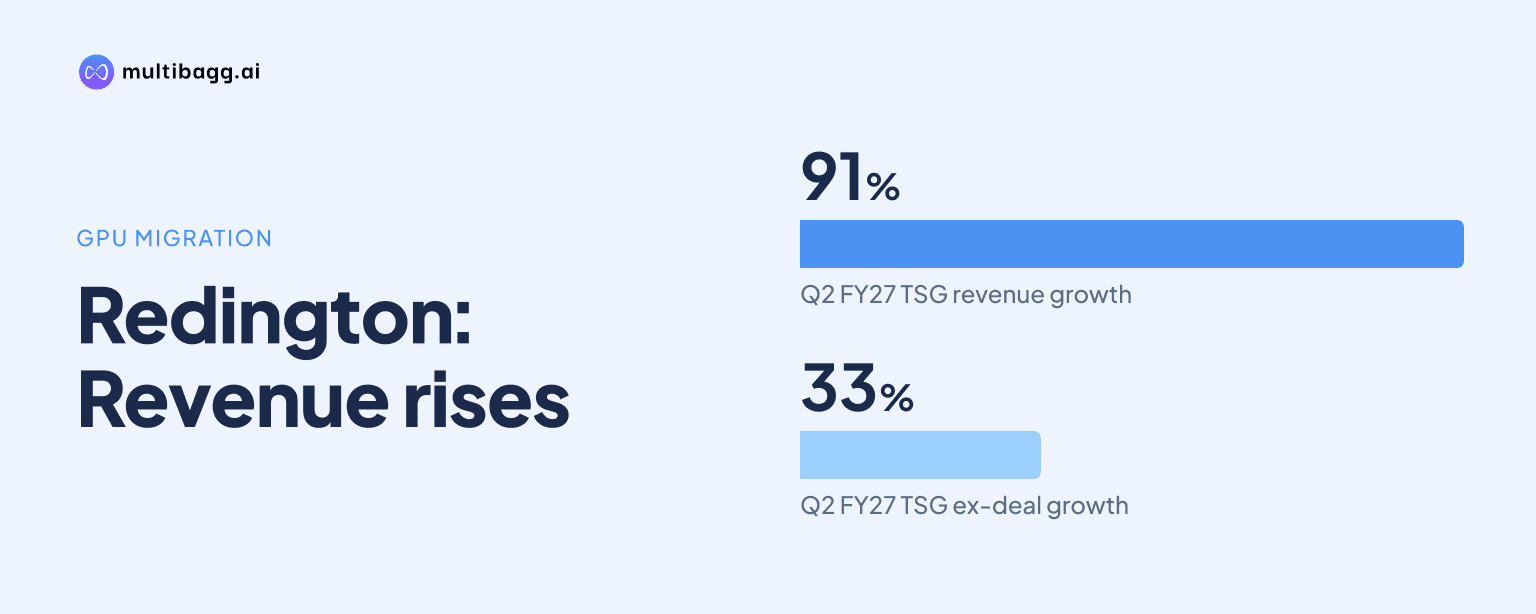
Redington Limited said Technology Solutions Group revenue rose 91% year on year in Q2 FY27 because enterprises are shifting from central processing unit servers to graphics processing unit systems, whose richer configurations often carry average selling prices about four times higher. Large deals exceeding Rs 3,800 crore also lifted the reported quarter.
Know Redington inside out
Results, valuation, peers and who's buying, in one view.
Why did Redington's Technology Solutions Group grow 91%?
Redington said Technology Solutions Group, or TSG, grew 91% year on year in Q2 FY27 chiefly because enterprise customers are migrating from central processing units, or CPUs, to graphics processing units, or GPUs, for AI-related infrastructure. Servers, storage and networking all contributed, but management identified AI servers with GPU-based, higher-specification configurations as the main source of growth.
The mechanism, according to Redington, is a change in the systems enterprises are purchasing rather than a price increase for the same configuration. GPU-server systems often have average selling prices, or ASPs, about four times higher than earlier configurations. Management said the CPU-to-GPU transition had been under way for the past two, three and four quarters and was a global trend, not one confined to its markets.
TSG also became a larger part of Redington's reported mix in Q2 FY27, contributing 20% of consolidated revenue. Its 91% expansion exceeded the 40% growth in Mobility, 38% in Endpoint Solutions and 39% in Software Solutions Group, or SSG. Mobility represented 34% of revenue, Endpoint Solutions 30%, and SSG 15%, showing that the fastest growth came from the smallest of these four disclosed verticals.
How much did large data-centre deals contribute to Redington's TSG growth?
Redington said large deals exceeding Rs 3,800 crore accounted for roughly 9% of consolidated revenue in Q2 FY27, with a substantial share of the Indian contracts coming from data centres. Those projects were a material contributor to TSG's reported 91% growth, and management described the segment's quarter as a standout performance.
TSG grew 33% after excluding the large deals, according to Redington. That comparison indicates that the headline result included a concentrated contribution from large projects, while servers, storage and networking outside those transactions also recorded double-digit growth. Redington did not disclose the revenue split among those three TSG product categories or provide a numerical pipeline for future large deals.
Management said the opportunity was still evolving and that Redington would take part where it can add value in hardware, professional services, managed services and capacity-filling activity for mid-market customers. It added that larger customers may execute projects independently. This distinction matters because the Rs 3,800 crore-plus deal flow is not presented as a recurring quarterly run rate or as guidance for the second half of FY27.
Got a follow-up? Ask IRIS
Is Redington's GPU-server demand different from PC and smartphone price inflation?
Redington said GPU-server demand differs from the price-led revenue growth affecting PCs and smartphones because TSG reflects a technology migration by enterprises. In Endpoint Solutions, which grew 38% in Q2 FY27, higher ASPs were the principal driver, alongside a sequential increase in commercial PC volumes. Management said price increases in PCs and smartphones had ranged between 30% and 50%.
Consumer PC unit volumes were declining, while commercial PC volumes were flat to modestly higher, Redington said. Management cited commercial PC volume growth of about 0% to 7%, while Microsoft activation data for consumer PCs was down about 20% to 30%. It said higher-priced AI-capable PCs supported Endpoint Solutions revenue even as consumer unit demand weakened.
The buyer mix also differs. Redington said AI-capable PCs account for more than 40% of commercial PC adoption, compared with about 10% for consumers. Management expects enterprises to require PC refreshes after systems bought in the post-COVID period reach three, four or five years of use, but it also said it would need to wait and see whether higher prices eventually weaken commercial demand.
For TSG, management said the essential driver is enterprises adopting GPUs to pursue AI use cases, not component scarcity. It nevertheless made that outlook conditional on enterprises continuing to be motivated by what GPU systems and AI can achieve. Redington did not quantify the number of enterprise GPU customers or say what portion of the 33% ex-large-deal TSG growth came from AI servers.
What does Redington say about GPU-deal margins and execution?
Redington said large hardware deals have margins below the normal business-unit run-rate range of 4.5% to 5%. Management therefore emphasized return on capital employed, or ROCE, discipline rather than treating large data-centre revenue as having the same economics as the wider distribution portfolio. It did not disclose the ROCE threshold used to select hardware transactions.
Finance Director S. V. Krishnan said gross margin excluding large deals was about 5.13% in Q2 FY27, similar to the same quarter a year earlier. The comparison indicates that the large-deal mix affected reported gross margin, while the underlying margin measure cited by management was broadly unchanged year on year. Redington also said operating expenses rose 40%, below consolidated revenue growth of 48%.
Redington reported working capital of 35 days in Q2 FY27, at the lower end of its 35-to-40-day guidance range. It reported net ROCE of 22.7% and return on equity of 21.6%; excluding Arena, those measures were 28% and 24.4%, respectively. The India and Middle East chief financial officer said funded capital investment in large deals was almost nil, with non-funded facilities used for such transactions.
Execution risks remain alongside the AI infrastructure opportunity. Redington said channel inventory remained above a comfortable level as customers sought to benefit from anticipated price increases. Management also entered the second half of FY27 alert to geopolitical, liquidity and market risks, while Arena reported revenue down 37% year on year and a Rs 115 crore loss during Q2 FY27.
Conclusion
Redington's Q2 FY27 results support management's view that TSG's 91% growth was led by a shift toward GPU-based enterprise infrastructure rather than solely by component inflation. Large deals exceeding Rs 3,800 crore increased the reported result, but the 33% TSG growth excluding those transactions points to activity across the broader servers, storage and networking portfolio.
The next issue is whether Redington can turn infrastructure sales into additional cloud, software and services activity while retaining its disclosed 35-to-40-day working-capital range and deal-selection discipline. Management said its AI Exchange had moved into commercial activity, launched a physical AI Centre of Excellence in Singapore and is building a virtual centre, but it has not provided a quantified TSG pipeline or second-half FY27 target.