










Redington says price rises are reducing consumer volumes
Key highlights
- Redington said PC and smartphone prices increased 30% to 50% year on year.
- Redington cited Microsoft PC activation data declining 20% to 30% as consumer volumes weakened.
- Commercial PC volumes were between flat and 7% growth, while AI-PC adoption exceeded 40% in commercial PCs versus about 10% in consumer PCs.
- TSG grew 91% in the quarter, with large deals exceeding Rs 3,800 crore.
powered by IRIS
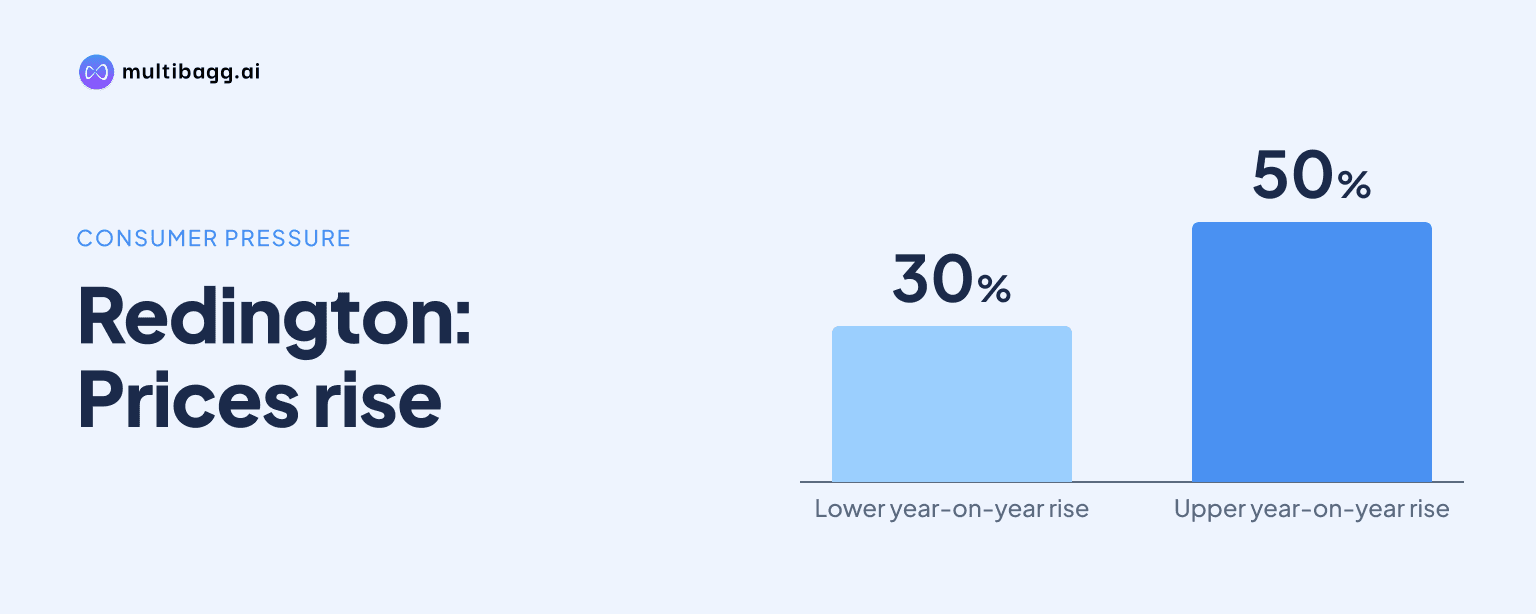
Redington said year-on-year PC and smartphone price increases of 30% to 50% are supporting revenue while consumer unit volumes decline, with Microsoft PC activation data down 20% to 30%. Management said commercial PC demand remains near flat to modestly positive, but expects price-volume elasticity eventually to restrain consumption.
Know Redington inside out
Results, valuation, peers and who's buying, in one view.
Why are Redington consumer device volumes declining?
Redington said consumer device unit volumes are declining because higher prices are constraining purchases, especially in entry-level and mid-range categories. Management said year-on-year PC volumes were flat to slightly lower overall, with consumer demand weaker and commercial volumes holding up. Higher average selling prices, or ASPs, rather than broad unit growth, are contributing more to device revenue.
The clearest indicator cited was Microsoft activation data, which management said was down 20% to 30% for PCs. Commercial PC unit volumes were between 0% and 5% higher in one response, and between 0% and 7% higher in another. Redington said it had not yet seen a 10% to 20% decline in commercial PC demand, but said further price increases could produce such softening.
Smartphone demand is also split by customer purchasing power and financing. Management said buyers upgrading from wages are moving more slowly into premium devices than buyers using wealth or credit, while about two-thirds of Redington's premium smartphone sales in India use equated monthly instalments, or EMIs. New premium launches, foldable phones, camera features and artificial-intelligence features are supporting demand, but management said entry-level and mid-range segments are already seeing pressure.
How much have Redington PC and smartphone prices increased?
Redington said PC and smartphone prices have increased by 30% to 50% year on year. Management said it could not precisely separate the effects of price inflation, changing product mix and customer preference for better specifications. AI-capable PCs with higher trillion operations per second, or TOPS, specifications are becoming a larger share of shipments, while entry-level PCs represent a smaller share.
Commercial and consumer PC demand have different product mixes. Management said AI-PC adoption is more than 40% in commercial PCs, largely purchased by enterprises, compared with about 10% in consumer PCs. Enterprises are replacing systems bought during the post-COVID refresh cycle 3 to 5 years ago, which is helping commercial shipments remain close to flat or modestly positive despite higher ASPs.
Redington distinguished device pricing from Technology Solutions Group, or TSG, demand. TSG server ASPs can be about four times higher when customers move from central processing units, or CPUs, to graphics processing units, or GPUs. Management described that as a technology migration, rather than a short-term constrained-component pricing effect, although richer server configurations increase reported revenue.
How exposed is Redington to weaker consumer demand?
Redington said its distribution business is roughly two-thirds enterprise and one-third consumer, reducing its aggregate exposure to consumer-device demand. Management clarified that the two-thirds enterprise split applies to PCs, while Mobility and PCs are broadly equal businesses in the wider portfolio. That distinction means declining consumer PC and smartphone units do not represent the full demand picture.
Consumer-facing device segments nevertheless remain substantial. Mobility accounted for 34% of consolidated revenue and grew 40% in the quarter, supported by premiumisation, new product introductions and selective price increases. Endpoint Solutions represented 30% of revenue and grew 38%, with higher ASPs the principal driver and sequential commercial PC volume growth providing additional support.
Management said Redington was flat to slightly higher in market share across brands and markets where it operates, without providing a numerical measure. It said it had not lost market share. This indicates that management attributes weaker consumer volumes primarily to market demand and pricing, rather than to a broad decline in Redington's distribution position.
Got a follow-up? Ask IRIS
Which businesses does Redington expect to drive second-half growth?
Redington said it is more cautious on Endpoint Solutions and Mobility in the second half because price-volume elasticity could dampen demand. Management said price increases may continue for a few more quarters and that channel inventory remained somewhat above a comfortable level. It linked the inventory position partly to participants seeking to benefit from further price movements.
TSG is expected to be the leading growth driver in the second half, followed by Software Solutions Group, or SSG, according to management. TSG revenue grew 91% in the quarter and reached 20% of consolidated revenue, while SSG grew 39% and contributed 15%. TSG large deals exceeded Rs 3,800 crore, equal to roughly 9% of group revenue, and management said they were almost entirely related to neo-cloud data centres.
Excluding large deals, TSG grew 33%, which management cited as evidence of broader underlying demand. Management said data-centre orders and revenue recognition can be lumpy, but it views CPU-to-GPU server migration as a run-rate opportunity over the next 3 months. It also said large hardware deals carry margins below the normal business-unit run rate of 4.5% to 5%.
What could change Redington's device-demand outlook?
Redington said later product launches and seasonal demand could lift smartphone unit volumes, but higher prices remain a constraint. Management said the later launch of a base smartphone model could improve fourth-quarter volumes after premium models arrived earlier. It cautioned that buyers may instead retain older models or defer purchases because prices have increased across the range.
Supply-chain disruptions are also affecting sales timing and inventory. Management said alternative routes were needed after the Strait of Hormuz closure, extending turnaround times and contributing to higher inventory. Redington reported receivable provisions of about Rs 213 crore, including about Rs 67 crore in SISA and about Rs 135 crore in Arena, while saying inventory provisioning was not material.
Conclusion
Redington's Mobility and Endpoint Solutions growth is increasingly supported by higher selling prices and richer product mix rather than rising consumer unit demand. Commercial PC replacement demand, premium devices and financing are cushioning that effect, but management's disclosure of declining consumer volumes, lower PC activations and 30% to 50% device price increases identifies a clear elasticity risk.
The next indicators are whether commercial PC volumes remain within the 0% to 7% range, whether the later base-model launch improves fourth-quarter smartphone units, and whether inventory returns to a comfortable level. Management expects TSG and SSG to be the main second-half growth drivers, while remaining more cautious on Mobility and Endpoint Solutions because price increases could further reduce consumption.