










Redington says neo-clouds drove Rs 3,800 crore Q2 deals
Key highlights
- Redington said neo-cloud operators accounted for almost all Rs 3,800 crore of Q2 FY27 large deals.
- TSG grew 90% year on year in Q2 FY27, compared with 35% excluding large deals.
- Management estimates a Rs 1,50,000 crore neo-cloud opportunity over the next four years.
- An analyst cited Q2 FY27 free cash flow of negative Rs 1,871 crore as growth raised working-capital needs.
powered by IRIS
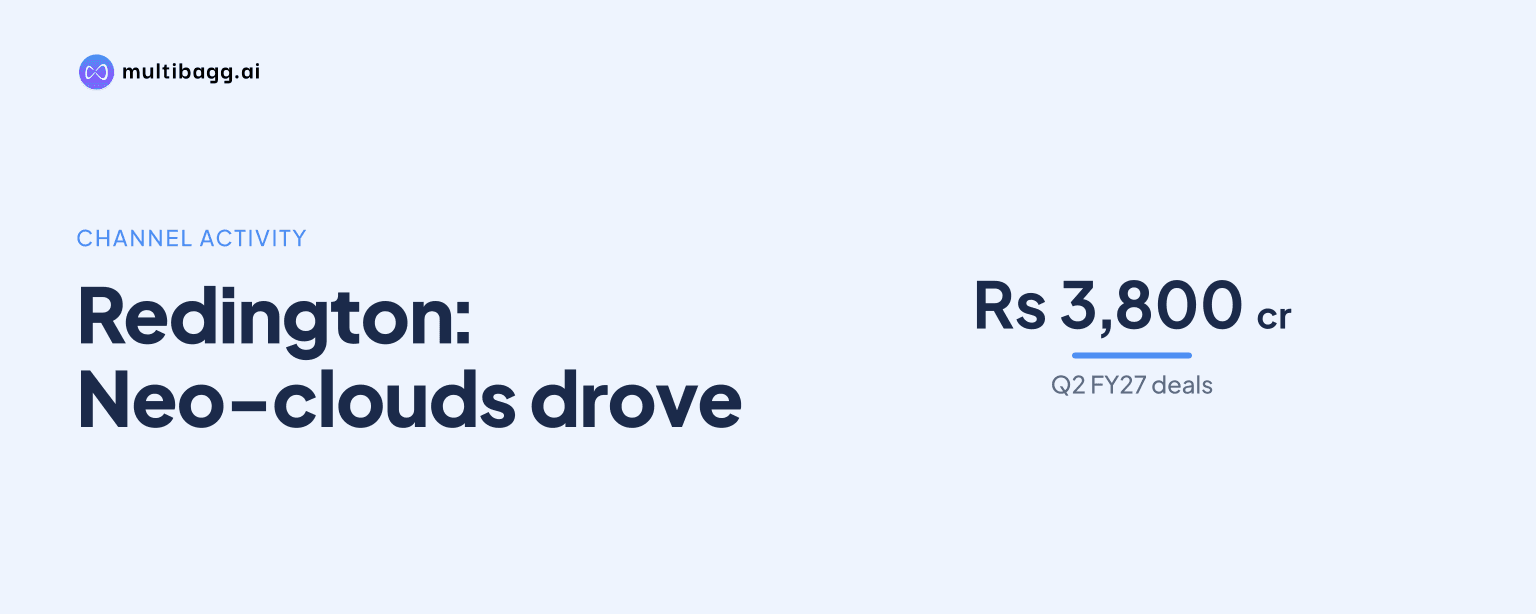
Redington Limited said neo-cloud operators accounted for almost all Rs 3,800 crore of its large deals in Q2 FY27, contributing to 90% year-on-year growth in Technology Solutions Group. Management said Technology Solutions Group growth would have been 35% without the large transactions, showing their material effect on the quarter.
Know Redington inside out
Results, valuation, peers and who's buying, in one view.
What drove Redington’s Rs 3,800 crore of large Q2 deals?
Neo-cloud operators drove almost all of Redington’s Rs 3,800 crore of large deals in Q2 FY27. Asked whether the data-centre orders came from neo-clouds, private enterprises or government customers, V.S. Hariharan answered that they were “almost all neo cloud”, identifying the principal customer group behind the unusually large transaction flow.
The disclosure narrows the source of the data-centre activity within Technology Solutions Group, or TSG. It does not identify individual neo-cloud customers, the number of contracts, their contract values or the point at which each order will be recognised as revenue. Redington also did not provide a split of the Rs 3,800 crore between servers, storage, networking, cooling or power systems.
The large-deal flow created a marked difference between reported TSG growth and growth excluding those orders. Hariharan said TSG grew 90% year on year in Q2 FY27, while growth without the large deals would have been 35%. The 55-percentage-point arithmetic difference shows the scale of the large transactions’ contribution, although Redington did not quantify their gross profit contribution.
Are Redington’s neo-cloud data-centre sales recurring or lumpy?
Redington said data-centre orders and their revenue recognition can be lumpy, while its broader TSG server business should be less lumpy. Hariharan made the distinction while discussing enterprise migration from central processing units, or CPUs, to graphics processing units, or GPUs, as well as related storage and networking products.
Management described the wider server transition as a run-rate business while enterprises continue moving from CPU-based to GPU-based infrastructure over the next three months. That view is tied to an ongoing technology transition rather than a single data-centre build. However, Redington separately said that the timing of data-centre orders and recognition can create volatility.
The Rs 3,800 crore large deals were explicitly distinguished from the remainder of quarterly activity. S. V. Krishnan said that, after excluding large deal sizes, everything else was business as usual, or BAU. The 35% TSG growth rate excluding such deals indicates expansion outside the large-order book, but it does not establish a recurring revenue level for neo-cloud deployments.
What does Redington disclose about data-centre deal margins?
Redington did not disclose the gross margin, return on capital or working-capital terms for its Rs 3,800 crore neo-cloud large deals. In response to an analyst’s question on the margin profile and return on capital of the potential neo-cloud opportunity, management instead described the company’s distribution role in sourcing hardware and coordinating multi-vendor solutions.
That role includes working with brands and neo-cloud operators and combining server, storage, networking, cooling and power systems. Redington said such solution assembly is one place where distributors can add value. The transcript does not provide a numerical basis to judge whether Q2 FY27 neo-cloud contracts differ economically from other TSG sales.
Management did provide a margin indicator for Software Solutions Group, or SSG, a separate business. Hariharan said SSG gross margin was above 6% in Q2 FY27 and that its profitability was above Redington’s average profit after tax, or PAT. He said Redington aims over the next three to five years to improve combined TSG and SSG gross margins through solutioning, services, marketplace tools, automation and lifecycle management.
Got a follow-up? Ask IRIS
How large does Redington think the neo-cloud opportunity could become?
Redington sees a Rs 1,50,000 crore neo-cloud opportunity over the next four years, based on management’s view of India-specific neo-cloud capacity rising from 1.5 gigawatts to 7 gigawatts and then 12 gigawatts. Hariharan presented this as an opportunity assessment for distribution, rather than as Redington revenue guidance or a booked-order forecast.
Management said distribution could participate in hardware deal sourcing, working with brands and neo-cloud operators, and joining together products from multiple suppliers. The potential work spans servers, storage, networking, cooling and power, giving Redington a stated role beyond moving a single hardware product through the channel.
Redington said the eventual shape of the market remains unresolved. Management pointed to the role of Indian conglomerates bringing capital and forming partnerships with United States-based neo-cloud operators, alongside smaller locally established neo-clouds. The company did not state a targeted market share, revenue share or margin assumption for the Rs 1,50,000 crore opportunity.
What could affect Redington’s data-centre growth in the second half?
Management said TSG should remain Redington’s leading growth driver in the second half of FY27, followed by SSG. Hariharan said CPU-to-GPU migration and SSG work should support the outlook, while Enterprise Solutions Group and Mobility Solutions Group warranted more caution because price increases could dampen volumes.
When asked whether overall second-half growth could exceed 25%, Hariharan said there was no reason to disbelieve that outcome at the time. He gave two caveats: demand could contract after price increases settle in, particularly in consumer smartphones and PCs, and geopolitical disruption could affect the United Arab Emirates, Saudi Arabia and parts of the Gulf region.
Working-capital requirements are another issue as larger orders increase the scale of the business. An analyst cited negative free cash flow of Rs 1,871 crore in Q2 FY27 and positive free cash flow of Rs 583 crore for the first half of FY27. Krishnan said free cash flow was not the appropriate measure during rapid growth in a working-capital-intensive business, because the absolute quantum of working capital and debt rises with revenue even if working-capital days are controlled.
Management said Redington can currently manage growth through additional debt, while moderating dividends or raising capital are other available levers. Krishnan said a capital raise could become necessary if the growth trend persists and requires more capital. The company did not announce a capital raise, debt target or dividend change during the call.
Conclusion
Redington’s Q2 FY27 comments show that neo-cloud operators were the primary source of Rs 3,800 crore in large data-centre deals, rather than private enterprises or government customers. Those transactions materially lifted TSG growth to 90% year on year, compared with 35% excluding large deals, while management cautioned that data-centre orders and their recognition can be lumpy.
The next results will show whether TSG remains the main second-half FY27 growth driver and whether the stated Rs 1,50,000 crore, four-year neo-cloud opportunity converts into further orders. Management identified post-price-increase demand, disruption in West Asia, larger working-capital needs and the possible need for additional capital as matters to watch.