










Redington says sustained growth could require capital raise
Key highlights
- Redington said a capital raise could become necessary if its high-growth trend continues.
- Management said debt currently funds expansion within a 0.6x to 0.8x debt-to-equity comfort range.
- Redington reported about Rs 213 crore of receivables provisioning in the current quarter.
- Large deals accounted for roughly Rs 3,800 crore in the current quarter.
powered by IRIS
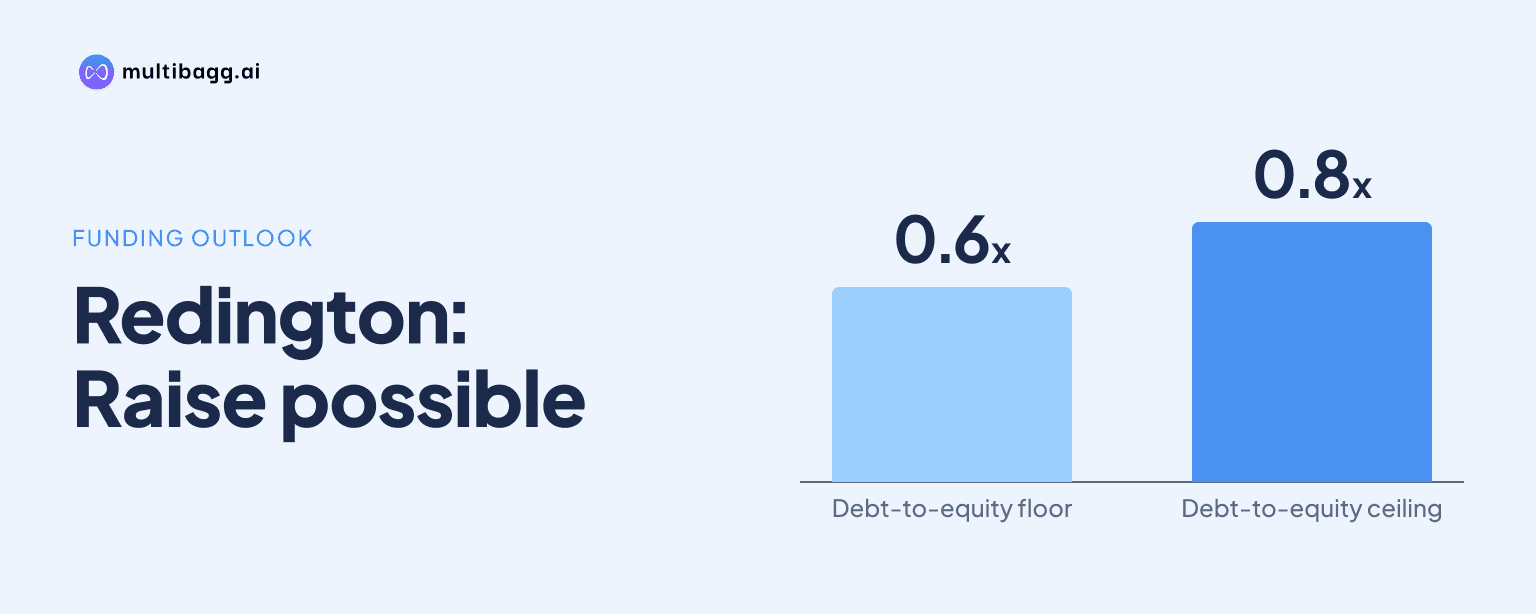
Redington said in the current quarter that debt can fund its present expansion, but a capital raise could become necessary if the higher-growth trend persists. Management cited a debt-to-equity range of 0.6x to 0.8x as comfortable and said it could also moderate dividends as working-capital needs increase.
Know Redington inside out
Results, valuation, peers and who's buying, in one view.
Why could Redington raise capital if growth remains high?
Redington could raise capital if management concludes that the current growth trend is sustained and requires funding beyond additional debt. S. V. Krishnan said capital intensity is a priority area because the distribution business is growing faster and requires working capital to support that expansion.
Management identified three funding levers: additional debt, dividend moderation and a capital raise. Redington said it can presently manage the higher growth with debt, but would bring in the other levers when required. Krishnan said that if the trend is seen as strong into the future, raising capital would become a requirement.
This was not an announcement of an equity issue. Redington did not disclose an amount, timing, structure, target leverage level or intended use of proceeds for any potential capital raise. The comment instead described the conditions under which management could move from debt funding to more permanent capital.
The funding question arises because distribution is working-capital intensive. In a separate response on leverage, Krishnan said such businesses globally can have debt-to-equity above 1:1, while Redington is currently comfortable in the 0.6x to 0.8x range. That indicates management is considering both the pace of growth and the cash tied up in operating assets rather than setting a disclosed hard debt limit.
How is Redington funding expansion at present?
Redington is currently funding expansion through debt within management’s stated 0.6x to 0.8x debt-to-equity comfort range. The questioner referred to a ratio of about 0.5x to 0.6x, and Krishnan responded that the company remained comfortable with the funding structure while it could manage growth through debt.
Dividend moderation is an available option, not a declared policy change. Redington said it has opportunities to moderate the dividend if needed, alongside raising additional debt or capital. Management did not announce a lower dividend, nor did it state that dividend moderation would necessarily precede a capital issue.
The distinction matters because Redington has linked a possible capital raise to the durability of growth, rather than to a stated funding shortfall. Management said the company would return to the market “at the right time” if additional capital were required, but gave no indication that it had begun a fundraising process.
Redington’s growth mix can affect the amount of capital required. The company said roughly Rs 3,800 crore of the current quarter’s activity came from large deals, with the rest being business as usual. Large transaction values can increase cash requirements even where the underlying distribution model and vendor relationships remain unchanged.
What is adding to Redington’s working-capital requirement?
Redington’s working-capital requirement is being affected by receivables, supply-chain transit times and large technology deals. Management reported about Rs 213 crore of receivables provisioning in the current quarter, including about Rs 67 crore in SISA and about Rs 135 crore in Arena.
Receivables were a particular concern in Turkey, where management said general liquidity conditions were not very good. The company also described Arena-related provisions connected to discontinued businesses, including business provisions and transition provisions. These included rebates and discounts given to partners that management said had been expected from vendors but were not fully aligned.
Arena’s quarterly loss also included an impairment of intangibles, according to management. In discussing the provision, Redington said the business loss for the quarter was smaller when separated from transition-related items and the impairment. That distinction means the disclosed Rs 213 crore receivables provisioning should not be read as solely reflecting ordinary operating losses.
Inventory was elevated for a different reason. Krishnan said supply chains were under stress because the Strait of Hormuz was closed, requiring alternative material-receipt routes and increasing turnaround time. Management described inventory provisioning as not significant or material, while identifying receivables rather than inventory valuation as the greater concern.
Redington also said operating expenditure could run at about Rs 950 crore to Rs 1,000 crore a quarter. Management attributed the current cost profile to higher accounts-receivable provisioning, investments primarily in the SSG business, and higher Middle East costs, particularly insurance costs linked to the war-related situation.
Got a follow-up? Ask IRIS
Which growth businesses could increase Redington’s funding needs?
Redington said TSG should be the leading growth driver in the second half, followed by SSG, while ESG and MSG face more demand uncertainty from price increases. Management described TSG demand as being supported by enterprises moving from central processing units, or CPUs, to graphics processing units, or GPUs, plus related storage and networking products.
Management said the broader TSG server business should be a run-rate business over the next three months while enterprises continue the CPU-to-GPU migration. It distinguished that from data-centre business, where order wins and revenue recognition can be lumpy. Nearly all of the large data-centre-related orders discussed on the call were from neo-cloud customers.
The company’s revenue growth is also being influenced by pricing and mix rather than unit growth alone. Management said product price increases in personal computers and smartphones ranged from 30% to 50%. It said consumer unit volumes were declining, while commercial personal-computer demand was still around 0% to 5% or 0% to 7% growth.
The commercial and consumer comparison illustrates the different demand drivers. Redington said adoption of artificial-intelligence-capable personal computers was more than 40% in the commercial segment but around 10% among consumers. On the personal-computer side, management said roughly two-thirds of business was enterprise and one-third consumer, while it clarified that the mix differs when mobility is included.
Geography is another variable in the funding outlook. Management identified India, GGCL and Africa as continuing growth drivers, but said recovery in the UAE and KSA would depend on geopolitical disruption. The same disruption has affected insurance costs and material transit times, linking regional execution conditions to working-capital requirements.
What could change Redington’s capital-raising decision?
Redington’s need for capital could change if demand weakens after product price increases or if growth in TSG and SSG remains durable. Management said there was no reason, apart from specified caveats, to disbelieve that overall second-half growth could be above 25%.
The first caveat was demand elasticity. Management said higher prices could lead customers to delay purchases, particularly in consumer smartphones and consumer personal computers. It said enterprises still need to refresh equipment after systems purchased in the COVID-era refresh cycle became three to five years old, but added that it would need to wait and see whether commercial demand softens.
The second caveat was the West Asia crisis and its possible effect on the UAE, KSA and parts of GGCL. Management said it was more cautious on ESG and MSG because price-led revenue growth may eventually face volume dampening, even as TSG and SSG remain the principal growth drivers for the second half.
Management also said a pullback in artificial-intelligence spending would affect TSG and data-centre activity, and to some extent personal computers. It differentiated SSG, saying cloud security and software consumption had been growing separately from the more direct artificial-intelligence hardware cycle. The eventual funding choice will therefore depend on both the scale and composition of future growth.
Conclusion
Redington has not announced a capital raise, but management has explicitly identified one as a potential requirement if its elevated growth continues. Debt remains the current funding method within the stated 0.6x to 0.8x debt-to-equity range, while dividend moderation and new capital are available as receivables, large deals and longer inventory transit periods consume working capital.
The next indicators are second-half performance in TSG and SSG, consumer unit demand after 30% to 50% price increases, and the effect of geopolitical disruption on the UAE, KSA and supply routes. Management’s view that overall second-half growth could be above 25%, subject to those caveats, will help determine whether debt remains sufficient or other funding levers are needed.