










Redington targets higher margins through technology orchestration
Key highlights
- Redington said Software Solutions Group gross margin was above 6% in Q2 of '27.
- Redington’s technology business grew 91% year on year in Q2 of '27, while Software Solutions Group grew 39%.
- Large deals contributed Rs 3,800 crore, and technology-business growth excluding them would have been 35%.
- Management estimated a Rs 150,000 crore India neo-cloud opportunity over the next four years.
powered by IRIS
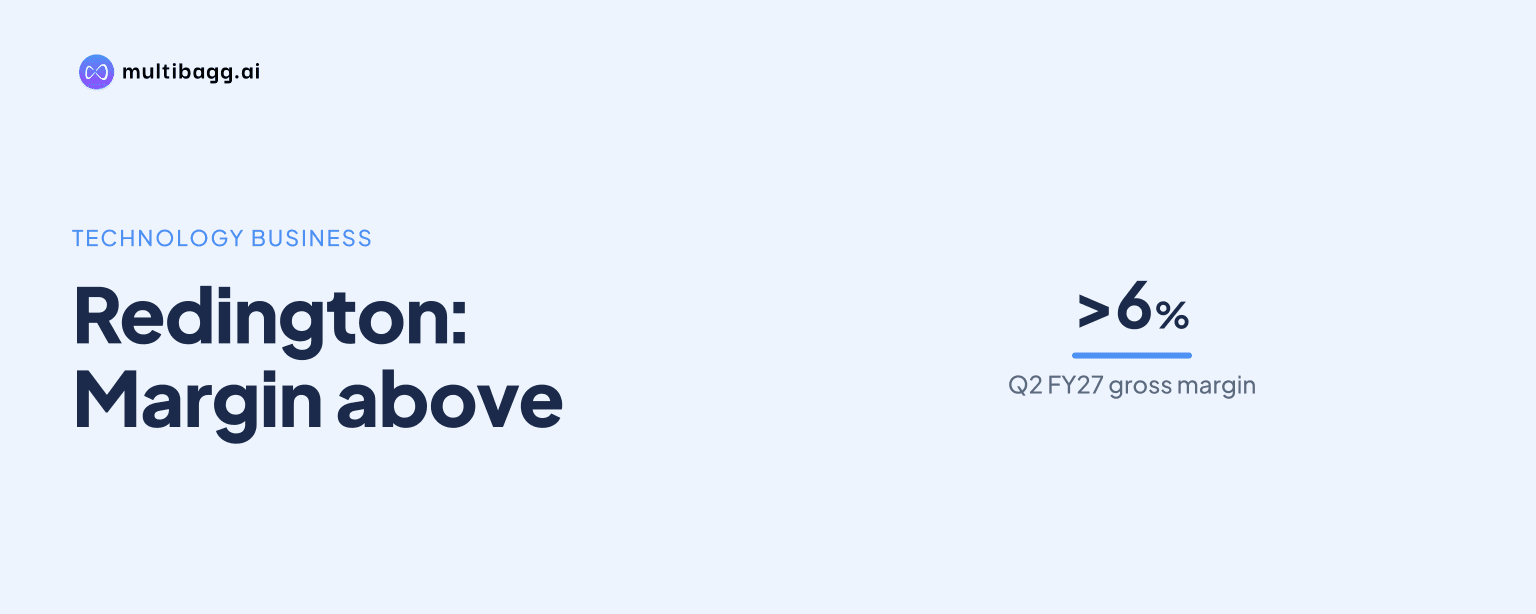
Redington Limited said it is pursuing higher gross margins over the next three to five years by moving from pure distribution to technology orchestration, with Software Solutions Group gross margin above 6% in Q2 of '27. Management expects cloud, cybersecurity, solutioning, services and lifecycle capabilities to increase value for customers and partners.
Know Redington inside out
Results, valuation, peers and who's buying, in one view.
What margin change is Redington targeting?
Redington is targeting better gross margins across its Software Solutions Group and technology business over the next three to five years, without disclosing a numerical consolidated margin target. Management said its ecosystem-orchestration model will involve more solutioning and services than pure distribution, with the intended result being greater customer and partner value and higher gross margin.
The clearest current indicator was Software Solutions Group gross margin above 6% in Q2 of '27. Management also said profitability from Software Solutions Group was higher than Redington’s average profit after tax, or PAT, positioning the software-led segment as a comparatively higher-margin part of the wider business.
Management did not provide a target for earnings before interest, tax, depreciation and amortisation, or EBITDA, or for return on capital employed, or ROCE. Its three-to-five-year margin expectation instead rests on changing the transaction role across the technology business and Software Solutions Group through services, automation, marketplaces and lifecycle management.
How did Redington's technology and software businesses grow?
Redington’s technology business grew 91% year on year in Q2 of '27, while Software Solutions Group grew 39%, based on figures cited during the call. Management said large deals contributed Rs 3,800 crore to the technology business and that growth excluding those deals would have been 35%.
The comparison shows that technology-business growth outpaced Software Solutions Group growth by 52 percentage points in Q2 of '27, but the large-deal contribution materially affected the technology result. Management said 90% growth in the technology business came from the large-deal portion, while it did not disclose a comparable technology-business gross-margin percentage.
Software Solutions Group’s above-6% gross margin was therefore the specific profitability metric management used to support the orchestration strategy. Large enterprise and data-centre projects can add scale, but management’s margin case focuses on combining those projects with software, cloud, cybersecurity, services and solutioning.
What does technology orchestration mean for Redington?
For Redington, technology orchestration means combining products with solutions, services, marketplaces, automation and lifecycle management across its technology business and Software Solutions Group. Management named CloudQuarks 2.0, its marketplace, automation tools and lifecycle management as capability-building measures intended to support higher gross margin over three to five years.
The model also extends to data-centre projects. In discussing India’s neo-cloud buildout, management said distributors can add value by stitching together server, storage, networking, cooling-system and power contracts rather than only sourcing a single product category.
Management estimated a Rs 150,000 crore distribution opportunity over the next four years as India-specific neo-cloud capacity progresses from 1.5 gigawatts to 7 gigawatts and then 12 gigawatts. That estimate was an opportunity assessment, not a Redington revenue forecast or margin target.
Management said the eventual shape of this opportunity will depend on how locally established neo-cloud operators and United States neo-cloud operators partnering with Indian conglomerates develop their projects. Redington described its prospective role as sourcing hardware with brands, working with operators and assembling multi-vendor solutions.
Got a follow-up? Ask IRIS
What could affect Redington's margin transition?
Redington’s project mix and funding needs could affect the transition because large deals drove a significant part of the technology business’s 91% growth in Q2 of '27. Management said working-capital days are being controlled, but the absolute quantum of working capital and debt is expected to rise as growth increases in a working-capital-intensive business.
An analyst cited negative free cash flow of Rs 1,871 crore in Q2 of '27, compared with positive free cash flow of Rs 583 crore in the first half of '27. Management said free cash flow may not be the appropriate metric during growth of this nature, attributing the movement to higher growth and the trade-off being chosen.
Management said it currently sees levers for higher debt and would decide on additional capital if required. This means the intended margin improvement from higher-value technology work will need to be considered alongside the funding required for larger enterprise and data-centre transactions.
Demand and geopolitical developments are additional variables. Management said it was watching potential demand softening after price increases, particularly following Diwali for smartphones and consumer personal computers, and the effect of the West Asia crisis on the United Arab Emirates, Saudi Arabia and some GGCL operations.
How is Redington building cloud, software and AI capabilities?
Redington is building cloud, software and artificial-intelligence capabilities through partner engagement and its AI exchange, which management said was launched about two quarters before the call. The company said it was engaging hundreds of partners and had many independent software vendors participating, while seeing early traction and a good funnel.
The AI exchange is intended to offer ready-made products and agents already delivered for some customers, rather than requiring a separate artificial-intelligence solution for every use case. Management cited banking, financial services and insurance as an example where a model used by 10 customers could be evaluated by another customer.
Management said the platform must demonstrate customer value and achieve replication and multiplication through partners before it becomes a scalable model. It compared the present stage with cloud around 10 years ago and cautioned that the process would be a long journey rather than an overnight change.
Management also said Google’s smartphone business and office-and-cloud business had together grown well for Redington. It added that Redington plays actively in Google Cloud in India but does not have a Google partnership in every geography.
Conclusion
Redington’s stated margin plan depends on changing the work it performs rather than only increasing distribution volumes. Software Solutions Group gross margin above 6% in Q2 of '27 and profitability above Redington’s average PAT are management’s disclosed evidence for that direction, while the technology business’s 91% growth illustrates the scale available in enterprise and large-deal activity.
The next indicators are whether CloudQuarks 2.0, automation, lifecycle management and partner-led solutioning produce higher combined gross margins over the stated three-to-five-year period. Management’s Rs 150,000 crore neo-cloud opportunity estimate for the next four years, together with working-capital and debt needs as project-led growth continues, will also be important to watch.