










Why the Rupee Hit Record Lows in 2026, and How the Midterms Could Change That
Key highlights
- The rupee hit a record low of 96.9650 per dollar in May 2026, per ThePrint.
- The RBI raised its repo rate by 0.25 point to 5.50% on 7 October 2026.
- India's forex reserves fell from $785.706 billion (week ended 4 September) to $721 billion (week ended 16 October).
- The rupee traded at 94.97 per dollar in early trade on 2 November 2026.
powered by IRIS
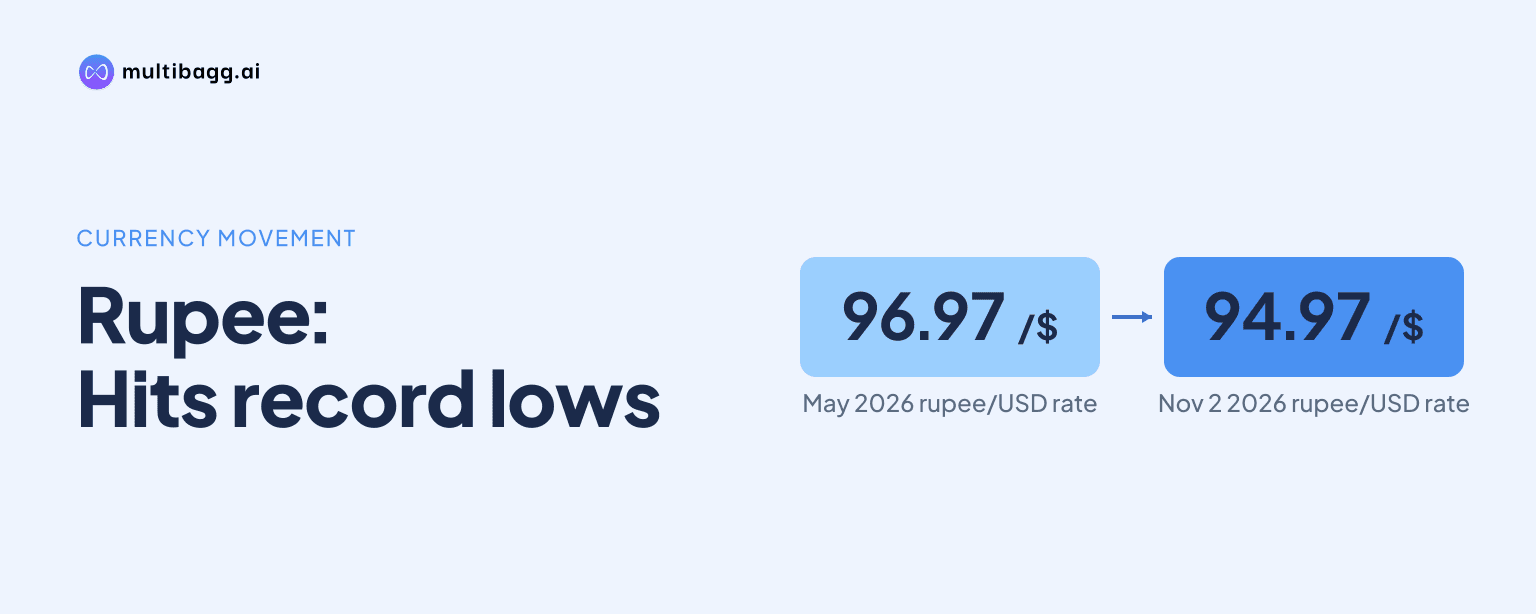
The rupee hit a record low of 96.9650 per dollar in May 2026, according to ThePrint, and was down more than 7% for the year in early October, according to CNBC. Oil above $100 a barrel, heavy foreign selling and a firm dollar are the main causes. The US midterms matter mainly through the dollar.
How far has the rupee fallen in 2026?
The rupee fell to repeated record lows between April and May and has recovered part of that loss since October. A record low means the largest number of rupees ever needed to buy one US dollar. Outlook Business reported on 4 May 2026 that the rupee hit 95.33 on 30 April and had lost 5.5% in 2026 by then. ThePrint reported on 12 October that the record, 96.9650, was set in May.
The table lists dated levels from Indian media reports. Levels for the same day can differ by a few paise (one paisa is one hundredth of a rupee).
After a rise of more than 1% on 12 October, the rupee was reported at 95.5938. In early trade on 2 November 2026 it was 94.97, according to Daily Pioneer, about Rs 2 stronger than the May record. CNBC put the 2026 fall at more than 7% on 10 October, and ThePrint put it at about 6% on 12 October, after the rally.
Why has the rupee weakened so much?
Oil, foreign selling, a strong dollar and heavy dollar demand have all pushed the same way. Brent crude, the global oil benchmark, traded at $114.13 a barrel on 29 October and $109.95 on 2 November (futures prices, per ThePrint and Daily Pioneer). ThePrint reported on 12 October that Brent had risen more than 40% since the Iran war began. Oil is bought in dollars, so dearer oil raises demand for them, Subhash Chandra Garg wrote in The Quint on 21 October.
Foreign portfolio investors (FPIs), overseas funds that buy Indian shares and bonds, had withdrawn about $20.6 billion from Indian equities by 4 May 2026, more than in all of 2025, according to Outlook Business.
The dollar is the third force. The US Federal Reserve raised its benchmark range to 3.75% to 4% on 16 September and held it on 28 October, with two members preferring a hike. Higher US bond yields (the return on government bonds) make dollar assets more attractive. On 29 October, Anuj Choudhary of Mirae Asset Sharekhan said expectations of a December Fed hike could strengthen the dollar further, as reported by ThePrint.
CNBC added on 10 October that importers' dollar needs far exceed exporters' supply. It also said strong demand for hedging, meaning buying dollars ahead of time to protect against a falling rupee, had weighed on the currency.
Got a follow-up? Ask IRIS
What has the RBI done to defend the rupee?
The Reserve Bank of India (RBI) has raised interest rates, sold dollars and tightened rules on currency derivatives. On 7 October it raised the repo rate (the rate at which it lends to banks) by 0.25 point to 5.50%, its first rise since February 2023, according to ThePrint. Governor Sanjay Malhotra said the rupee may be undervalued by many estimates.
On 10 October, CNBC reported, the RBI cut the limit on derivative deals (contracts whose value depends on an exchange rate) without proof of real currency exposure from $100 million to $5 million. It also required dealers to hold 20% of the value of certain dollar-buying contracts above $2 million as a foreign exchange risk reserve, and opened a dollar window for three state oil companies.
Foreign exchange reserves, the dollars and gold the RBI holds, reached a record $785.706 billion in the week ended 4 September and were $721 billion in the week ended 16 October, according to Chronicle India. Subhash Chandra Garg wrote that he expected the rupee's October recovery to be temporary. ANZ's Dhiraj Nim told CNBC that the underlying drivers, oil prices and capital flows, remain.
How could the midterm result change the rupee's path?
The result can move the rupee mainly by moving the dollar, and analysts expect that effect to be modest. The dollar index, which tracks the dollar against a basket of major currencies, was 101.94 in early trade on 2 November, according to Daily Pioneer. Everything below is an analyst view, not a confirmed outcome.
Capital.com (29 October) and Matthew Ryan of Ebury (8 October) expect a Democratic sweep to weaken the dollar modestly and a Republican hold to support it, though Ryan said the dollar's reaction to a Republican hold would be hard to call. ING (30 October) also sees a sweep as slightly negative for the dollar, but said a still-hawkish Fed argues against a major correction. A softer dollar would ease one pressure on the rupee, and a stronger one would add to it.
Capital.com concluded that the midterms are unlikely to override inflation, Fed policy and growth as the main dollar drivers. Anindya Banerjee of Kotak NEO expects the rupee to trade between 94.40 and 95.60, with renewed oil strength pushing it toward the upper end.
Conclusion
The data show a rupee driven mostly by oil, foreign money flows and the Fed. The RBI's defence has slowed the fall at a cost to reserves, which dropped from $785.706 billion to $721 billion in six weeks. The midterms add a dollar risk that analysts see as modest, and the result is not known as of 3 November 2026.
Next, watch the US vote count, the Fed meeting on 8 and 9 December 2026 and the RBI policy meeting on 2 to 4 December. The US stopgap funding law runs to 11 December 2026. Weekly RBI reserves data and Brent prices will show whether the pressure is easing.