








Steamhouse broadens growth through asset-light contracts

Find your next multibaggerBe a Pro Investor
Research stocks and track your picks on the go. Download the app.
Key highlights
- Steamhouse operates 8 community-boiler plants with 375 TPH across 10 industrial clusters.
- Steamhouse won a Rs 311 crore Una EPC contract with 25 years of O&M in September 2026.
- Steamhouse signed 5-year steam purchase agreements for Haldia and Dahej Special Economic Zone in April 2026, with first-half FY28 operations expected.
- Pirana is a 300-tonnes-per-day municipal waste-to-steam project with about Rs 34.75 crore of stated subsidy support.
powered by IRIS
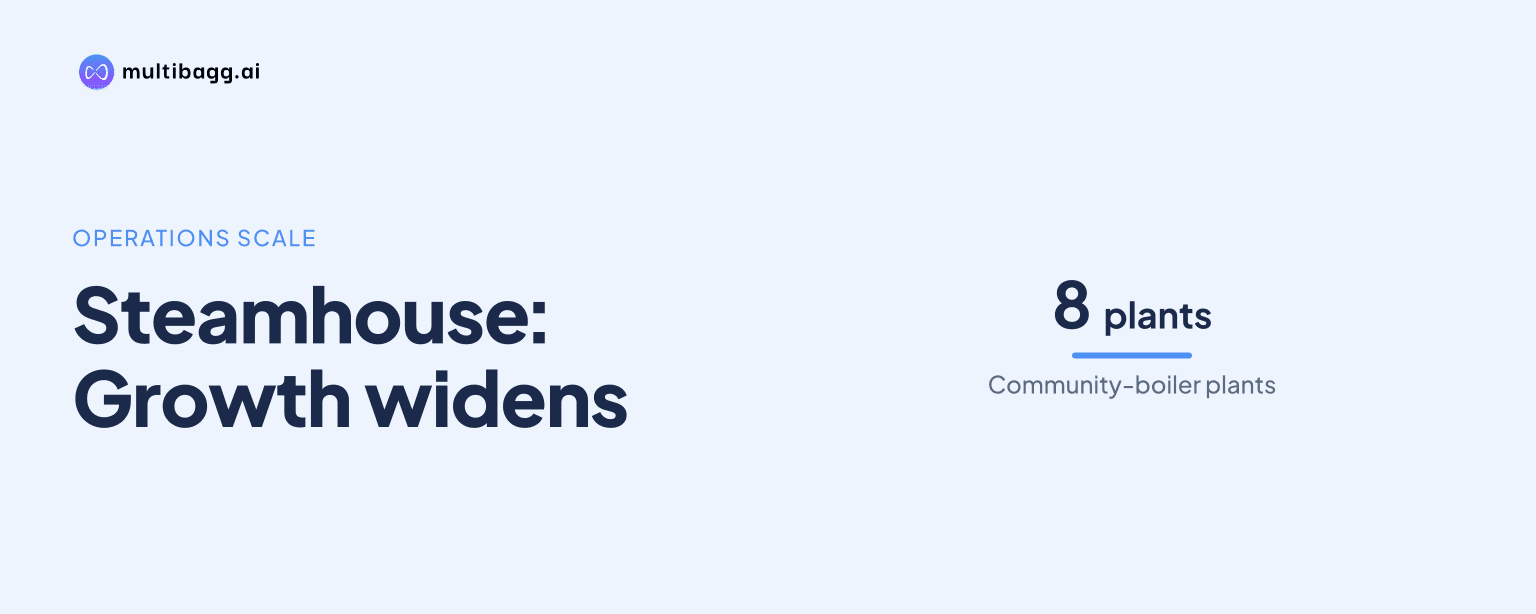
In September 2026, Steamhouse broadened its growth model with a Rs 311 crore Una Bulk Drug Park engineering, procurement and construction award, combining a 24-month build with 25 years of operating and maintenance work. The client-funded contract sits alongside steam trading and waste-to-steam initiatives, while Steamhouse retains eight owned plants with 375 TPH capacity.
Know Steamhouse India inside out
Results, valuation, peers and who's buying, in one view.
How has Steamhouse changed its operating model?
Steamhouse has moved from operating community boilers alone to a model that can build, purchase, distribute and operate industrial utilities. Its first community boiler began at Sachin GIDC in 2014, followed by Vapi in 2017 and Ankleshwar in 2018. A second Ankleshwar boiler was added in 2022, while Sarigam and Nandesari started in 2023, extending the approach across industrial estates.
The broadening accelerated in 2024 through Dahej steam aggregation, where Steamhouse purchases and distributes steam, and a 10-year work order for a 300-tonnes-per-day municipal-solid-waste-to-steam project at Pirana. In 2025, it added an integrated boiler at Panoli, a 350 normal-cubic-metres-per-hour nitrogen plant at Ankleshwar, its first Vapi waste-to-energy plant and co-generation at Nandesari.
In March and April 2026, Steamhouse received a patent for its atmospheric fluidised-bed combustion bed-material recovery system, added about 9,500 metres of pipeline and recorded 57 purchase-and-sale agreements at Haldia and Dahej Special Economic Zone. The September 2026 Una award then added an engineering, procurement and construction, or EPC, route in which the customer owns the asset and Steamhouse operates it.
What remains Steamhouse's core owned-generation business?
Steamhouse's core remains owned generation, comprising eight operating community-boiler plants with 375 tonnes per hour, or TPH, of capacity across 10 industrial clusters and more than 62 kilometres of pipelines. The model produces steam in Steamhouse facilities and supplies it through pipelines, requiring boilers, pipeline networks and auxiliary systems funded under a stated 75:25 equity-to-debt mix.
Recurring supply is central to this engine: Steamhouse reported a customer repeat rate of 90.72% in FY26 and 99.38% in the first quarter of FY27. Its tariff has a fixed charge and a variable charge per kilogram of steam, while the presentation describes continuous industrial operations of about 330 days annually and utilisation of about 80% of rated capacity.
The presentation forecasts Indian industrial steam demand rising from 203,472 TPH in FY26 to 318,853 TPH in FY31, a 9.4% compound annual growth rate. Steamhouse reported FY26 revenue of Rs 491 crore and placed its market share at 0.13% of the stated Rs 3.66 lakh crore steam-as-a-service market, showing the gap between its 375 TPH operating base and the cited national demand.
How does steam trading lower Steamhouse's required capital?
Steam trading lowers Steamhouse's generation capital needs because it buys steam from an existing industrial unit and distributes it through its pipeline network instead of building a boiler. Steamhouse has operated at Sachin GIDC since 1 April 2024 and Dahej GIDC Phase 1 since 2 April 2024, with no new boiler, fuel procurement or direct emissions liability under this model.
Steamhouse signed five-year steam purchase agreements for Dahej Special Economic Zone and Haldia, West Bengal, in April 2026, with operations expected in the first half of FY28. The presentation says these projects need pipeline capital expenditure only and cites return on capital employed of more than 40% for the engine; this is a company metric and not a reported outcome from the planned projects.
The difference from owned generation is the source of supply and the project-development burden. A community-boiler project entails land identification, approvals, plant construction typically taking 12 to 18 months and pipeline installation, whereas trading depends on surplus steam and an available distribution route. Steamhouse says this can enable entry into clusters without boiler construction and with faster payback than owned generation, though it gives no project-specific payback for Haldia or Dahej Special Economic Zone.
Got a follow-up? Ask IRIS
What is Steamhouse's waste-to-steam opportunity?
Waste-to-steam is Steamhouse's alternative-fuel engine, using textile waste, biomass, municipal solid waste, agricultural residue and related material instead of coal. Its Vapi waste-to-energy plant is operational, and Steamhouse identifies green facilities at Nandesari. The company estimates fuel cost at about Rs 1,000 per tonne, while describing imported coal as a higher-cost alternative without giving a direct coal-price comparison.
Pirana, Ahmedabad is the principal municipal project: a 300-tonnes-per-day municipal-solid-waste-to-steam plant with a 10-year AMC work order. The presentation states that AMC funds 50% of capital expenditure through a subsidy of about Rs 34.75 crore and provides land. Steamhouse describes Pirana as India's first municipal waste-to-energy project at this scale, while Nandesari Phase 2 and Vapi Waste-to-Energy II remain listed as further facilities.
The model is linked to fuel and emissions rules identified in the presentation. Industrial coal was banned in six National Capital Region districts from January 2023 under CAQM Direction 89, while a 50 milligrams per normal cubic metre particulate-matter limit is due to be phased in from August and October 2026 for identified industries. Steamhouse's October 2026 Haryana memorandum of understanding proposes biomass- and paddy-stubble-based boilers at Panipat and Sonipat, with about Rs 500 crore proposed rather than awarded.
Why does the Una EPC and O&M contract matter?
The Una contract matters because Steamhouse can earn EPC revenue and long-term operating and maintenance, or O&M, income without owning the project asset. Awarded on 28 September 2026, the Rs 311 crore contract, including goods and services tax, covers a 300 TPH steam facility and about 30 megawatts of co-generation at Una Bulk Drug Park in Himachal Pradesh.
The project has a 24-month EPC period followed by 25 years of O&M on a cost-plus-markup basis. The Himachal Pradesh government special-purpose vehicle funds the asset, while Steamhouse acts as EPC contractor and long-term operator. This differs from owned generation, where Steamhouse funds plant and pipeline assets, and from trading, where it purchases steam from an industrial supplier.
Steamhouse identifies several possible follow-ons, but their status is not equivalent to Una. The Panipat and Sonipat proposal is a non-binding memorandum of understanding at feasibility and approvals stage for 250 to 300 TPH plus O&M. Gujarat Bulk Drug Park had a live tender as of the first quarter of FY27, while Nalkapani and Jambusar bulk drug parks are identified EPC opportunities rather than awarded work.
Conclusion
Steamhouse is building several growth routes around its 375 TPH owned-generation base: pipeline-led trading can avoid boiler investment, waste-to-steam can use alternative fuel sources and municipal arrangements, and EPC plus O&M can shift capital ownership to clients. The Rs 311 crore Una award is the most defined example because it combines a 24-month construction programme with 25 years of operating work.
The next disclosed milestones are expected first-half FY28 operations at Haldia and Dahej Special Economic Zone, completion of Una's 24-month EPC period and progress on the non-binding Haryana proposal of about Rs 500 crore. Execution of Pirana's 300-tonnes-per-day facility, Nandesari Phase 2 and Vapi Waste-to-Energy II will also show whether the listed green projects become operating capacity.

