








Steamhouse India Ltd cash flow turns negative as debt falls

Find your next multibaggerBe a Pro Investor
Research stocks and track your picks on the go. Download the app.
Key highlights
- Steamhouse reported net operating cash use of Rs 57.69 crore in H1 FY27, versus Rs 72.29 crore generated in H1 FY26.
- Steamhouse's net debt declined by Rs 180.18 crore to Rs 90.93 crore at H1 FY27.
- Steamhouse's investing cash outflow increased to Rs 284.64 crore in H1 FY27 from Rs 62.03 crore a year earlier.
- Steamhouse's H1 FY27 EBITDA rose 65.72% to Rs 55.62 crore and EBITDA margin reached 21.67%.
powered by IRIS
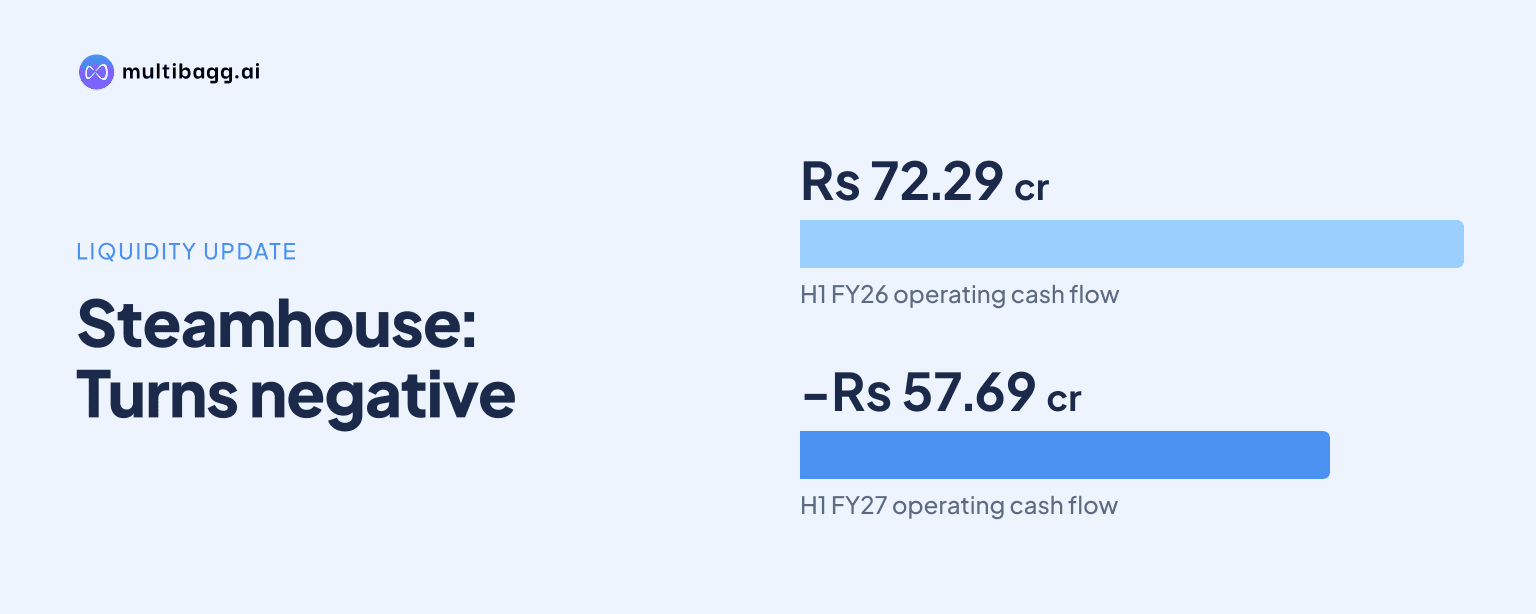
Steamhouse India Ltd reported net operating cash use of Rs 57.69 crore in H1 FY27, against Rs 72.29 crore generated a year earlier, but financing inflows of Rs 350.55 crore helped reduce net debt to Rs 90.93 crore from Rs 271.11 crore at FY26. Gross debt fell by Rs 14.38 crore.
Know Steamhouse India inside out
Results, valuation, peers and who's buying, in one view.
Why did Steamhouse's operating cash flow turn negative in H1 FY27?
Steamhouse's operating cash flow turned negative because cash generated from operations moved to an outflow of Rs 47.26 crore in H1 FY27 from an inflow of Rs 72.81 crore in H1 FY26, while income taxes paid rose to Rs 10.43 crore from Rs 0.52 crore. Net cash used in operations was therefore Rs 57.69 crore, compared with net cash generated of Rs 72.29 crore a year earlier.
Management attributed the negative operating cash flow primarily to payments of trade payables funded through debt and equity capital raised during H1 FY27. The cash result diverged from the reported profit and loss account: profit after tax rose 99.56% to Rs 26.11 crore from Rs 13.09 crore, while earnings before interest, tax, depreciation and amortisation, or EBITDA, increased 65.72% to Rs 55.62 crore.
How did financing inflows reduce Steamhouse's net debt?
Steamhouse reduced net debt by Rs 180.18 crore to Rs 90.93 crore at H1 FY27, as financing activities generated Rs 350.55 crore and the cash balance used in its debt profile increased to Rs 176.31 crore. Financing inflows were Rs 6.03 crore in H1 FY26, making the H1 FY27 figure substantially larger.
The net-debt reduction was driven mainly by the higher debt-profile cash balance rather than by a comparable reduction in gross debt. Gross debt declined Rs 14.38 crore to Rs 267.24 crore, with working-capital borrowings down Rs 15.06 crore and other debt down Rs 4.10 crore, while term loans increased Rs 4.78 crore.
Steamhouse's consolidated equity also increased to Rs 576.95 crore at H1 FY27 from Rs 172.77 crore at FY26. Other equity rose by Rs 394.09 crore to Rs 521.67 crore and equity share capital increased by Rs 10.09 crore to Rs 55.28 crore, consistent with the presentation's statement that equity capital was raised during the half year, although no financing split is provided.
Where did Steamhouse deploy cash during H1 FY27?
Steamhouse used Rs 284.64 crore in investing activities in H1 FY27, compared with Rs 62.03 crore in H1 FY26, an increase of Rs 222.61 crore. The presentation does not provide a line-by-line investing cash-flow breakdown, so it does not directly assign the outflow to individual assets or projects.
Balance-sheet movements show increased investment in operating and development assets during the period. Property, plant and equipment increased to Rs 319.39 crore at H1 FY27 from Rs 284.70 crore at FY26, while capital work-in-progress rose to Rs 204.17 crore from Rs 157.94 crore. Intangible assets under development increased to Rs 11.19 crore from Rs 6.58 crore.
Total non-current assets increased by Rs 114.37 crore to Rs 671.70 crore at H1 FY27. Total assets rose to Rs 978.46 crore from Rs 679.45 crore, while total current assets more than doubled to Rs 306.77 crore from Rs 122.13 crore, partly reflecting other bank balances of Rs 175.85 crore compared with Rs 10.33 crore at FY26.
Got a follow-up? Ask IRIS
Did Steamhouse's H1 FY27 operating performance improve?
Steamhouse's operating performance improved in H1 FY27, with revenue from operations rising 7.63% to Rs 256.62 crore and EBITDA margin expanding to 21.67% from 14.08%. The margin increase was 759 basis points, where one basis point equals one-hundredth of a percentage point.
Steam sold increased 14.35% to 6,07,459 tonnes from 5,31,240 tonnes, while revenue from steam rose 44.84% to Rs 245.90 crore from Rs 169.80 crore. EBITDA per tonne increased 44.93% to Rs 916 from Rs 632, according to the H1 FY27 financial-performance slide.
Capacity utilisation rose to 41.91% in H1 FY27 from 37.03% in H1 FY26. In the second quarter, utilisation was 42.41%, compared with 35.28% in Q2 FY26 and 41.40% in Q1 FY27, while the presentation states that lower utilisation leaves capacity available for new industries and incremental demand from existing customers.
How did Steamhouse's revenue mix and liabilities change?
Steamhouse's H1 FY27 revenue mix was led by core steam generation at 74.73%, followed by steam distribution at 21.10% and other revenue at 4.17%, which includes nitrogen. In FY26, core steam generation represented 52.14%, steam distribution 17.70%, coal trading 26.92% and other revenue 3.24%; coal trading was not shown in the H1 FY27 mix.
Current liabilities declined to Rs 207.91 crore at H1 FY27 from Rs 336.60 crore at FY26. Trade payables due to parties other than micro and small enterprises fell to Rs 10.55 crore from Rs 91.65 crore, while current borrowings declined to Rs 147.49 crore from Rs 182.50 crore, movements that align with management's explanation of trade-payable payments.
The presentation reports different cash measures across its statements. Its cash-flow statement shows closing cash and cash equivalents of negative Rs 7.75 crore in H1 FY27, after negative Rs 15.97 crore at the beginning of the period, whereas the debt profile reports Rs 176.31 crore. On the balance sheet, Rs 0.47 crore of cash and cash equivalents plus Rs 175.85 crore of other bank balances equals Rs 176.31 crore, but the presentation does not provide a reconciliation to the cash-flow closing figure.
Conclusion
Steamhouse's H1 FY27 cash-flow profile was shaped by Rs 57.69 crore of operating cash use and Rs 284.64 crore of investing outflows, offset by Rs 350.55 crore of financing inflows. That funding and the higher debt-profile cash balance reduced net debt to Rs 90.93 crore even as gross debt declined by only Rs 14.38 crore; meanwhile, EBITDA rose to Rs 55.62 crore and profit after tax reached Rs 26.11 crore.
The next results will show whether operating cash flow returns to positive after the trade-payable payments management identified as the principal H1 FY27 factor. Investors can also monitor further investing outflows, the balance of working-capital borrowings after their fall to Rs 102.34 crore, and any reconciliation of the negative cash-flow closing balance with the Rs 176.31 crore figure used in the debt profile.

