








Steamhouse H1 PAT rises 99.56% as EBITDA margin hits 21.67%

Find your next multibaggerBe a Pro Investor
Research stocks and track your picks on the go. Download the app.
Key highlights
- Steamhouse reported H1 FY27 PAT of Rs 26.11 crore, up 99.56% year on year.
- Steamhouse’s EBITDA margin rose 759 basis points to 21.67% in H1 FY27.
- Steamhouse sold 607,458.63 tonnes of steam in H1 FY27, up 14.35%.
- Steamhouse’s EBITDA per tonne increased 44.93% to Rs 915.54 in H1 FY27.
powered by IRIS
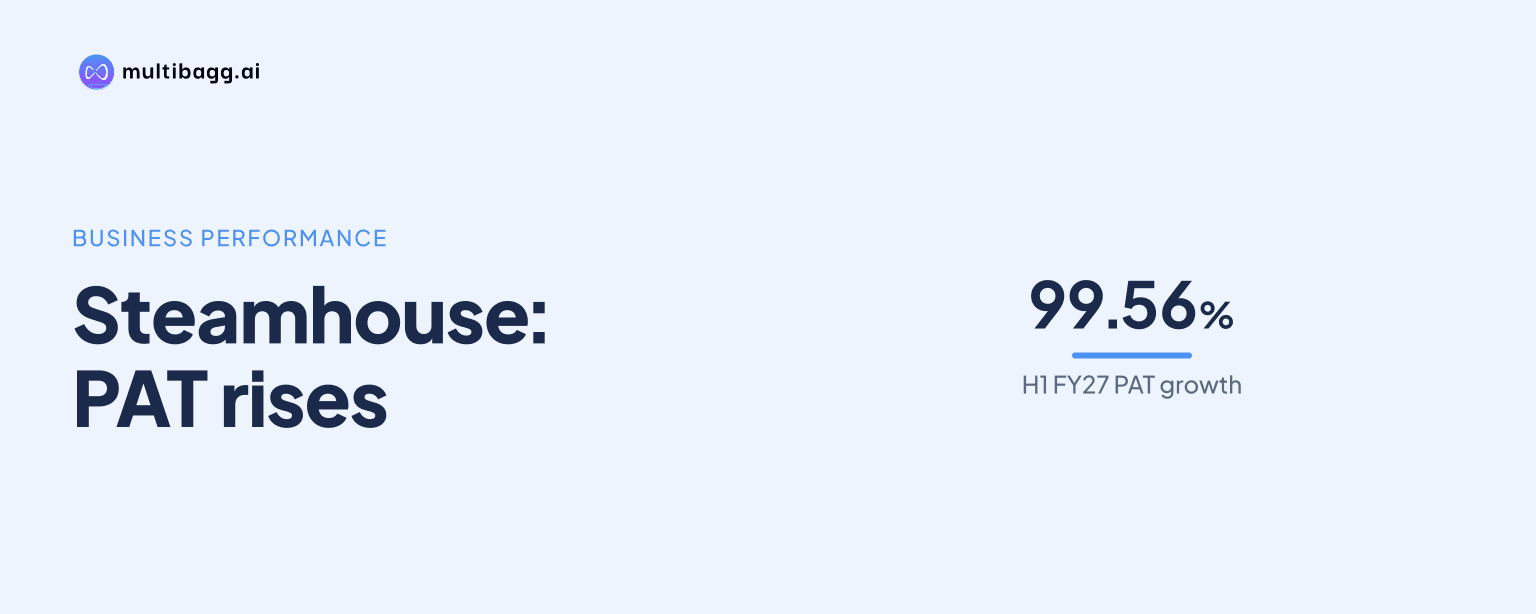
Steamhouse reported profit after tax of Rs 26.11 crore in H1 FY27, up 99.56% year on year, as its EBITDA margin expanded 759 basis points to 21.67%. Revenue from operations increased 7.63% to Rs 256.62 crore, while steam sold rose 14.35% and EBITDA per tonne increased 44.93%.
Know Steamhouse India inside out
Results, valuation, peers and who's buying, in one view.
Why did Steamhouse’s H1 FY27 profit rise faster than revenue?
Steamhouse’s profit rose faster than revenue because total expenses fell 1.88% even as revenue from operations grew 7.63% in H1 FY27. Revenue increased to Rs 256.62 crore from Rs 238.42 crore in H1 FY26, while total expenses declined to Rs 201.00 crore from Rs 204.86 crore. EBITDA consequently increased 65.72% to Rs 55.62 crore from Rs 33.56 crore.
The consolidated statement reports an EBITDA margin of 21.67% in H1 FY27, compared with 14.08% a year earlier. Profit before tax rose 102.62% to Rs 34.03 crore, while PAT rose to Rs 26.11 crore from Rs 13.09 crore. PAT margin increased by 469 basis points to 10.18% from 5.49%.
The cost mix changed across the two half years. Cost of materials consumed rose 32.10% to Rs 127.69 crore and other expenses increased 42.85% to Rs 25.90 crore, but purchases of stock in trade fell 55.71% to Rs 40.38 crore from Rs 91.18 crore. Employee-benefit expense declined 1.87% to Rs 7.03 crore.
Finance costs increased 49.91% to Rs 16.56 crore in H1 FY27 and depreciation, amortisation and impairment rose 24.74% to Rs 8.78 crore. Other income increased to Rs 3.75 crore from Rs 1.32 crore. These below-EBITDA movements occurred alongside the Rs 22.06 crore increase in EBITDA.
How did Steamhouse’s volumes and unit economics change?
Steamhouse sold 607,458.63 tonnes of steam in H1 FY27, a record volume and 14.35% above 531,240 tonnes in H1 FY26. Revenue from steam increased 44.84% to Rs 245.90 crore from Rs 169.80 crore. The presentation separately reports consolidated revenue from operations of Rs 256.62 crore for H1 FY27.
EBITDA per tonne rose 44.93% to Rs 915.54 from Rs 631.71 in H1 FY26. Management attributed the increase to optimal utilisation of waste-to-energy boilers and operating leverage from higher steam sales. Clean EBITDA, defined by Steamhouse as EBITDA adjusted for operating lease expenses, rose 71.13% to Rs 51.72 crore from Rs 30.22 crore.
Capacity utilisation increased to 41.91% in H1 FY27 from 37.03% in H1 FY26. Q2 FY27 utilisation was 42.41%, compared with 35.28% in Q2 FY26 and 41.40% in Q1 FY27. Steamhouse says the remaining utilisation capacity provides room to serve new industries and incremental demand from existing customers.
Got a follow-up? Ask IRIS
Which activities made up Steamhouse’s H1 FY27 revenue mix?
Steamhouse reported that steam generation and distribution accounted for 77.98% of H1 FY27 steam revenue, while steam purchase and distribution accounted for 22.02%. Its generation model uses centralised community boiler facilities and dedicated pipelines, whereas its purchase model sources surplus steam from industrial units for distribution to nearby customers through its pipeline network.
In the broader revenue classification, core steam generation represented 74.73% of H1 FY27 revenue, steam distribution represented 21.10%, and others represented 4.17%. Others include nitrogen revenue. In FY26, core steam generation represented 52.14%, steam distribution 17.70%, coal trading 26.92%, and others 3.24%; coal trading is not shown in the H1 FY27 classification.
Steam Generation & Distribution revenue rose 49.04% to Rs 191.76 crore in H1 FY27 from Rs 128.67 crore in H1 FY26. Steam Distribution revenue increased 31.69% to Rs 54.14 crore from Rs 41.11 crore. Together, the two reported steam activities total Rs 245.90 crore, equal to the presentation’s revenue-from-steam figure.
Steamhouse also identifies nitrogen separation and distribution as a third business model, using pipeline infrastructure and customer relationships. The H1 FY27 presentation includes nitrogen in others but does not disclose standalone nitrogen revenue or profitability. The disclosed mix therefore does not permit a separate earnings assessment for this activity.
What do capacity plans and cash flow disclosures show next?
Steamhouse operates 375 tonnes per hour of capacity across eight operating locations, with about 62.06 km of steam pipelines serving 10 industrial clusters. It lists 330 tonnes per hour of planned additions, including 30 tonnes per hour each at Nandesari Phase 2 and Vapi Phase 3 scheduled for CY 2026. Pirana and Tarapur are scheduled for CY 2027, while Ankleshwar Phase 3, Panoli Phase 2 and Dahej GIDC Phase 2 are scheduled for CY 2028.
Management says rising demand and higher utilisation are expected to create operating leverage and support further margin expansion. The company’s stated development process includes customer letters of intent, land and government approvals, construction typically taking 12 to 18 months, and pipeline installation nearer commissioning after right-of-use approvals.
Net cash used in operating activities was Rs 57.69 crore in H1 FY27, compared with net cash generated from operations of Rs 72.29 crore in H1 FY26. Steamhouse attributed the H1 FY27 operating cash outflow primarily to payment of trade payables funded through debt and equity capital raised during the period. Net cash used in investing activities rose to Rs 284.64 crore from Rs 62.03 crore.
Financing activities generated Rs 350.55 crore in H1 FY27, compared with Rs 6.03 crore in H1 FY26. The debt-profile slide reports gross debt of Rs 267.24 crore at H1 FY27, down from Rs 281.62 crore at FY26, and net debt of Rs 90.93 crore, down from Rs 271.11 crore. Separately, the cash-flow slide reports closing cash and cash equivalents of negative Rs 77.51 lakh, while the debt-profile slide reports Rs 176.31 crore in cash and cash equivalents; the presentation does not explain the difference.
Conclusion
Steamhouse’s H1 FY27 earnings growth was led by higher steam volumes, a Rs 283.83 increase in EBITDA per tonne and a 488-basis-point increase in half-year utilisation. These operating changes accompanied a 759-basis-point EBITDA-margin increase and PAT growth of 99.56%, substantially ahead of the 7.63% rise in revenue from operations.
The next disclosed milestones are the CY 2026 commissioning targets for Nandesari Phase 2 and Vapi Phase 3, utilisation progress from 41.91% in H1 FY27, and the treatment of working-capital cash outflows after operating cash use of Rs 57.69 crore. The difference between the presentation’s debt-profile cash figure and its cash-flow closing balance is also unresolved in the supplied material.

