








Steamhouse plans 330 TPH additions against 375 TPH base

Find your next multibaggerBe a Pro Investor
Research stocks and track your picks on the go. Download the app.
Key highlights
- Steamhouse operates 375 TPH across 8 locations with about 62.06 km of steam pipelines.
- Steamhouse plans 330 TPH of additions between CY 2026 and CY 2028.
- The pipeline contains 90 TPH of green capacity and 240 TPH of coal capacity.
- H1 FY27 steam sales rose 14.35% year on year to 607,458.63 tonnes.
powered by IRIS
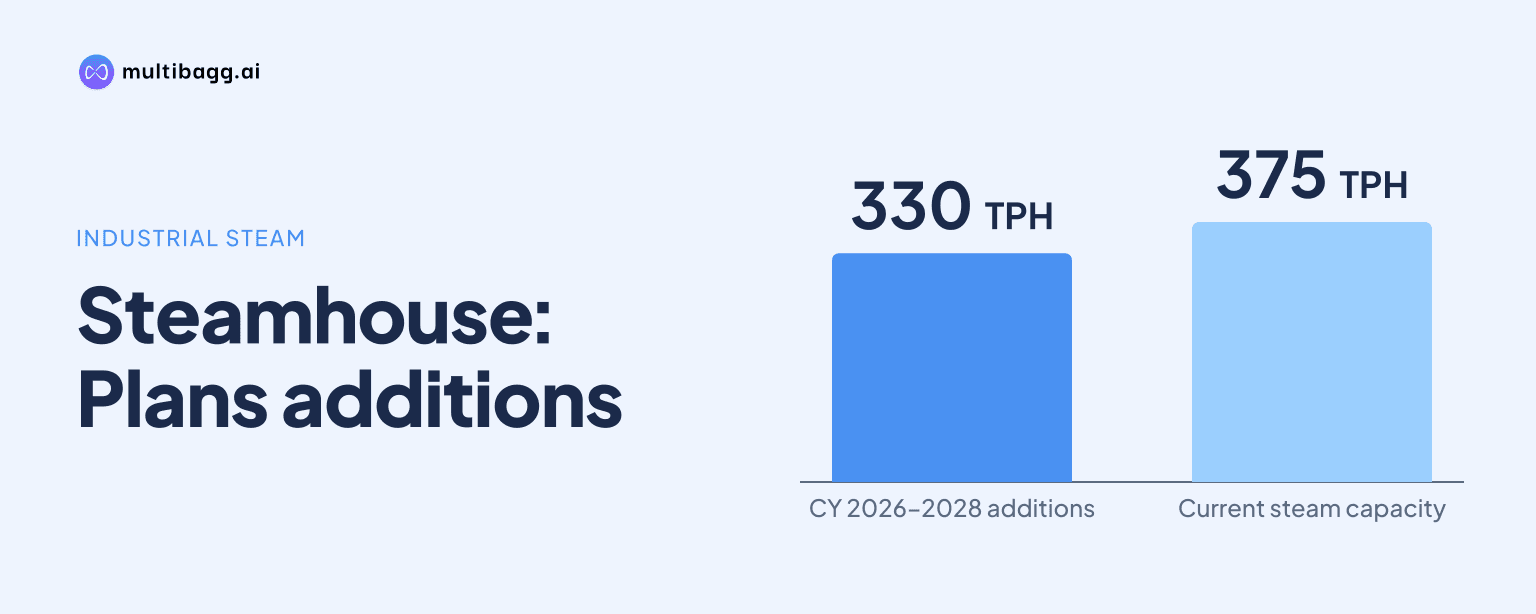
Steamhouse plans 330 tonnes per hour (TPH) of capacity additions from CY 2026 to CY 2028, equivalent to 88% of its existing 375 TPH operating base. The seven projects comprise 90 TPH of green capacity and 240 TPH of coal capacity, with 180 TPH scheduled for CY 2028.
Know Steamhouse India inside out
Results, valuation, peers and who's buying, in one view.
What is Steamhouse's operating network today?
Steamhouse operates 375 TPH across eight operating locations, supported by about 62.06 kilometres of steam pipelines serving 10 industrial clusters. Its central boiler plants supply industrial customers through pipeline connections equipped with pressure-reducing stations, meters and steam-control equipment.
Ankleshwar is the largest listed site at 120 TPH, followed by Vapi at 75 TPH and Sarigam and Panoli at 60 TPH each. Ankleshwar and Vapi use coal and agricultural waste in listed units, while Vapi also has a 15 TPH green, waste-based unit; Sarigam, Panoli, Nandesari and Jhagadiya are listed as coal-based facilities.
Steamhouse uses Internet of Things, or IoT, systems for real-time boiler, temperature, pressure, fuel-use and emissions data across its 375 TPH network. Its operating layer also includes supervisory control and data acquisition, or SCADA, remote monitoring, drone pipeline inspections, and steam traps and automatic valves for condensate and flow control.
Which projects make up Steamhouse's 330 TPH plan?
Steamhouse's disclosed expansion pipeline comprises seven projects totalling 330 TPH, split between three 30 TPH green projects and four coal projects. The four largest additions are each 60 TPH, at Tarapur, Ankleshwar Phase 3, Panoli Phase 2 and Dahej GIDC Phase 2.
Nandesari Phase 2 and Vapi Phase 3 extend existing 30 TPH and 75 TPH locations, while Ankleshwar Phase 3 and Panoli Phase 2 add to existing sites of 120 TPH and 60 TPH, respectively. Pirana, Dahej GIDC and Tarapur are separately named locations in the planned network.
If all seven listed projects are commissioned, the 330 TPH increment would mathematically take operating capacity from 375 TPH to 705 TPH. This calculation is not a revised target disclosed by Steamhouse, but shows the additions are nearly equal to its present operating system.
When is Steamhouse scheduled to add the capacity?
Steamhouse schedules 60 TPH in CY 2026 through the 30 TPH green Nandesari Phase 2 and 30 TPH green Vapi Phase 3 projects. These two projects account for 18% of the 330 TPH addition pipeline.
CY 2027 is scheduled to contribute 90 TPH through Pirana at 30 TPH and Tarapur at 60 TPH. CY 2028 has the largest planned addition at 180 TPH, consisting of three 60 TPH coal projects at Ankleshwar, Panoli and Dahej GIDC.
The fuel mix changes over the timetable: all 60 TPH planned in CY 2026 is green, while coal represents 60 TPH of the 90 TPH in CY 2027 and all 180 TPH in CY 2028. Across the full programme, coal accounts for 240 TPH, or about 73%, and green projects account for 90 TPH.
Got a follow-up? Ask IRIS
What operating results has Steamhouse reported alongside the plan?
Steamhouse reported record steam sales of 607,458.63 tonnes in H1 FY27, up 14.35% year on year, while revenue from operations rose 7.63% to Rs 256.62 crore. Earnings before interest, tax, depreciation and amortisation, or EBITDA, increased 65.72% to Rs 55.62 crore.
EBITDA per tonne rose 44.93% to Rs 915.54 in H1 FY27 from Rs 631.71 in H1 FY26. Steamhouse attributed the increase to optimal utilisation of waste-to-energy boilers and operating leverage from higher steam sales.
EBITDA margin increased to 21.67% in H1 FY27 from 14.08% in H1 FY26, while utilisation rose to 41.9% from 37.0%. Profit after tax reached Rs 26.11 crore, up 99.56% year on year, and the profit margin was 10.18%, up 469 basis points.
Revenue from steam generation and distribution rose 49.04% to Rs 191.76 crore in H1 FY27, while steam distribution revenue increased 31.69% to Rs 54.14 crore. These two lines represented 77.98% and 22.02%, respectively, of Steamhouse's H1 FY27 revenue from steam.
How does Steamhouse develop new steam projects?
Steamhouse describes a six-stage development process that begins with industrial-cluster surveys and steam-demand feasibility, followed by land identification and customer letters of intent. It says common boiler facilities are typically constructed and installed within 12 to 18 months after land and approvals are secured.
Pipelines are laid closer to commissioning after right-of-use approvals, according to Steamhouse's project-life-cycle disclosure. The company says land is selected to serve the maximum number of industries with minimal pipeline infrastructure, a consideration relevant to its existing 62.06-kilometre network.
Steamhouse presents new-build community-steam capital expenditure of Rs 1.5 crore to Rs 2.5 crore per TPH and an illustrative utilisation ramp of about 50% in year one, 70% in year two and 85% in year three. It also gives an illustrative payback period of 3.0 to 3.8 years and breakeven utilisation of about 15% to 20%, rather than forecasts for the seven named additions.
Separately, Steamhouse was awarded a Rs 311 crore engineering, procurement and construction contract, including goods and services tax, for the Una Bulk Drug Park in Himachal Pradesh on 28 September 2026. The award covers 300 TPH of steam capacity, about 30 megawatts of co-generation and 25 years of operations and maintenance on a cost-plus-markup basis; Steamhouse says it does not own the underlying asset.
Conclusion
Steamhouse's 330 TPH pipeline is substantial relative to its 375 TPH operating network, with the expansion weighted toward 180 TPH of coal projects scheduled in CY 2028. The operating backdrop includes H1 FY27 steam sales growth of 14.35% to 607,458.63 tonnes and EBITDA growth of 65.72% to Rs 55.62 crore.
The next disclosed milestones are commissioning of 60 TPH in CY 2026, 90 TPH in CY 2027 and 180 TPH in CY 2028. Steamhouse also identified a Gujarat Bulk Drug Park tender as live in Q1 FY27, while Haryana, Rajasthan, Maharashtra and Andhra Pradesh projects remained at memorandum-of-understanding, feasibility or pre-tender stages.

