








Steamhouse wins ₹311 crore Una EPC with 25-year O&M mandate

Find your next multibaggerBe a Pro Investor
Research stocks and track your picks on the go. Download the app.
Key highlights
- Steamhouse received a ₹311 crore EPC award for Una Bulk Drug Park on 28 September 2026.
- The Una plant is designed for 300 TPH of steam and about 30 MW of co-generation.
- Steamhouse has a 25-year cost-plus-markup O&M mandate, while the client owns the Una asset.
- Steamhouse’s operating network totals 375 TPH, and its planned own-network additions total 330 TPH.
powered by IRIS
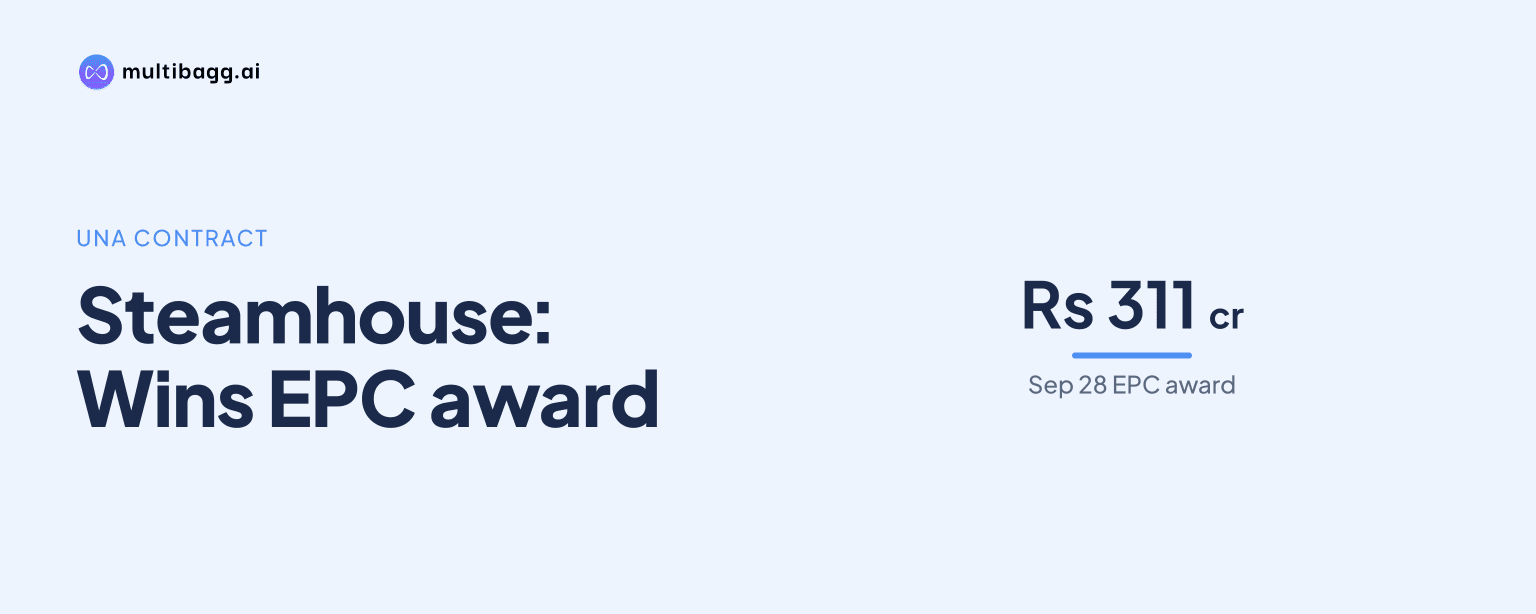
Steamhouse won a ₹311 crore, GST-inclusive engineering, procurement and construction contract for Una Bulk Drug Park on 28 September 2026, covering 300 tonnes per hour of steam capacity, about 30 megawatts of co-generation and a 25-year operations and maintenance mandate. The client will fund and own the underlying asset.
Know Steamhouse India inside out
Results, valuation, peers and who's buying, in one view.
What did Steamhouse win at Una Bulk Drug Park?
Steamhouse won an awarded and signed ₹311 crore engineering, procurement and construction, or EPC, contract for the Central Industrial Infrastructure Plant at Una Bulk Drug Park in Himachal Pradesh. The presentation identifies 28 September 2026 as the award date and states that the contract value includes goods and services tax, or GST.
The plant is designed to supply 300 tonnes per hour, or TPH, of steam and about 30 megawatts, or MW, of co-generation capacity. Alongside EPC work, Steamhouse has a 25-year operations and maintenance, or O&M, arrangement on a cost-plus-markup basis. The presentation identifies HPBDPIL as asset owner and Steamhouse as EPC contractor and long-term operator.
Una is classified as Stage 1 in Steamhouse’s industrial opportunity pipeline because the contract has been awarded and signed. That differs from Gujarat Bulk Drug Park, where the tender was live as of Q1 FY27, and Haryana, where an memorandum of understanding, or MoU, was at the feasibility and approvals stage rather than an awarded contract.
How does the Una contract change Steamhouse’s operating model?
The Una contract gives Steamhouse a client-funded EPC-plus-O&M format: the company earns project margin from construction and a long-term O&M annuity, while the client owns the plant. Steamhouse describes capital intensity for its EPC and O&M engine as nil because the client funds the capital expenditure.
This structure differs from Steamhouse’s own-generation business, which had 375 TPH of operating capacity across eight plants and 10 industrial clusters. For its community-boiler projects, Steamhouse produces steam in its own plants and supplies it through more than 62.06 kilometres of pipelines, using a stated typical funding mix of 75% debt and 25% equity.
The presentation discloses a 24-month EPC period for the Una flagship win, followed by the 25-year O&M relationship. The operating mandate is on a cost-plus-markup basis, whereas Steamhouse’s own-generation model earns from supplying steam through company-owned boiler and pipeline infrastructure.
Steamhouse also has a steam-trading model that purchases steam from an existing industrial unit and distributes it through pipelines. Its Dahej Special Economic Zone and Haldia steam purchase agreements, signed in April 2026, each have five-year terms, with Haldia operations expected in H1 FY28. Una differs because it combines construction and plant operations for a client-owned utility rather than purchase-and-distribute activity.
Got a follow-up? Ask IRIS
How large is Una compared with Steamhouse’s existing capacity?
The 300 TPH Una plant equals 80% of Steamhouse’s 375 TPH operating network, although it is not an addition to Steamhouse-owned generation capacity. The comparison shows the scale of the facility Steamhouse will build and operate, not an expansion of its owned asset base.
Steamhouse’s existing 375 TPH network includes 120 TPH at Ankleshwar, 75 TPH at Vapi, 60 TPH at Sarigam and 60 TPH at Panoli. Una’s 300 TPH capacity exceeds that of any individual operating location disclosed in the presentation.
Steamhouse also lists 330 TPH of incremental own-network additions scheduled between calendar year 2026 and calendar year 2028. These comprise 30 TPH green projects at Nandesari Phase 2, Vapi Phase 3 and Pirana, plus four 60 TPH coal-fuelled projects at Ankleshwar Phase 3, Panoli Phase 2, Dahej GIDC Phase 2 and Tarapur.
The distinction matters because the presentation explicitly says Steamhouse does not own the Una underlying asset. The 300 TPH facility represents EPC execution and a 25-year operating responsibility, while Steamhouse’s stated owned operating capacity remains 375 TPH across eight locations.
What other industrial-infrastructure opportunities has Steamhouse disclosed?
Steamhouse identifies several follow-on opportunities, but only Una is described as awarded. Gujarat Bulk Drug Park had a live tender as of Q1 FY27, while Andhra Pradesh Bulk Drug Park was identified under the scheme but had yet to be tendered. Rajasthan and Maharashtra were at feasibility stage, with possible Maharashtra Industrial Development Corporation alignment mentioned for Maharashtra.
For Haryana, Steamhouse disclosed an MoU covering Panipat and Sonipat, with approximately ₹500 crore proposed for 250 to 300 TPH plus O&M. The presentation describes this proposal as non-binding and at feasibility and approvals stage, while a separate slide says the October 2026 Haryana MoU concerns community boilers using biomass and paddy stubble.
Government schemes provide a larger pool of potential shared-infrastructure projects but are not Steamhouse awards. The presentation lists seven approved PM-MITRA textile parks across Tamil Nadu, Telangana, Karnataka, Maharashtra, Gujarat, Madhya Pradesh and Uttar Pradesh, with about ₹1,000 crore of central government support per park for shared facilities. It explicitly states that Steamhouse has not been awarded contracts under that programme.
Steamhouse places its industrial-park pipeline in the context of shared utility infrastructure replacing separate factory boilers in new estates. The presentation cites Central Pollution Control Board community-boiler guidelines, Gujarat shared-utility incentives from 2015 and 2020, Viksit Gujarat Industrial Policy 2026, and Ministry of Environment, Forest and Climate Change particulate-emission standards from 2023. These policies are context rather than evidence of additional contracted revenue.
Conclusion
The Una award gives Steamhouse a ₹311 crore EPC project and a 25-year O&M relationship for a 300 TPH, roughly 30 MW central utility plant. It broadens the company’s disclosed business mix beyond its 375 TPH owned steam network by applying its project and operating capability to an asset funded and owned by the client.
The next disclosed milestones are the 24-month Una EPC period, the live Gujarat Bulk Drug Park tender and progress on the Haryana MoU through feasibility and approvals. Steamhouse also plans 330 TPH of own-network additions from CY 2026 to CY 2028, while Andhra Pradesh Bulk Drug Park remains yet to be tendered.

