










Which Sectors Win and Lose After a US Midterm
Key highlights
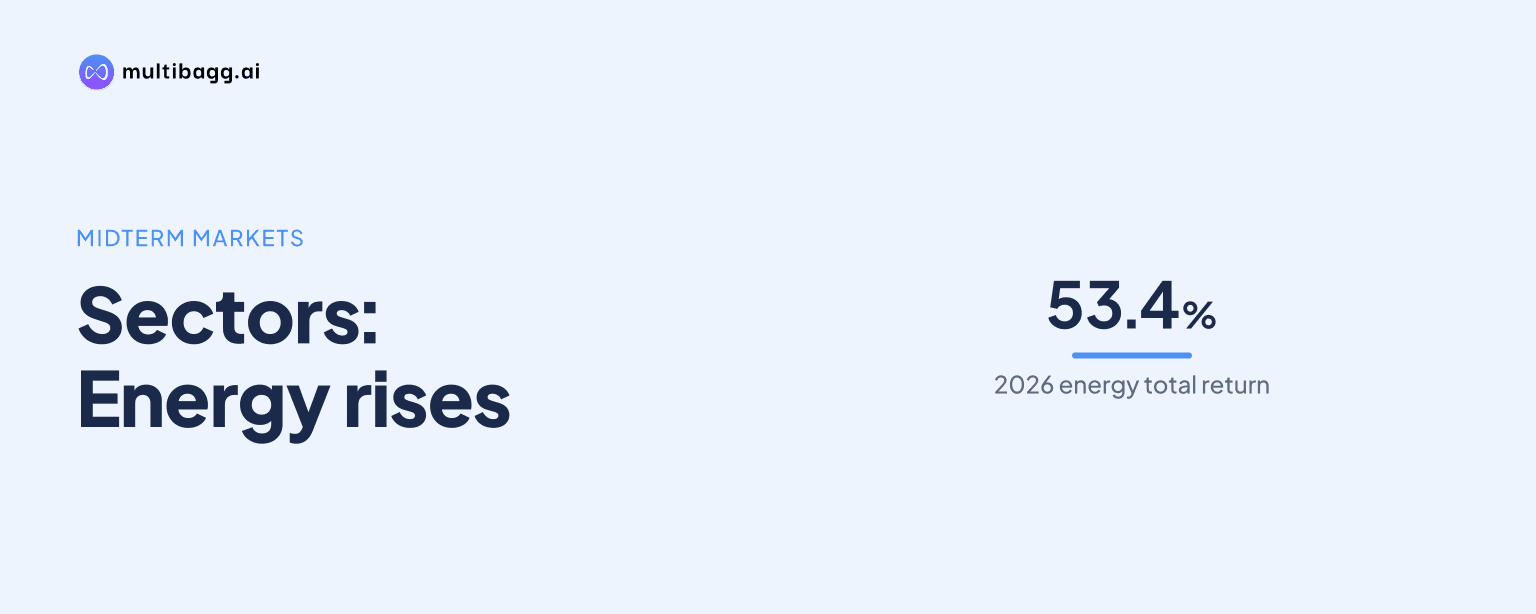
- Energy is up 53.4% in 2026 as of 2 November, the best S&P 500 sector (SPDR ETF total return, on ChartRow's estimates).
- Since 1990, the gap between the best and worst S&P 500 sector averaged 11.3% in midterm years, against 8.5% in all years (BlackRock).
- The White House requested $1.5 trillion for national defence in fiscal 2027.
powered by IRIS
No sector reliably wins or loses after a US midterm: BlackRock says sector leadership has rarely followed a party script, though the gap between the best and worst sector averaged 11.3% in midterm years since 1990, against 8.5% in all years. Healthcare, defence, clean energy, banks, AI, crypto and consumer stocks are most exposed to this vote.
Which sectors are most exposed to a US midterm?
Healthcare, defence, energy, banks, AI, crypto and consumer stocks each depend on a different policy lever, according to CNBC and BNY research from October and November 2026. The table maps each lever to the outcome it is most sensitive to. All of it is analyst expectation, not result.
For context, these are moves before the vote, not midterm results. Energy's sector ETF (exchange-traded fund, a basket of the sector's stocks) is up 53.4% in 2026 and communication services is down 14.1%, as of 2 November (ChartRow estimates). BlackRock says sector performance has been far less tied to politics than many assume.
What could change for healthcare and defence?
Analysts quoted by CNBC and BNY see more room for change in healthcare than in defence. Medicaid, the US public health insurance programme, is the main lever: a KFF analysis of Congressional Budget Office estimates, reported by CNBC, projects that the 2025 tax and spending law cuts federal Medicaid spending by $911 billion through 2034. LPL Financial's Jeff Buchbinder said Democrats would likely push back, which he argued could steady insurer enrolment and hospital volumes. CNBC notes a Democratic chamber could not repeal the law alone, and BNY sees drug pricing as the area with most room for compromise. The healthcare ETF is up 20.7% in 2026 as of 2 November on ChartRow's estimates (total return). Reuters puts the S&P 500 healthcare sector up more than 19% this year, at record highs.
The White House asked for $1.5 trillion in national defence funding for fiscal 2027, plus an $87.6 billion fiscal 2026 supplemental driven mainly by Iran-related operations, CNBC reports. BNY says a Democratic Congress is unlikely to cut defence spending, though supplemental funds tied to the Iran conflict would face much greater scrutiny. Morgan Stanley's Monica Guerra advised stock-picking and named shipbuilding, autonomous systems and missile defence as likely winners. Defence stocks have given back most of their January gains, and Congress has yet to fund some large weapons-replenishment contracts, Reuters reported on 2 November.
Got a follow-up? Ask IRIS
What could change for energy, banks and crypto?
Energy's exposure runs through tax credits and fuel policy. The sector is the year's strongest, up 53.4% in 2026 as of 2 November, on ChartRow's estimates. BNY says a Republican sweep would reinforce fossil fuel development and AI-linked power expansion, while a Democratic Congress could restore some support to solar and wind. Wind and solar credits now apply only to projects that began construction by 4 July 2026 or that enter service by 2028, and over 170 GW (gigawatts) of capacity was locked in before the cutoff, according to pv magazine citing Crux.
Analysts quoted by CNBC place bank exposure at the regulatory level more than in Congress. Federal regulators estimate their proposed capital overhaul, announced in a Federal Reserve statement on 19 March 2026, would cut requirements for the largest banks by about 4.8%. BNY says fiscal standoffs could add volatility to yields on long-term US government bonds. The financials ETF is up 6.4% in 2026 as of 2 November (ChartRow estimates).
Crypto-linked stocks wait on market-structure rules. The Senate failed to advance the Trump-backed Clarity Act in September, and Coinbase and Circle shares fell as much as 11% on the news, CNBC reports. Democratic gains could bring stricter consumer safeguards and limits on yield-bearing stablecoins (crypto tokens pegged to the dollar), according to the same report.
What could change for tech, AI and consumer stocks?
Morgan Stanley's Ariana Salvatore said the election could have meaningful consequences for AI and data centres, but on a highly localised basis. A CNBC All-America Economic Survey in October found 63% of registered voters oppose a data centre within 10 miles of their home, against 13% who support one. BNY says Democrats plan a House Select Committee on AI oversight, with state utility commissions and legislatures the other area to watch. The technology ETF is up 21.4% in 2026 as of 2 November, on ChartRow's estimates. Tech fell sharply late in October: on 30 October the Nasdaq Composite fell 2.86% to its lowest close since 31 July, the Nasdaq-100 closed 9.1% below its 6 October record, and the Philadelphia semiconductor index fell 7.2%.
Consumer stocks depend mostly on tariffs. BNY expects tariffs to persist. It says Democrats appear inclined to protect key manufacturing sectors while reducing tariffs on certain consumer goods, though bills to limit tariffs would face frequent vetoes. Consumer staples are up 19.2% in 2026 as of 2 November, while consumer discretionary is down 0.4% (ChartRow estimates).
How do Indian IT and pharma connect to the US vote?
Both are tied so far to White House actions rather than to Congress, according to the sources reviewed. Indian IT faces a $100,000 US fee on H-1B workers (skilled foreign workers on US visas), extended by one year in a September 2026 proclamation and pending before two federal courts, Kotak Neo reported on 21 September. Indian pharma's generics are currently exempt from a 100% US tariff on patented drugs, with a review planned within one year, according to India Briefing.
Conclusion
Taken together, the sources tie healthcare and clean energy to specific spending and tax decisions, while banks, AI and consumer stocks depend more on regulators, states and tariffs. BlackRock's data shows the S&P 500 averaged 10.4% in the six months after midterms when one party lost control of the trifecta (presidency plus both chambers), against 16.1% when control was gained or Congress stayed divided.
Watch the vote count after polls close on 3 November, then the Federal Reserve's meeting on 8 and 9 December 2026. A continuing resolution (a stopgap funding law) funds the US government at fiscal 2026 levels through 11 December 2026, per BNY, so budget talks are the next test for healthcare and defence spending. Medicaid work requirements take effect on 1 January 2027, or earlier in some states.