










How US Tariffs Hit Indian Jewellery, Textiles and Auto Parts
Key highlights
- Since 24 July 2026 most Indian goods pay an extra 10% US Section 301 duty.
- Jewellery pays about 15.5% to 16% in total once the normal 5.5% to 6% US duty is added, GJEPC says.
- India's gem and jewellery exports to the US fell 44.92% to $5.09 billion in FY2025-26.
- The US took 26% to 27% of India's $24 billion auto component exports in FY2025-26, per ACMA data reported by Autocar Pro and Business Today.
powered by IRIS
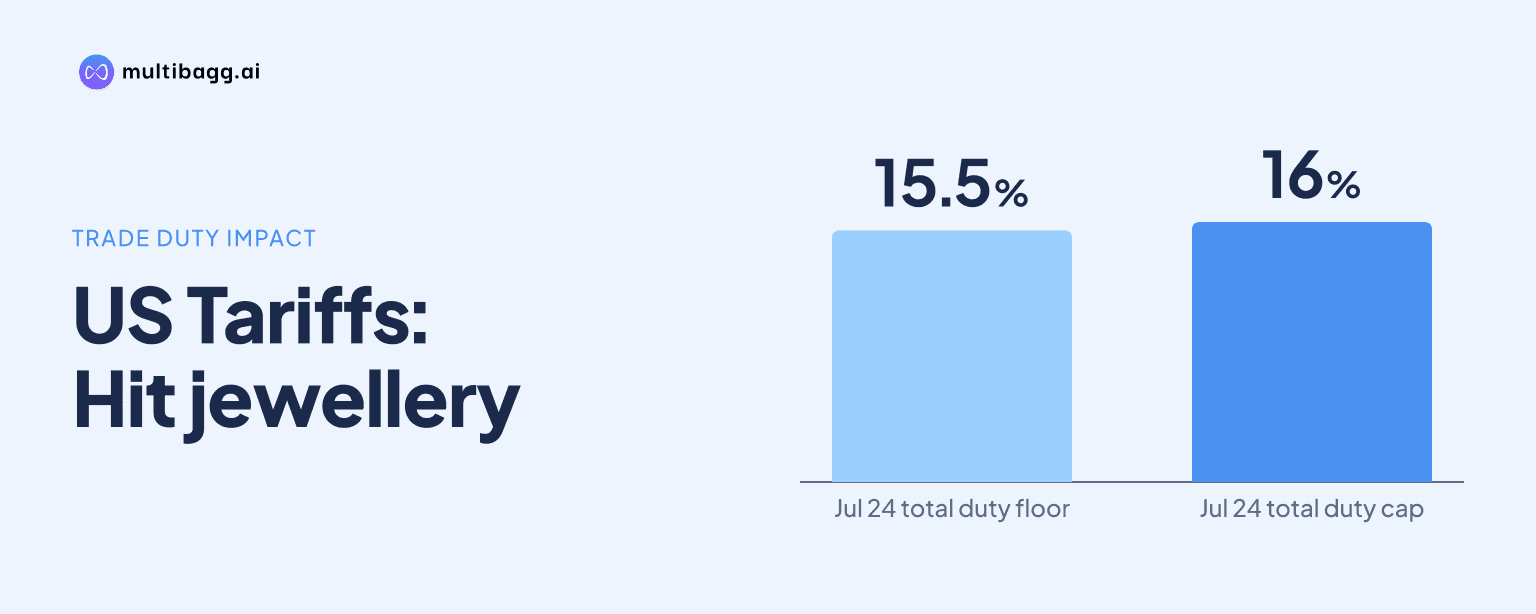
Since 24 July 2026, most Indian goods entering the US, including textiles and apparel, pay an extra 10% Section 301 duty, says the law firm ATB Legal. Jewellery pays about 15.5% to 16% in total, says the industry body GJEPC (Gem and Jewellery Export Promotion Council). Auto parts under Section 232 pay 25% instead.
What tariffs do Indian goods face in the US in 2026?
Most Indian goods pay the normal US import duty plus an extra 10% under Section 301, according to ATB Legal's article of 22 October 2026, which states the position as at 12 October. Section 301 is a US trade law that lets the US Trade Representative (USTR) act against another country's trade practices. USTR's fact sheet says the action covers 60 economies, which account for 99.4% of US imports. India sits in the lower 10% band because it adopted a ban on imports made with forced labour, GJEPC says. In jewellery, rivals including China, Thailand, the UAE and Vietnam face 12.5%, Indian Jeweller reported on 27 July 2026.
Goods under Section 232 are left out of the Section 301 duty, USTR's fact sheet says. Section 232 is a law that allows duties on specific products. ATB Legal lists steel, aluminium, autos and parts among them, and those goods pay the Section 232 rate instead. India's Commerce Ministry says nearly 45% of India's exports to the US fall outside the new duty, as reported by Open magazine. It names generic medicines and smartphones among the exempt products.
How did the extra duty on India change since 2025?
The extra duty on India has come from four measures since August 2025, according to ATB Legal: two under IEEPA (the International Emergency Economic Powers Act), then a temporary duty under Section 122, then Section 301.
The Supreme Court ruled 6-3 on 20 February 2026 that IEEPA does not allow tariffs. The Russian-oil duty had already been removed from 7 February.
Section 122 is a law allowing a temporary duty for up to 150 days. It was used for a 10% global duty, and it expired on 24 July with no extension. Section 301 began that day. No India-US trade deal had been signed as at 12 October, and USTR said on 1 October that one was not imminent. Separately, a Russia-sanctions law passed by Congress, Public Law 119-111, allows duties of up to 100% from 18 October 2026 on the five largest buyers of Russian crude or gas unless the President waives it, and ATB Legal says it had not been applied to India as at 12 October.
Got a follow-up? Ask IRIS
How exposed are jewellery, textiles and auto parts to the US?
The US share of exports differs by sector, and the periods are not identical.
For gems and jewellery, GJEPC data reported by Outlook Business on 15 April 2026 show total exports of $27.72 billion in FY2025-26 (April 2025 to March 2026), down 3.32%. Exports to the US fell 44.92% to $5.09 billion from $9.24 billion, and the UAE became the top market at $8.70 billion. That year included months when the total duty was 50%, so it does not show the effect of today's 10%. GJEPC says jewellery also pays the normal US duty of 5.5% to 6%, taking the total to about 15.5% to 16%.
ICRA, a rating agency, said in a report covered by Apparel Resources on 1 April 2026 that the US takes about 32% to 33% of India's apparel exports. US-bound shipments fell about 6% in dollar terms in April to December FY2025-26, while total apparel exports rose 1.5%. For textiles, Open magazine reported that a separate US mechanism for the sector has not yet been put in place. The law firm Clark Hill says USTR plans tariff-rate quotas (a lower duty on a set volume) for some textile and apparel goods from Bangladesh, Cambodia, Indonesia and Malaysia, which pay 10% like India. India is not named.
ACMA, the auto parts makers' association, reported FY2025-26 exports of $24 billion, up 5%, with the US taking 26% (Autocar Pro) to 27% (Business Today), both on 7 July 2026. Its director general, Vinnie Mehta, said nearly half of the exports to the US are covered by Section 232 at 25%, according to Business Today. A separate US overcapacity probe was still open on 7 July, he said, and Business Today reported that any added duty could stack on parts outside Section 232.
What have exporters in clusters like Tiruppur reported?
A Deccan Chronicle column by Patralekha Chatterjee on 25 September 2026 says about 35% of Tiruppur's exports went to the US last year. It says the crisis ran from August to December 2025, with cancelled orders and layoffs of contract workers, followed by a temporary recovery in early 2026. Exporter D. Elango said business has been slower over the past six months. The column is one writer's reporting and does not measure the effect of the 10% duty.
Conclusion
Together the findings show a layered system. Most Indian goods pay 10%, Section 232 goods pay their own rates, and jewellery pays about 15.5% to 16% once the normal duty is added. The 10% is below the 50% total that applied between 27 August 2025 and 6 February 2026, but the export figures above mostly cover earlier periods, so they do not yet show how sectors have adjusted.
Next, watch the counting of the 3 November midterm votes, any USTR notice on the open overcapacity probe, and whether the Russia-sanctions law is applied to India. Any signed India-US trade text could also change the rates.